The Chinese Crocodile Lizard is a fascinating creature that's often misunderstood.
It's a type of lizard that belongs to the family Shinisauridae.
Native to China, these lizards have a unique appearance with a broad, flat head and a long, narrow tail.
They can grow up to 20 inches in length, with some individuals reaching lengths of 24 inches.
Their name comes from their resemblance to small crocodiles, but don't let that fool you - they're actually quite harmless.
Physical Description
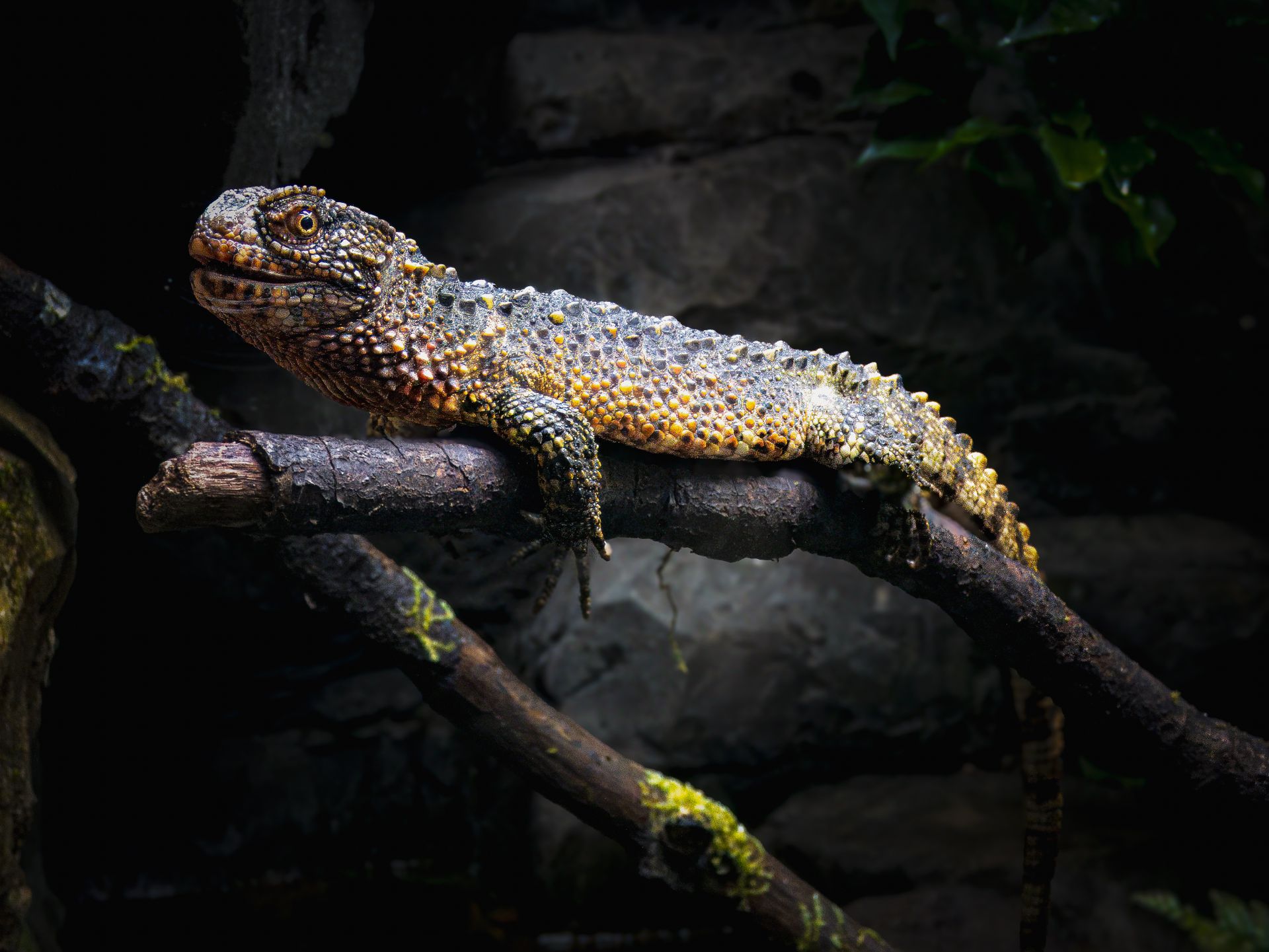
The Chinese crocodile lizard is a pretty cool-looking creature. Its gray-brown body has a yellow-tan underside, and it's adorned with red-orange markings along its throat and sides.
These markings gradually transition to alternating light and dark bands that extend to the tip of its tail. Hatchlings are a deep brown color with a lighter, tan head.
Males are typically larger and more colorful than females, with their color vibrancy intensifying during the breeding season. They're also the more common sex, especially during breeding time.
Worth a look: Brown Chinese Shar Pei
Two rigid rows of scales extend down the lizard's tail, giving it a crocodilian look. This is one of the lizard's most distinctive features.
Chinese crocodile lizards are more likely to choose flight over fight if possible. If they can escape, they'll jump into the water and use their powerful tail to propel themselves away from a threat.
If caught, however, they'll go into a fit of violent struggle, defecating, hissing, and biting to free themselves from a predator's grip.
Readers also liked: Red Tail Boa Constrictor Snake
Behavior and Habitat
The Chinese crocodile lizard is a semi-aquatic creature that spends most of its time alone in slow-moving streams and freshwater pools.
They can be found in densely vegetated subtropical forests between 200-1,500 meters above sea level. This species is associated with slow-moving streams and pools, where individuals will rest on branches overhanging the water below.
In the winter months, these lizards will hibernate together in tree holes or rock crevices, triggered by the water temperature dropping below 15.5°C.
Related reading: Blotched Water Snake
Habitat and Ecology
Chinese crocodile lizards live in subtropical forests near freshwater ponds and slow-moving streams in southern China and Vietnam.
These lizards prefer to inhabit areas with dense vegetation, which offers sufficient shelter and protection while resting. They often rest on branches overhanging the water below.
Their habitats range from 200 to 1,500 meters above sea level in China and 400 to 800 meters above sea level in Vietnam. This elevation range is quite broad, indicating their adaptability to different environments.
These semiaquatic creatures spend their time alone in slow-moving streams and freshwater pools. They are rarely found exposed on the forest floor.
In the winter months, when water temperatures dip below 15.5 degrees Celsius, Chinese crocodile lizards seek out the shelter of rock crevices and tree holes to hibernate together. They will hibernate for several months, triggered by the drop in water temperature.
On a similar theme: How Big Are Leatherback Sea Turtles
Territorial Behavior
Shinisaurus crocodilurus are territorial creatures that occupy a specific space in their environment. They are known to claim an entire pond or stream as their own territory.
In a given territory, one sole lizard will dominate the space, and other lizards will retreat from its presence. This is established through a series of behaviors, including gaping, which involves widening their mouths to assert dominance.
The frequency of gaping is thought to establish a dominant-subordinate social structure among conspecifics. This is similar to other lizards, such as Dipsosaurus dorsalis and Tropidurus spp.
To establish dominance, the Chinese crocodile lizards will also swing their tails and lunge at their competitors. The dominant lizard will whip its tail at the subordinate lizard, but the impact is usually minimal.
The subordinate lizard will retreat from the dominant's territory after being lunged at. This behavior helps to maintain the social hierarchy within the group.
In addition to gaping and tail-swishing, Shinisaurus crocodilurus also exhibit push-up behavior to establish dominance. They will straighten their forelimbs and level their head, but only perform this motion with their anterior portion.
While performing push-ups, the lizards may also bob their head in a circular motion. This unique behavior is distinct from other lizards, which may use different methods to assert dominance.
Taxonomy
The Chinese crocodile lizard's taxonomy is a fascinating story. The species was named Shinisaurus, which literally means "Shin's lizard" in honor of Chinese biologist Sin Shu-szi.
Sin Shu-szi was a member of a joint Chinese-German expedition that discovered this species, along with the frog Quasipaa shini. The specific name of the species, "crocodile-tail", refers to its physical characteristics.
The Chinese crocodile lizard was once classified as a member of Xenosauridae, but recent studies have shown that it's more closely related to monitor lizards and helodermatids. This reclassification has placed the species as the only living member of the clade Shinisauria within the Anguimorpha.
Here's an interesting read: Common Snapping Turtle Species
Conservation Status
The Chinese crocodile lizard is an endangered species, listed as such on the International Union for Conservation of Nature's Red List.
Habitat loss, fragmentation, and degradation due to logging, mining, damming, and land encroachment driven by tourism are major threats to the species.
Protected areas exist in China and Vietnam, but extreme habitat degradation is still present outside of these regions.
Only two subpopulations of Chinese crocodile lizards remain, both of which are already under pressure from over-extraction for the pet and animal products trades.
The species is popular among collectors due to its vivid coloration and likeness to crocodiles.
The Association for Zoos & Aquariums formed the Lizard Advisory Group in 1996 to help manage North American collections of rare and endangered lizards, including the Chinese crocodile lizard.
The species has successfully been bred in captivity in North American institutions.
The Chinese crocodile lizard is not an official protected species in Vietnam, although national legislation has been proposed to list these animals as a protected species.
A joint German-Vietnamese team has established breeding programs in both Hanoi, Vietnam, and Cologne, Germany.
Researchers are constantly working to improve protections for the species, including surveys to better understand how many are left and raise awareness among tourists, locals, and local governments.
The species is vulnerable to being mislabeled as captive-bred when it's actually wild-caught, due to the use of protein-loaded feeding insects in captivity.
Threats to Survival
The Chinese crocodile lizard is facing a multitude of threats to its survival.
Deforestation is the primary reason for the decline in Chinese crocodile lizard population, leading to loss of habitat.
Human activities like logging and coal mining in Vietnam are putting the area where a subspecies was discovered in 2003 in danger.
Thomas Ziegler estimates that there are only 200 of this subspecies left.
Electro-fishing and fish poisoning are affecting younger crocodile lizards, often killing them directly.
The exotic pet trade is another significant threat, with crocodile lizards being taken from the wild and sold as pets.
General Information
The Chinese crocodile lizard is not a crocodile but a lizard, getting its name from its powerful tail that's scaly like a crocodile's.
This lizard has a gray-brown body with a yellow-tan underside and red or orange scales running along its sides.
Males are usually larger and more colorful than females, with colors growing more vivid during breeding season.
It's a popular household pet, known as the shinisaurus, and hails from a small mountain range in southern China and northern Vietnam.
Frequently Asked Questions
Are Chinese crocodile lizards venomous?
No, Chinese crocodile lizards are not venomous. Research has found no evidence of venom-derived peptides or proteins in their gland extracts.
Featured Images: pexels.com