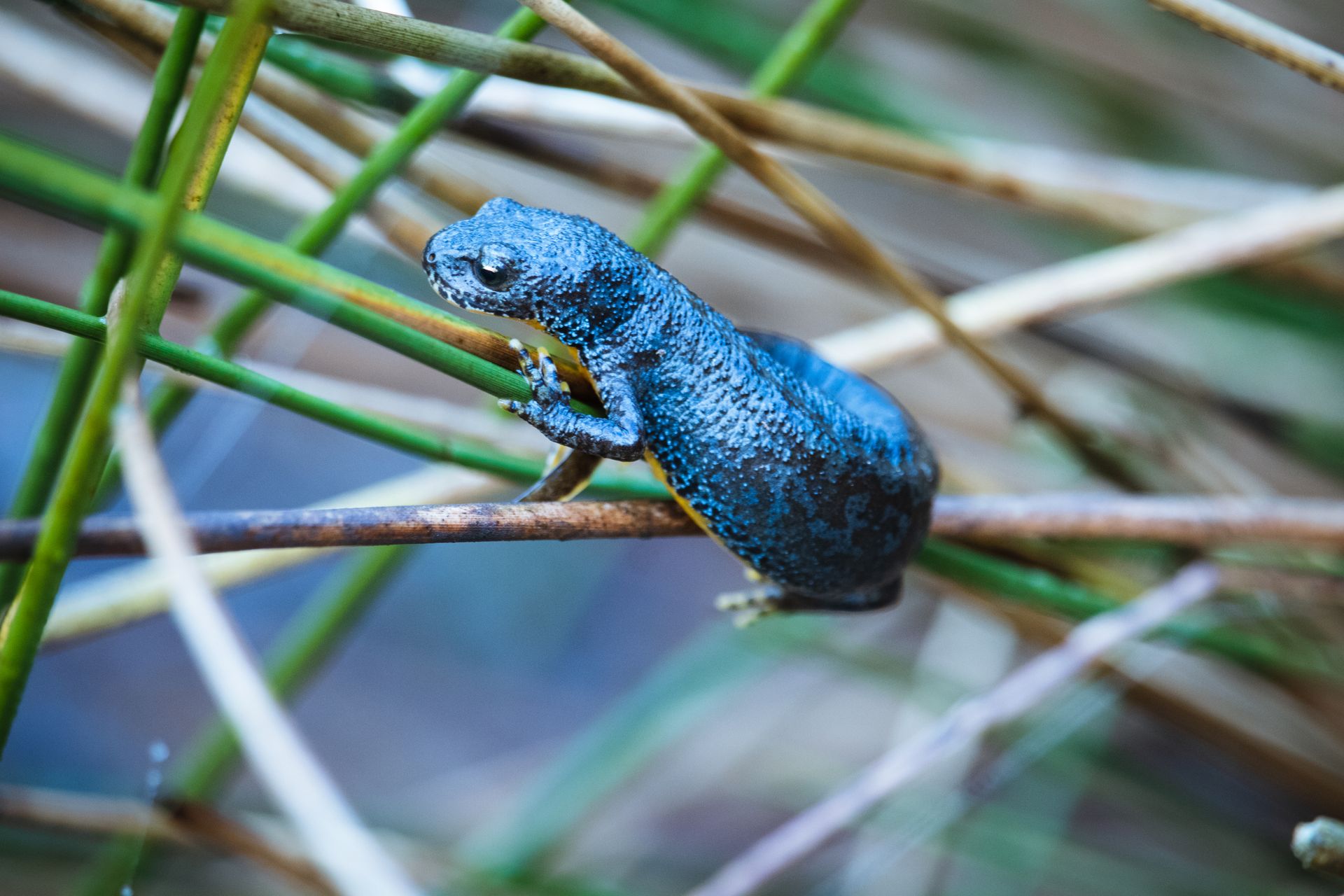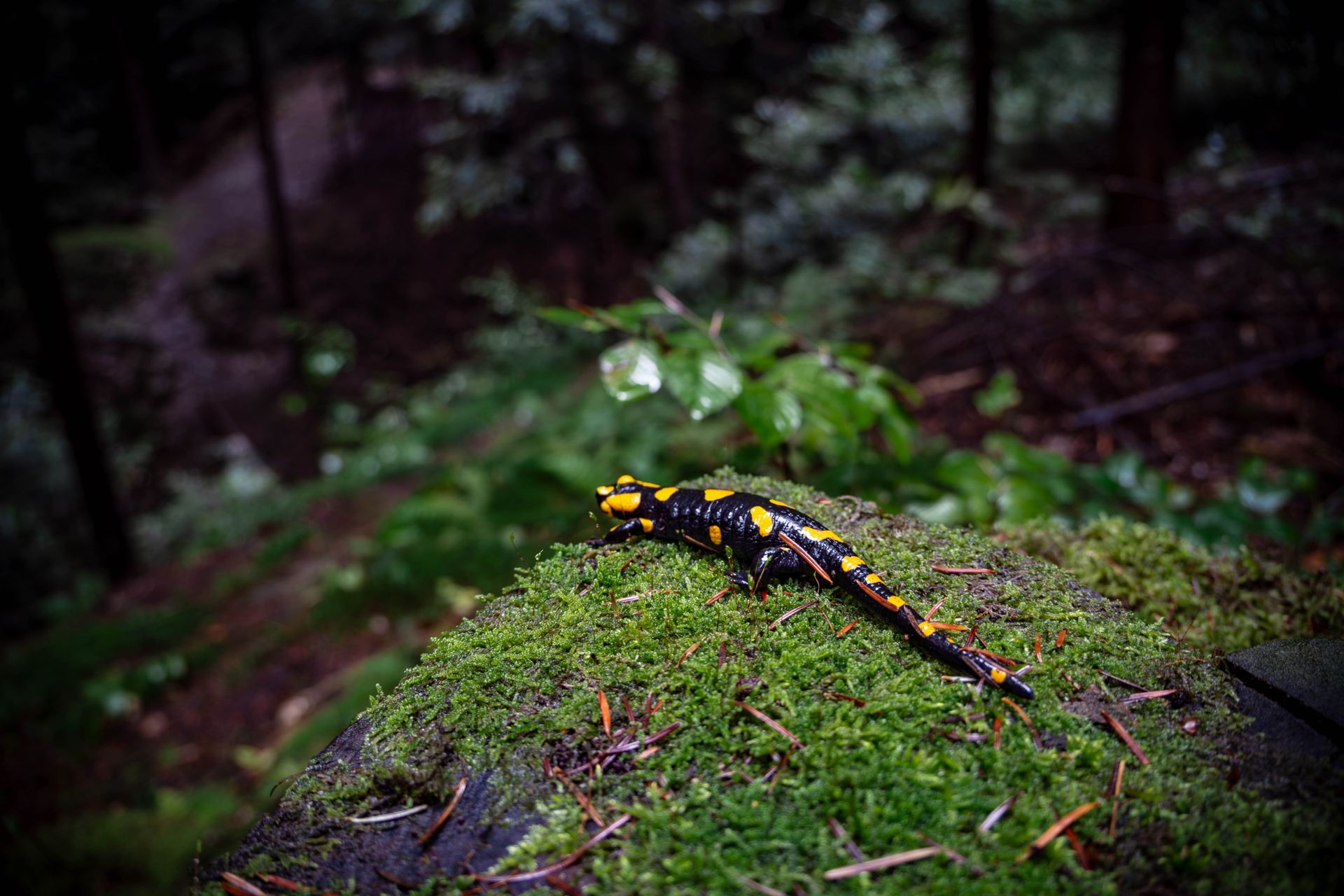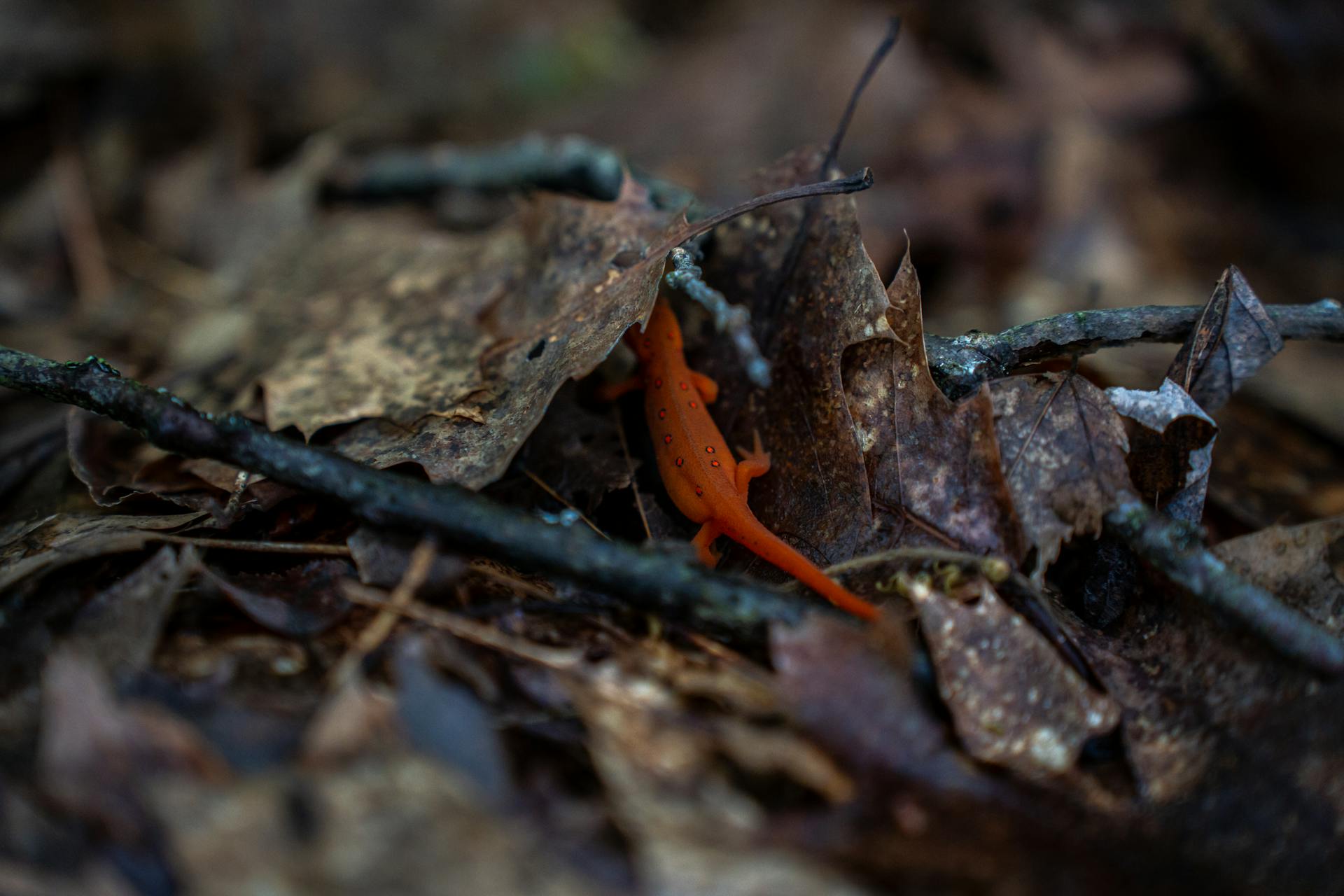
Cave salamanders are fascinating creatures that have adapted to life in the dark depths of caves. They have poor eyesight, but their sensitive skin and highly developed sense of touch help them navigate their surroundings.
One of the most interesting things about cave salamanders is their unique behavior. They are primarily nocturnal, meaning they do most of their foraging at night. This is likely due to the abundance of insects and other small invertebrates that are active during this time.
Cave salamanders play a crucial role in their ecosystem, serving as both predators and prey. They feed on a variety of small invertebrates, helping to regulate their populations.
Consider reading: Spotted Salamanders Habitat
Physical Characteristics
Cave salamanders can grow up to 181 mm in length, with a maximum recorded length of 181 mm.
Their dorsal pigmentation ranges from bright reddish-orange to a bland yellow, while their ventral coloring is a light yellow without spots. Younger adults tend to be duller in color.
Cave salamanders have broad, flattened heads and large eyes that are roughly the same size as their snout length.
On average, females have snouts that measure 62 mm, while males have snouts that measure 60 mm. Both sexes have prehensile tails that make up 52 to 68% of their total length.
Males have larger margins on their vents, contoured with papillae, and longer tails compared to females. Male mental glands are also more rounded.
Here are some key physical characteristics of cave salamanders:
- Length: 125 to 181 mm (4.92 to 7.13 in)
- Color: Bright reddish-orange to bland yellow
- Tail length: Up to 60-65% of total length
- Legs: Four slender legs, two long forelimbs, and two short hind limbs
Their front legs have four toes, and their back legs have five webbed toes. Cave salamanders are ectothermic and exhibit bilateral symmetry.
Habitat and Distribution
Cave salamanders are typically found in areas with exposed limestone or other calcareous rock, particularly in crevices of rock faces, bluffs and caves.
They can be found hundreds of metres from the mouths of caves, far beyond the twilight zone of the cave. This species is also frequently found in forests near bluffs and rocky crevices and around springs, and also under moist rocks and logs.
A different take: Horse Cave Kentucky
Cave salamanders are troglophiles, meaning they can live entirely in caves and depend on cave-like conditions to complete their life cycles.
They have been reported in rock crevices along riversides, and in southern Illinois adults also inhabit rocky borders of cypress swamp areas.
Here are some of the states where cave salamanders can be found:
- Alabama
- Arkansas
- Illinois
- Missouri
- Kentucky
- Virginia
- West Virginia
- Oklahoma
- Tennessee
- Kansas
- Indiana
- Ohio
Cave salamanders make their homes in limestone caves, typically in what is known as the "twilight zone", an area by the mouth of the cave where some light penetrates but not enough for plant life to survive.
Their range stretches from northeastern Oklahoma to western Virginia, with more concentrated populations in the Appalachian Mountain range, reaching from Alabama to northern Virginia.
They can be found as far north as central Indiana and south to central Alabama, and in the westernmost part of their range covers mid to southern Missouri, northeastern Oklahoma and northern Arkansas.
Take a look at this: Cave Paintings of Dogs
Behavior and Ecology
Cave salamanders are nocturnal creatures, which means they're most active at night. They tend to be more active at the surface of the water during summer months.
Cave salamanders have a unique ability to use the earth's magnetic field for navigation. They use this sense as a compass to migrate to different locales within caves.
These salamanders are also known to migrate in the summer to their summer habitat and home range. They don't defend territories, which is likely due to their adaptable nature.
Some key behaviors of cave salamanders include being terricolous, troglophilic, nocturnal, motile, migratory, and social. Here's a breakdown of what each of these terms means:
- terricolous: living on land
- troglophilic: living in caves
- nocturnal: active at night
- motile: able to move
- migratory: moving from one place to another
- social: interacting with other salamanders
Behavior
Cave salamanders are fascinating creatures that thrive in the twilight zones of caves. They inhabit these areas alongside long-tailed salamanders, which can lead to interspecific competition due to their similar diets.
One unique ability of cave salamanders is their use of the earth's magnetic field for navigation. They use this sense as a compass to migrate to different locales within caves.
Cave salamanders rely on cave-like conditions to complete stages of their life cycles, such as metamorphosis. They migrate in the summer to their summer habitat and home range.
Discover more: Spotted Salamanders
These salamanders tend to be more active at the surface of the water during summer months. Their active ranges change according to the season, but no specific areas have been reported for their home range.
Here are some key behaviors of cave salamanders:
- Terricolous: They live on land.
- Troglophilic: They live in caves.
- Nocturnal: They are active at night.
- Motile: They are able to move.
- Migratory: They migrate to different areas.
- Social: They live in groups.
Cave salamanders do not defend territories, and they mainly live in freshwater environments that are not salty.
Larval Ecology
Larval cave salamanders are quite fascinating creatures. They appear similar to other larval Eurycea.
Larvae have been found in both surface streams and cave streams and pools. It's thought that some larvae found in surface streams may have been washed out of caves and crevices by heavy rains.
Cave salamander larvae are predators, feeding primarily on benthic invertebrates. This includes snails, ostracods, copepods, isopods, mayflies, stoneflies, beetles, and flies.
Ostracods, snails, and fly larvae are the most common dietary items for these larvae. They capture prey by slowly crawling over the substrate and grasping it with their mouth.
Prey is limited by the gape of the salamanders' mouth. This means they can only eat prey that's small enough to swallow whole.
From hatching to metamorphosis to a terrestrial adult, this process takes between 6 and 18 months.
You might enjoy: Horse Cave Ky
Ecosystem Roles
Cave salamanders commonly carry gastrointestinal parasites, with 77% of tested salamanders found to have one or more nematodes. This highlights the importance of understanding the parasite dynamics in these ecosystems.
Some of the parasites found in cave salamanders include trematodes like Brachycoelium salamandrae and nematodes like Capillaria inequalis, Oswaldocruzia pipiens, Thelandros magnavulvaris, and Trichoskrjabinia.
Cave salamanders may have interspecific competition with other species of salamander, particularly in the twilight zones of caves where they often coexist.
Here are some of the parasites found in cave salamanders:
- Nematode Trichoskrjabinia sp.
- Trematodes Brachycoelium salamandrae
- Nematode Capillaria inequalis
- Nematode Oswaldocruzia pipiens
- Nematode Thelandros magnavulvaris
Fortunately, there are no known negative economic impacts of cave salamanders for humans, making them an interesting and relatively harmless part of our ecosystems.
Cave Dancer Spiny Salamander
The Cave Dancer Spiny Salamander is a unique species that thrives in the dark environments of caves.
These salamanders have a specialized eye structure that allows them to detect even the smallest amounts of light.
They are nocturnal, spending most of their time underground and only emerging at night to forage for food.
Their diet consists mainly of small invertebrates, such as insects and crustaceans.
Reproduction and Development
Cave salamanders breed from October to January, with females typically laying 49 to 87 eggs at a time. These eggs are mostly laid in springs underground, streams found in caves, or limestone pools away from cave openings.
Females can produce between 5 and 120 eggs, but the average number is around 60, which they can lay twice a year. The number of days until hatching depends on temperature, with colder temperatures taking longer.
Recently laid eggs are white, with two jelly membranes surrounding the embryo, and egg diameter ranges from 2.5 to 3.2 mm. Females use their cheeks to maintain contact with the backs of males during courtship.
Male cave salamanders court females first by pushing and rubbing the snout of the female, and then press their cheeks against females and move forward. Pheromones play a crucial role in courtship, stimulating the vomeronasal organs of cave salamanders.
After mating, females deposit eggs from September to February, often in difficult-to-access places like springs, streams, and rim stone pools deep within caves and crevices. Females can produce between 5 and 120 eggs.
Here's a summary of key reproductive features of cave salamanders:
- Seasonal breeding
- Gonochoric (sexes separate)
- Sexual
- Oviparous
A breakdown of the breeding season and offspring is as follows:
- Breeding season: October to January
- Range number of offspring: 49 to 87
- Range time to hatching: 10 to 20 days
Conservation Status
The cave salamander is listed as a species of least concern on the IUCN Red List, but it's a different story at the state level. In Kansas, Mississippi, and Ohio, it's actually listed as state-endangered.
Cave salamanders are not listed on any federal or international list, apart from the IUCN Red List. They're also reported as rare in West Virginia.
Here's a breakdown of the cave salamander's conservation status:
- IUCN Red List: Least Concern
- US Federal List: No special status
- CITES: No special status
- State of Michigan List: No special status
Despite their relatively stable conservation status, cave salamanders still face threats such as human activities around caves, groundwater pollution, habitat destruction, and emerging diseases.
Species Information
Cave salamanders are found in the United States, specifically in the eastern and central regions, where they inhabit caves and underground areas.
These salamanders are relatively small, with most species reaching lengths of about 5-10 inches.
Their skin is typically gray or brown in color, helping them blend in with their dark surroundings.
Their eyes are often very small, or even absent, which is likely an adaptation to their underground lifestyle.
They have a distinctive, rounded body shape that helps them navigate through tight spaces.
Take a look at this: What Do Spotted Salamanders Eat
Life Cycle and Longevity
The life cycle and longevity of cave salamanders are fascinating topics. Cave salamanders can live for approximately nine years in human care.
Their lifespan in captivity is quite remarkable, with some individuals living up to 9.1 years. This is a testament to the care and attention they receive in controlled environments.
In the wild, however, their lifespan is unknown, leaving us with many unanswered questions about their natural habits and habitats.
Here's a breakdown of their lifespan in captivity:
- Range lifespan: up to 9.1 years
- Average lifespan: 9.1 years
Featured Images: pexels.com