
Cavalier King Charles Spaniels are prone to eye problems, and it's essential to be aware of the common issues that can affect their vision.
One of the most significant eye problems in Cavalier King Charles Spaniels is cataracts, which can cause vision loss and blindness.
Cataracts are caused by a buildup of proteins in the lens of the eye, leading to a cloudy or opaque area that affects vision.
Symptoms of cataracts in Cavalier King Charles Spaniels include a white or grayish appearance in the eye, and a decrease in vision, especially in bright light.
Regular eye exams are crucial to detect cataracts early, and surgery can be performed to remove the cloudy lens and restore vision.
Another common eye problem in Cavalier King Charles Spaniels is Progressive Retinal Atrophy (PRA), which can cause blindness in both eyes.
PRA is a genetic disorder that affects the retina, leading to a gradual loss of vision, starting with night blindness and progressing to complete blindness.
In addition to cataracts and PRA, Cavalier King Charles Spaniels can also be prone to cherry eye, which is a painful condition that causes a red, swollen gland in the corner of the eye.
Curious to learn more? Check out: Cloudy Eye
Eye Problems
Cavalier King Charles spaniels are prone to various eye problems due to their brachycephalic head shape, which can lead to shallow eye sockets and protruding eyeballs.
Brachycephalic ocular syndrome (BOS) is a common issue in CKCSs, causing eye disorders such as Exopthalmos, Exotropia, and Dry Eye.
Eye disorders in CKCSs can be painful and lead to vision loss, but treating BOS often requires surgery, such as medial canthoplasty, to reduce the eye's exposure and improve tear drainage.
Macroblepharon, a condition where the eyelid is too long, can cause corneal ulcers and excessive eye exposure, which can be resolved with medial canthoplasty surgery.
Posterior lenticonus, a congenital deformity, can cause a cone-like shape bulge in the lens and lead to cataracts and vision loss, often seen in CKCSs and other breeds.
Strabismus, or crossed eyes, can occur due to an imbalance of the eye muscles, which can be a result of trauma or other eye conformational abnormalities.
Excessive tearing, or lachrymation, can be caused by a blocked tear duct or an inadequately sized opening, leading to tear staining around the eyes.
A unique perspective: Bull Terrier Head Shape
Brachycephalic Ocular Syndrome
Brachycephalic Ocular Syndrome is a serious eye disorder affecting many breeds, particularly those with short, flat faces like the Cavalier King Charles Spaniel.
It's caused by the conformation of the dog's head, where the orbits of the eyes are shallow, allowing the eyeball to protrude and lack bony protection.
Eye disorders common in brachycephalic dogs include Exopthalmos, Exotropia, Dry Eye, Corneal Ulcers, and Proptosis.
These conditions can be linked to each other and may require surgical intervention to resolve.
Medial canthoplasty, a surgical procedure, is often performed to manage Brachycephalic Ocular Syndrome by reducing the size of the palpebral fissure and improving tear distribution.
In some cases, when blindness cannot be avoided, the eye(s) may have to be removed, as seen in the case of Rosie, a Cavalier King Charles Spaniel who lost both eyes to glaucoma.
Macroblepharon, a condition where the eye protrudes due to excessive eyelid length, is also common in brachycephalic breeds and can cause corneal ulcers.
Medial canthoplasty is often performed to resolve macroblepharon by reducing eyelid length and preventing abrasion of the eye's surface.
See what others are reading: Dogs Breeds That Start with B
Eye Problems
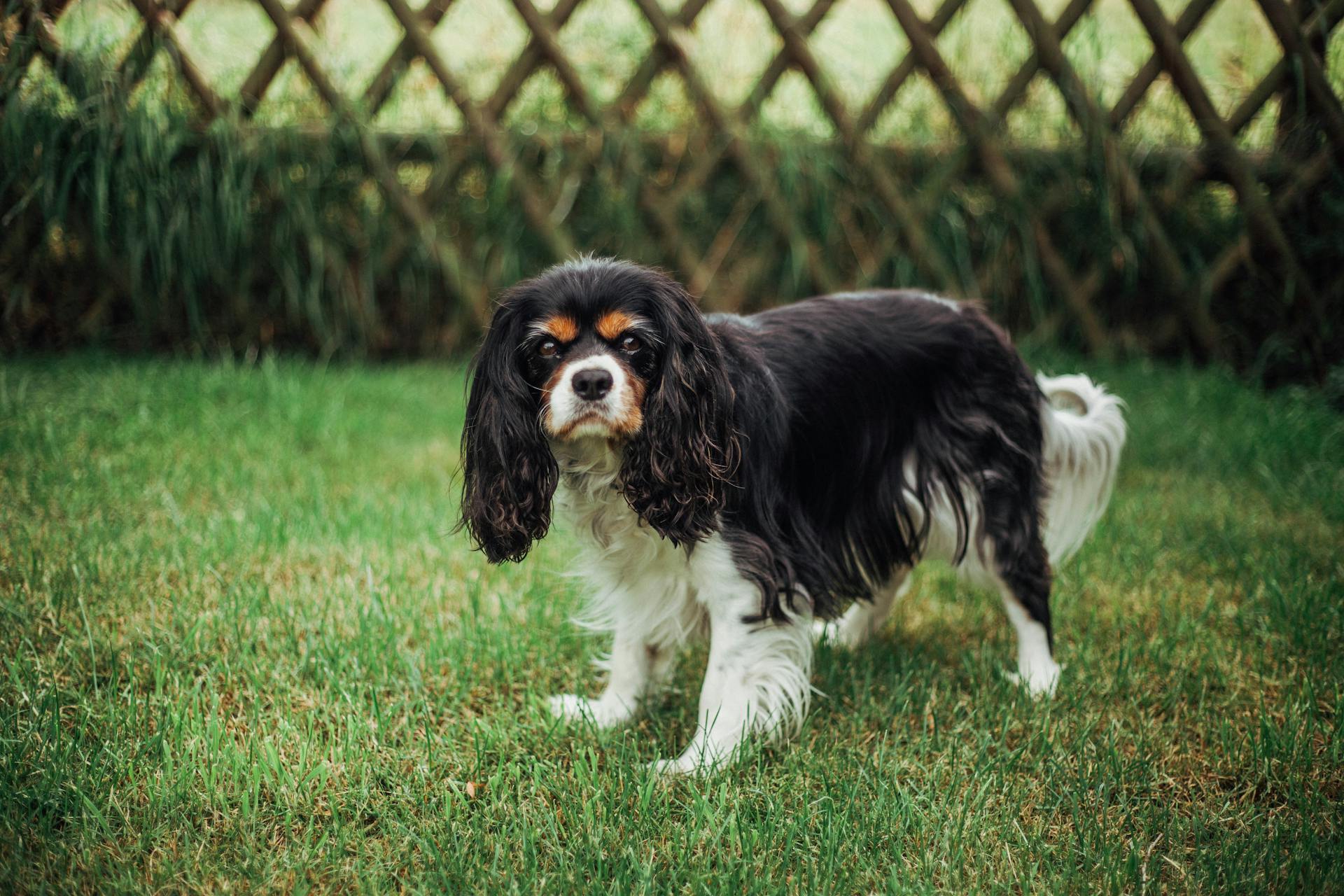
Cataracts are a common eye problem that can occur in dogs, including the Cavalier King Charles Spaniel breed. This condition causes the lens in the eye to become cloudy, leading to vision loss.
Posterior lenticonus is a rare congenital deformity in dogs where a cone-like shape bulge appears on the back of the lens. It's considered a serious condition that can progress with age.
Cavalier King Charles Spaniels are one of the breeds that can be affected by posterior lenticonus, which can lead to cataracts and even lens rupture. In some cases, the condition can cause pain and vision loss.
In severe cases, posterior lenticonus can lead to blindness and great pain, as seen in a 2-month-old Cavalier King Charles Spaniel puppy that was studied in a 1984 article. The puppy's eyes were preserved for further investigation and showed that the posterior lens capsule had ruptured in both eyes.
Posterior lenticonus is heritable in the Cavalier King Charles Spaniel breed, as concluded by investigators who reviewed the pedigrees of three affected dogs.
Check this out: Lead Dog Citra Solo
Strabismus
Strabismus is a condition where one of a dog's eyes can't focus with the other on an object due to an imbalance of the eye muscles.
Dr. David Williams reported a case of a cavalier with a severe form of strabismus, where it was impossible to move the globe medially and there was a lateral post-traumatic restrictive strabismus.
In some cases, strabismus can be associated with other eye conformational abnormalities, such as exophthalmos and exotropia.
A study by Drs. Rusbridge, Knowler, and others in 2014 found a combination of lateral strabismus, exophthalmos, and exotropia in cavaliers, and a possible association with Chiari-like malformation.
Strabismus can be a challenge to treat, as seen in the case of the cavalier mentioned above, where the owners chose not to treat the problem as the dog was not impaired by it.
Excessive Tear Staining
Excessive Tear Staining is a common problem in Cavalier King Charles spaniels. This issue occurs when the tear ducts are blocked, causing an overflow of tears that leads to tear staining, especially noticeable in white-faced dogs.
Take a look at this: How to Get Rid of Tear Stains on Maltese Dogs
The tear ducts are responsible for draining away tears, and in Cavalier King Charles spaniels, small or absent tear-duct openings can lead to this condition.
The symptoms of blocked tear ducts include redness, inflammation, and signs of discomfort, along with increased tear production.
A drop of fluorescein dye placed on the surface of the eye can diagnose blocked tear ducts. If the dye doesn't appear at the nostrils within a short period, it indicates a blockage in the corresponding duct.
Excessive Tearing
Excessive tearing in Cavalier King Charles Spaniels is a common issue that can be caused by a range of factors, including tear duct problems and allergies.
Their tear ducts are positioned in a way that makes them prone to blockages, which can lead to excessive tearing.
Cavalier King Charles Spaniels have a unique tear duct system that can cause tear duct problems, leading to excessive tearing.
Proper eye cleaning and maintenance can help prevent tear duct problems and reduce the risk of excessive tearing.
Regular veterinary check-ups can help identify any underlying issues that may be contributing to excessive tearing.
The breed's facial structure, with its short nasal passages and prominent eyes, can also contribute to tear duct problems and excessive tearing.
Cavalier King Charles Spaniels are prone to cherry eye, a condition that can cause excessive tearing and discomfort.
Diagnosis and Care
A thorough ophthalmic examination is crucial for diagnosing eye disorders in Cavalier King Charles Spaniels. This examination should include evaluation of the menace response, dazzle reflex, pupillary light reflex, slit-lamp examination, Schirmer Tear Test I, and rebound tonometry.
Your veterinarian should perform Schirmer tear testing and fluorescein staining at every visit to monitor your dog's eye health. This helps identify potential issues early on.
If a disorder is suspected, your veterinarian will perform a thorough ophthalmic examination, which includes a series of tests to assess your dog's eye health and detect any abnormalities.
Suggestion: Breeds of Dogs in a Dog's Purpose
Diagnosis
Diagnosis begins with standard initial steps, including Schirmer tear testing and fluorescein staining, performed by a veterinarian at every visit.
These tests help identify potential eye disorders, and a thorough ophthalmic examination is also necessary to evaluate the menace response, dazzle reflex, pupillary light reflex, and slit-lamp examination.
A Schirmer Tear Test I is part of the ophthalmic examination, and rebound tonometry is also used to assess eye health.
Archie's Age

Archie is a six year old Cavalier King Charles Spaniel.
At six years old, Archie is considered middle-aged for his breed, which is a significant factor in his diagnosis of Dry Eye.
Breeders' Responsibilities and Health
Breeders of Cavalier King Charles Spaniels should prioritize the health of their dogs, particularly when it comes to entropion, a painful and potentially blinding disease.
The Canine Eye Registration Foundation (CERF) advises that entropion is a serious issue that can be inherited in some breeds, but not in Cavalier King Charles Spaniels.
CERF does not deny certification to Cavalier King Charles Spaniels affected with entropion, as the Genetics Committee of the ACVO classifies the disorder as a "breeder option" for CKCSs.
However, the Cavalier King Charles Spaniel Club, USA recommends that breeding dogs have a normal rating or be within CERF "breeder options" from a screening by a board-certified veterinary ophthalmologist.
All breeding stock should be examined by board-certified veterinary ophthalmologists to determine if the dogs are affected with entropion.
Here's an interesting read: Dogs Certified Companion
The Canine Health Information Center (CHIC) provides a resource for breeders and owners to research and maintain information on health issues prevalent in specific breeds.
To qualify for CHIC certification, Cavalier King Charles Spaniels must have a CERF eye examination, which should be performed at 8 to 12 weeks, with a follow-up exam once the dog reaches 12 months.
Annual exams are recommended until the dog is 5 years old, and every other year until the dog is 9 years old.
It's worth noting that CHIC certification doesn't require that the results show no eye disorders, only that the breeding stock be examined by a veterinary ophthalmologist.
Frequently Asked Questions
What color eyes do Cavalier King Charles Spaniels have?
Cavalier King Charles Spaniels typically have warm, dark brown eyes. Their eye color is a distinctive feature of the breed.
What is Horner's syndrome in Cavalier King Charles Spaniels?
Horner's syndrome in Cavalier King Charles Spaniels is a condition characterized by facial asymmetry, including a small pupil, drooping eyelid, and sunken eye on one side of the face. If you suspect your dog has Horner's syndrome, it's essential to consult a veterinarian for proper diagnosis and treatment.
What is corneal dystrophy in Cavalier King Charles Spaniels?
Corneal dystrophy is a common condition in Cavalier King Charles Spaniels, characterized by the development of opaque lipid deposits under the corneas, usually appearing between 2-4 years old. It's typically non-painful and doesn't affect vision, but it's still essential to understand its implications and management options.
What is the most common genetic defect in cavalier king charles spaniels?
The most common genetic defect in Cavalier King Charles Spaniels is a malformation that affects the brain's cerebellum, occurring in over 90% of the breed. This condition, caused by a narrowing of the foramen magnum, can lead to serious health issues and requires careful consideration for potential owners.
Featured Images: pexels.com