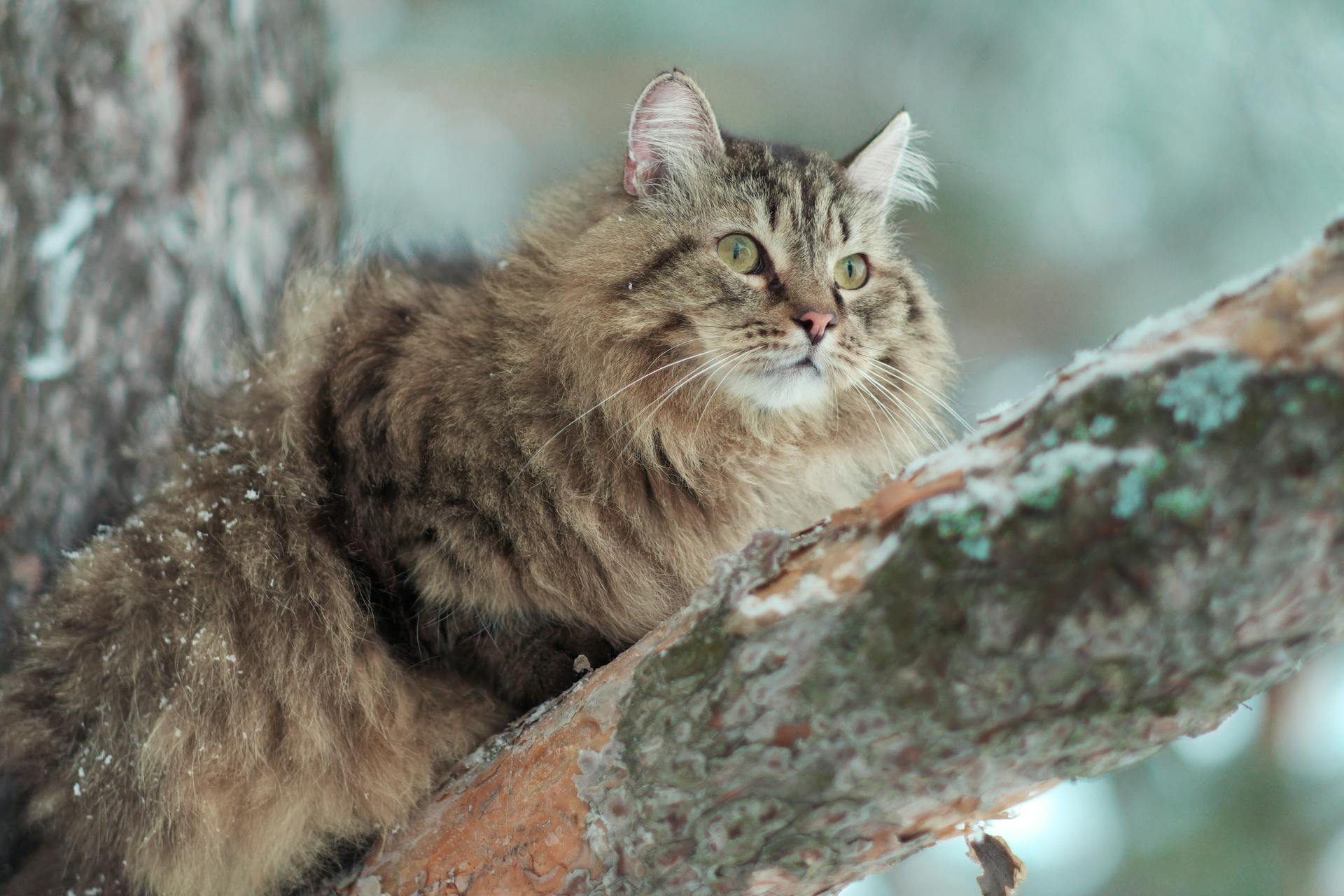
The domestication of cats is a remarkable story that spans thousands of years. The process began around 10,000 years ago in the Middle East, where wildcats were first attracted to human settlements.
These early humans likely provided food and shelter for the wildcats, which in turn offered protection from pests and other small animals. Over time, the wildcats adapted to living among humans and began to change physically.
One of the key factors in the domestication of cats was their ability to hunt small prey, such as rodents and birds. This skill made them valuable assets to early farmers, who needed to protect their crops from pests.
As humans and cats spent more time together, the cats began to change behaviorally as well, becoming more docile and affectionate. Today, cats are beloved pets in many parts of the world.
Here's an interesting read: Do African Wild Dogs Attack Humans
The Evolution of Cats
Cats have been around for over 9,500 years, with the first domesticated cats appearing in the Fertile Crescent.
They were initially attracted to human settlements because of the abundance of rodents and other small prey.
The ancient Egyptians were among the first to actively domesticate cats, recognizing their value as both hunters and companions.
Cats were often depicted in Egyptian art and literature, and were even worshipped as deities.
Their independence and self-reliance made them well-suited to life in ancient Egypt's busy cities.
By around 3,000 BCE, cats had become a staple of Egyptian life, with many households keeping them as pets.
The Egyptians' love of cats was so strong that they even mummified and buried them with their owners.
The domestication of cats is believed to have occurred in the Middle East, where wildcats were drawn to human settlements.
Over time, humans selectively bred these wildcats for desirable traits, such as smaller size and a more docile temperament.
This selective breeding led to the development of distinct breeds of domesticated cats.
Discover more: Cats in Ancient Greece
New Exhibition
The new exhibition "Cats: From Predators to Pets" is a must-visit for anyone fascinated by the domestic cat's transformation from fierce hunter to beloved companion.
The exhibition showcases the ancient origins of domesticated cats, which date back to around 9,500 years ago in the Fertile Crescent region.
One of the earliest archaeological evidence of cat domestication comes from a site in Cyprus, where the remains of a cat were found buried with its owner.
Cats were initially valued for their ability to hunt rodents and other small prey that threatened grain stores.
The ancient Egyptians revered cats as sacred animals, often mummifying and burying them with their owners in elaborate tombs.
Domesticated cats have since spread to become one of the most popular pets worldwide, with over 600 million cats kept as pets globally.
For another approach, see: Domesticated Hedgehog Diet
The Curious World of Cats
Cats are known for their unique personalities, but did you know that they also have a fascinating history as predators? In fact, the earliest evidence of cat domestication dates back around 10,000 years, with ancient Egyptians revering them as sacred animals.
Cats are natural hunters, with their eyesight being around 6 times stronger than humans. This is likely due to their evolution as predators in the wild. They have also been observed to have a highly developed sense of hearing, which helps them detect prey.
Despite their fierce instincts, domesticated cats have become beloved pets, with over 600 million kept worldwide. Their adaptability and affectionate nature have made them a popular choice for many families.
From Wild Prey to Domestic Pets
Cats have a long history of domestication, with evidence suggesting they were first tamed around 10,000 years ago.
Their ancestors were likely wildcats that roamed the Middle East, and it's believed that they were initially attracted to human camps and settlements by the abundance of rodents.
The earliest evidence of cat domestication comes from a site in Cyprus, where the remains of domesticated cats have been found dating back to around 9,500 years ago.
These early domesticated cats were likely valued for their hunting skills, which helped to control the rodent population and protect grain stores.
In ancient Egypt, cats were revered as sacred animals and were often mummified and buried with their owners.
The Egyptians believed that cats were associated with the goddess Bastet, who was often depicted as a cat or a woman with the head of a cat.
Cats were also highly valued for their ability to hunt and kill snakes, which were a significant threat to human life in ancient Egypt.
As humans began to move from a nomadic lifestyle to one that was more sedentary, cats adapted to living in close proximity to humans and began to change their behavior and physiology in response.
Over time, domesticated cats developed distinct physical and behavioral characteristics that set them apart from their wild ancestors.
Additional reading: Domesticated Hedgehog
The Story
Cats have been domesticated for over 10,000 years, with evidence suggesting they originated from the African wildcat.
Their independent nature is likely a result of their wild ancestors, who were solitary hunters.
Cats are highly territorial, and they use scent marking to define their boundaries.
They have scent glands on their faces, near their cheeks and lips.
Their unique vocalizations can convey a range of emotions, from contentment to anxiety.
A typical cat meows between 16 and 100 times per hour.
Their ears are incredibly flexible, with 32 muscles allowing them to rotate up to 180 degrees.
Cats have exceptional night vision, thanks to a reflective layer in the back of their eyes called the tapetum lucidum.
Their whiskers help them navigate through tight spaces and detect even slight changes in air pressure.
Featured Images: pexels.com