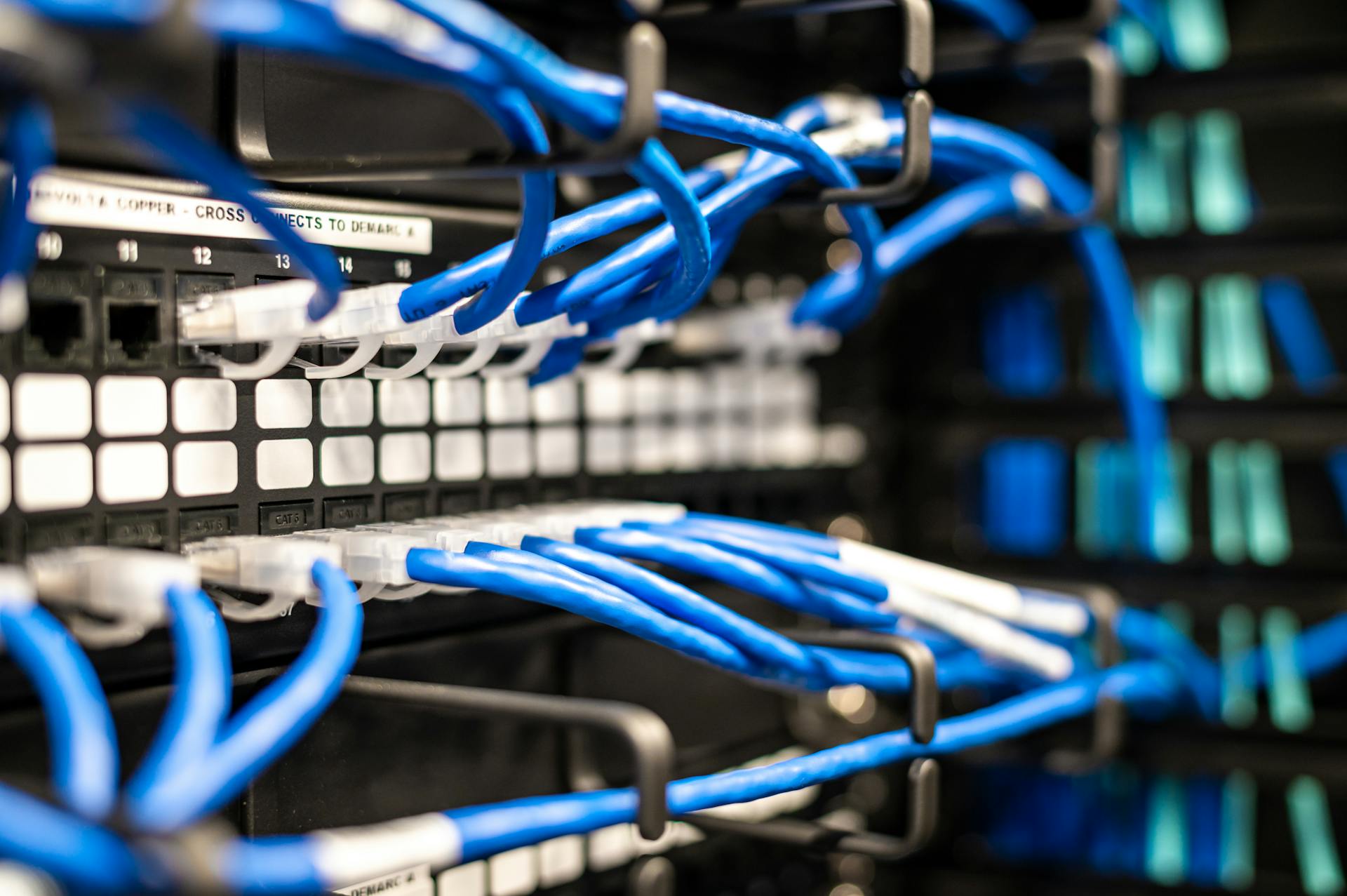
Cat cable types can be overwhelming, especially for those new to networking. There are several types of Cat cable, each with its own specifications.
Cat 5e cable supports speeds up to 1 Gbps.
For most home networks, Cat 5e is a good choice, offering a balance between speed and cost. It's also widely available and easy to install.
Cat 6 cable, on the other hand, supports speeds up to 10 Gbps, making it a better option for heavy internet users or those with large networks.
Cat Cable Types
Cat Cable Types are a crucial part of any network setup, and understanding the differences between them is essential for choosing the right one for your needs.
Cat 5 cables were one of the earliest iterations of twisted-pair Ethernet cables, capable of supporting data rates of up to 100 Mbps and frequencies of up to 100 MHz.
Cat 5e cables are an enhanced version of Cat 5 cables, designed to support higher data rates and reduce crosstalk and interference, capable of supporting data rates of up to 1 Gbps and frequencies of up to 100 MHz.
A unique perspective: How Many Kittens Can a Cat Have at One Time?
Cat 6 cables are designed to support even higher data rates and frequencies compared to Cat 5e cables, capable of supporting data rates of up to 10 Gbps and frequencies of up to 250 MHz.
Cat 6a cables are an augmented version of Cat 6 cables, designed to support even higher data rates and frequencies over longer distances, capable of supporting data rates of up to 10 Gbps at distances of up to 100 meters and frequencies of up to 500 MHz.
Cat 7 cables feature individually shielded pairs of wires and additional shielding overall, providing superior protection against crosstalk and interference, capable of transmitting up to 30 gigabits at 50 meters and 100 gigabits at only 15 meters.
Here's a summary of the main Cat Cable Types and their capabilities:
Cat 7 cables are best suited for use in large enterprise networks and data centers, while Cat 6a offers a comparable level of performance to Cat 7 at a lower cost.
Cat Cable Specifications
Cat Cable Specifications are crucial to understand the performance and capabilities of different Cat cable types.
Cat 5 cables support data rates of up to 100 Mbps and frequencies of up to 100 MHz, making them suitable for residential and small business networks.
Cat 5e cables, on the other hand, support data rates of up to 1 Gbps and frequencies of up to 100 MHz, with improved performance and reliability compared to Cat 5 cables.
Cat 6 cables are designed to support even higher data rates and frequencies, with a maximum transmission speed of 10 Gbps at frequencies up to 250 MHz.
Cat 6a cables feature improved insulation and shielding to reduce crosstalk and interference, making them suitable for high-performance networking applications.
The performance of a Cat cable depends not only on its category but also on factors such as cable length, installation quality, and environmental conditions.
Here's a summary of the key specifications for each Cat cable type:
Note that the performance of a Cat cable can vary depending on the specific application and environment in which it is used.
Shielding and Protection
Shielding and protection are crucial aspects of cat cable types, and understanding the different types can help you choose the right one for your needs.
Shielding Type of Ethernet Cables Plus Their Applications
STP (Shielded Twisted Pair) cables are suitable for high-speed networks and high-security transmission, making them a great choice for applications that require a high level of protection.
SFTP (Screened Foiled Twisted Pair) cables have a low attenuation of internal signal, making them perfect for special environments that require professional wiring.
UTP (Unshielded Twisted Pair) cables are suited for network applications with transmission bandwidth less than 250MHz and no special performance requirements.
FTP (Foiled Twisted Pair) cables are designed to provide greater protection from crosstalk from adjacent pairs and other cables, RFI (Radio Frequency Interference), and EMI (Electromagnetic Interference).
ASTP (Armored Shielded Twisted Pair) cables are perfect for preventing rodent damage and are also nice for explosion-proof wiring systems.
Here's a quick rundown of the shielding types and their applications:
Choose the Right Cable
Choosing the right cable can be overwhelming, but it's essential to get it right. The performance of a Cat cable depends not only on its category but also on factors such as cable length, installation quality, and environmental conditions.
To choose the right cable, consider the speed of the Internet you're using. It would be a waste to purchase a 10Gbps Cat6a cable if you're not gonna use 10Gbps speed of the Internet to match it and take advantage of its full potential.
Cat cables are defined by standards established by the Telecommunications Industry Association (TIA) and the Electronic Industries Alliance (EIA). The main types of Cat cables include Cat 5, Cat 5e, Cat 6, Cat 6a, Cat 7, and Cat 8.
Here's a quick rundown of the key differences between each category:
Remember, the purer the copper is, the less signal loss you will suffer. Oxygen-free copper wire with copper purity up to 99.95% is the best option, but it comes at a higher price.
Cable Information and Guides
Cat cables, also known as Ethernet cables, come in different types, each with its own speed and distance capabilities.
Cat 5 cables support data rates of up to 100 Mbps and frequencies of up to 100 MHz, making them suitable for residential and small business networks.
The main difference between Cat 5 and Cat 5e cables is that Cat 5e cables are designed to support higher data rates and reduce crosstalk and interference.
Cat 6 cables are designed to support even higher data rates and frequencies, with data rates of up to 10 Gbps and frequencies of up to 250 MHz.
Cat 6a cables are an augmented version of Cat 6 cables, supporting data rates of up to 10 Gbps at distances of up to 100 meters and frequencies of up to 500 MHz.
Cat 7 cables support even higher data rates and frequencies, with data rates of up to 10 Gbps and frequencies of up to 600 MHz.
The purity of copper in the Ethernet cable material affects the cable's performance and price. Oxygen-free copper wire with a purity of up to 99.95% is the best option for less signal loss.
Here is a comparison of the different network cable categories, including their performance and price:
The price of the Ethernet cable is another factor to consider, with Cat 6a cables being generally more affordable than Cat 8 cables.
Frequently Asked Questions
Is Cat6 or Cat8 better?
Cat8 is the better choice for high-speed networking, offering up to 4 times faster data transfer speeds and reduced latency compared to Cat6. If you need the latest in Ethernet cable technology, Cat8 is the clear winner.
Is Cat7 overkill for home use?
For most home setups, Cat7 cables offer more speed and shielding than needed, making them overkill for typical residential applications. However, they can be beneficial for high-bandwidth devices or future-proofing.
Featured Images: pexels.com