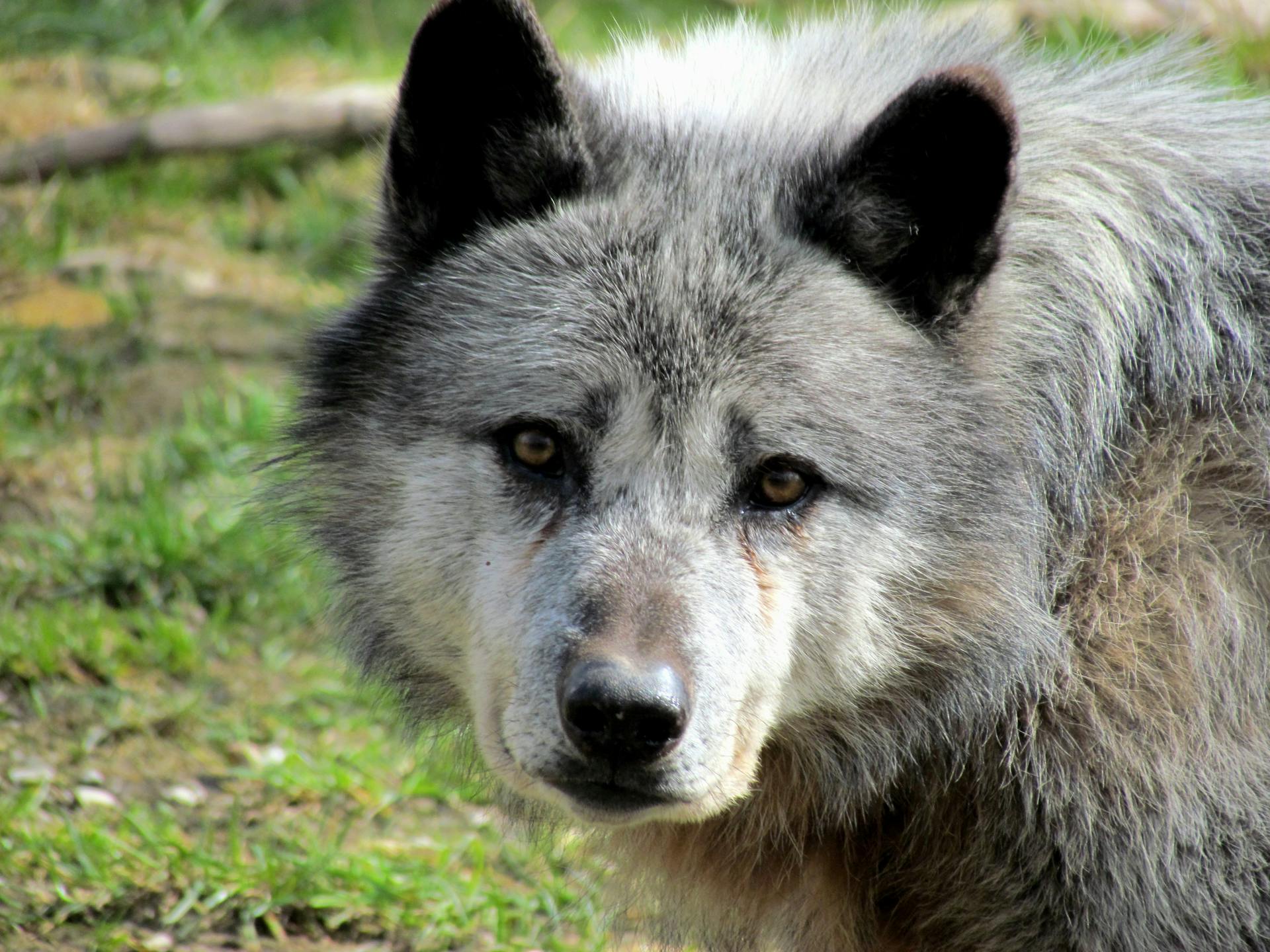
The Great Plains Wolf, also known as Canis Lupus Nubilus, is a fascinating creature. It's a subspecies of gray wolf that's native to North America.
They're incredibly adaptable, able to thrive in a wide range of habitats, from grasslands to forests. Their ability to adjust to different environments is a testament to their intelligence and resilience.
One key characteristic of the Great Plains Wolf is their diet, which consists mainly of large ungulates like deer and bison. This is a result of their evolution in an ecosystem where these animals were abundant.
Great Plains Wolf
The Great Plains Wolf is a fascinating creature. Its original range spanned throughout the United States and southern Canada, covering the Great Plains from southern Manitoba and Saskatchewan southward to northern Texas.
These wolves are incredibly adaptable, thriving in a wide range of habitats, including coastline, wetlands, watersheds, sand dunes, and forests. They've even been known to inhabit open tundra.
Great Plains wolves are carnivores and primarily feed on white-tailed deer and moose, but they'll also hunt smaller mammals like hares, rodents, and birds when larger prey is scarce. In fact, a pack of up to 6 wolves can stampede and cull the weak and young from a herd.
A Great Plains wolf can grow up to 6 1/2 feet long from nose to end of tail and weigh as much as 120 pounds, with males weighing about 20% more than females. Both sexes have coats that blend shades of brown, grey, black, red, and light brownish yellow.
Great Plains wolves are monogamous, with alpha pairs forming long-term bonds and only producing offspring together. Female wolves typically give birth to 4 to 6 pups after a 63-day gestation period, which are born between January and late February in northern climates.
In the wild, Great Plains wolves communicate with each other through a range of vocalizations, including howling, barking, whimpering, and snarling. They also use body language, such as tucking their tails between their legs or raising their heads and ears, to convey submission or friendliness.
Wolf Traits and Behavior
Great Plains wolves are known to hunt in packs with unrelated wolves, working together to protect their territory and raise their young.
Their communication skills are impressive, using a variety of vocalizations like howling, barking, whimpering, and snarling to convey information.
Wolves also communicate through body language, and even humans can decipher their signals. For example, a subordinate wolf will tuck its tail and pin back its ears when approaching a dominant pack member.
A wolf's mood and intentions can be conveyed through its howl, which is often longer and smoother than a coyote's howl.
Habitat
The Great Plains Wolf is a remarkable creature that can be found in a variety of habitats.
It originally inhabited the United States and southern Canada, ranging from southern Manitoba and Saskatchewan southward to northern Texas.
It can thrive in many different environments, including coastline, wetlands, watersheds, sand dunes, coastal marshes, rocky shorelines, prairies, savannas, forests, fens, and open tundra.
In the past, its range was vast, covering much of the western United States, southeastern Alaska, and central and northeastern Canada.
Estado de Conservación:
The wolf's conservation status has a fascinating history.
Initially, it was believed that the Great Plains wolf had gone extinct in 1926.
However, subsequent studies revealed that wolves found in Minnesota, Wisconsin, and the Upper Peninsula of Michigan were actually descendants of the Canis lupus nubilus.
Their numbers continued to decline until they were protected federally as an endangered species in 1974.
Thanks to protection, their population in Minnesota grew large enough to be reclassified as threatened in 1978.
By 2009, the wolf population in the Great Lakes region had increased to approximately 2,922 in Minnesota, 580 in Michigan, and 626 in Wisconsin.
This led to the Service's decision to remove these 4,000 wolves from the endangered species list.
However, environmental and animal protection groups challenged this decision, and the Service was forced to reinstate the wolves' protected status.
For your interest: Lupus and Service Dogs
Wolf Traits
Great Plains wolves can be as long as 6 1/2 feet from nose to end of tail.
The male Great Plains wolf weighs about 20% more than the female Great Plains wolf.
Both sexes of the Great Plains wolf have coats colored a blend of brown, grey, black, red, or light brownish yellow.
Wolf Behavior and Communication
Great Plains wolves are highly social creatures that communicate with each other in various ways. They use howling, barking, whimpering, and snarling to convey messages.
A wolf's body language is also a vital means of communication. Even humans can easily understand what a wolf is trying to convey through its posture and facial expressions. For example, a subordinate wolf will tuck its tail between its legs, pin its ears back, and slink towards a dominant pack member, signaling its submission.
Wolves use raised heads, tails, and ears to communicate with friendly social equals and mates. This non-verbal language is universal among wolves and helps maintain social harmony within the pack.
In contrast, disputes between wolves or threats are greeted with growls and displayed fangs. This aggressive behavior serves as a warning to potential threats and helps maintain the pack's hierarchy.
Great Plains wolves are known for their distinctive howls, which are longer and smoother in tone than those of coyotes. These howls convey essential information, such as who is calling, where they are, and their mood, whether threatened or unthreatened.
Wolf Diet and Lifecycle

The Great Plains wolf lifecycle is quite fascinating. Great Plains wolf pups are born from January through late February at northern climates.
The mother wolf gives birth to 4 to 6 pups in a den after a 63-day gestation period. These pups become fully grown in 6 to 8 months.
Great Plains wolves mate for life, and only the non-related alpha female and alpha male will produce offspring.
Wolf Diet on the Great Plains
On the Great Plains, wolves are skilled hunters that primarily feed on white-tailed deer and moose. They often target weak and young individuals within the herd, which is made possible by their ability to stampede and cull the herd.
Smaller mammals like hares, rodents, and birds fill in the gaps in their diet during times of scarcity.
Wolf Lifecycle
The Great Plains wolf's lifecycle is a remarkable process. Great Plains wolf pups are born from January through late February at such northern climates.
After a 63 days of gestation, the mother gives birth to 4 to 6 pups in a den. These pups become fully grown in 6 to 8 months.
Great Plains wolves mate for life, and only the non-related alpha female and the alpha male will produce offspring. They are sexually mature by about 22 months.
Frequently Asked Questions
Are there any buffalo wolves left?
Yes, there are buffalo wolves left, specifically in Minnesota, Wisconsin, and upper Michigan, where they have survived as a distinct subspecies. These wolves are descendants of the once-thought-to-be-extinct Great Plains wolf.
Featured Images: pexels.com