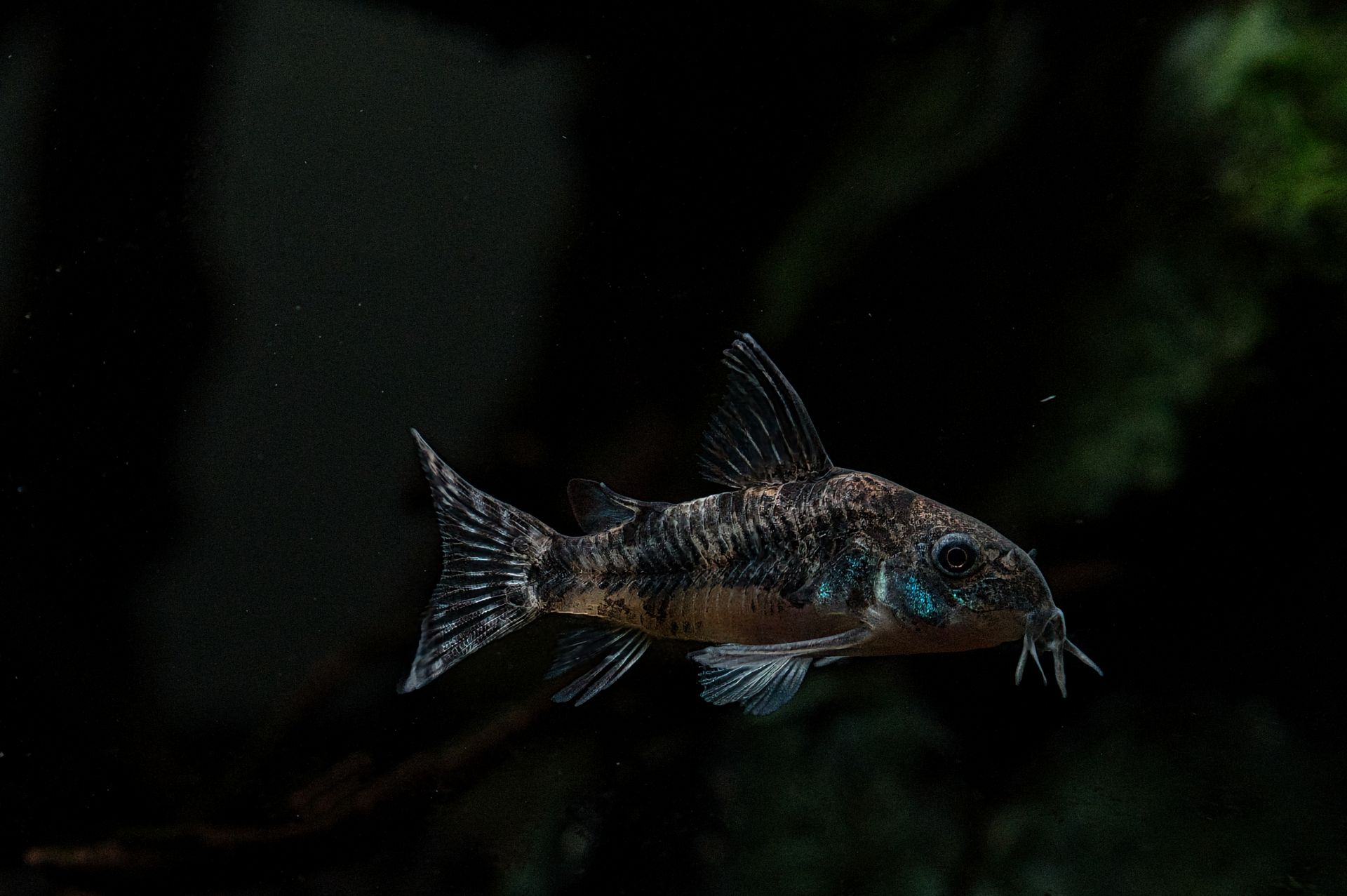
The Callichthyidae family consists of armored catfish, a group of fascinating fish species that have been around for millions of years. They are primarily found in freshwater environments in South America.
These fish have a unique appearance, characterized by their armored plates and spines, which provide protection from predators. Their armored bodies are made up of bony plates called scutes.
One of the most interesting things about Callichthyidae is their ability to thrive in a variety of environments, from slow-moving rivers to aquariums. They are relatively low-maintenance pets, making them a popular choice for aquarium enthusiasts.
Classification
The Callichthyidae family is a diverse group of catfish, and understanding their classification can be a bit overwhelming at first. The family gets its name from the Greek words kalli- (καλλι-, 'beautiful') and ichthys (ἰχθύς, 'fish').
The Callichthyidae family is part of the superfamily Loricarioidea, which also includes Scoloplacidae, Astroblepidae, and Loricariidae. This grouping is significant because it helps us understand the evolutionary relationships between these families.
One of the most interesting things about the Callichthyidae family is its diversity. Within the family, there are two subfamilies: Corydoradinae and Callichthyinae. The Corydoradinae subfamily is home to about 90% of the species in the Callichthyidae family, with around 170 valid species.
Here's a breakdown of the subfamilies and their corresponding genera:
The classification of the Callichthyidae family is still evolving, with different studies providing different relationships among the genera. For example, a 1997 paper found that Callichthys is the most basal member of the Callichthyinae subfamily, while a 2004 study found that Dianema and Hoplosternum form the most basal clade.
History and Fossil Record
The callichthyid family has a fascinating history that stretches back millions of years. The first known fossil species of callichthyid is Corydoras revelatus from Salta, Argentina, of the late Paleocene.
This ancient species is a member of the subfamily Corydoradinae, and its discovery indicates that the lineages leading to the two callichthyid subfamilies occurred at least by the late Paleocene.
Geographic and Habitat Information
The Callichthyidae family is found in most South American river drainages.
The Neotropical family Callichthyidae is found in several river systems, including the Paraná-Paraguay, São Francisco, and Amazon river drainages.
These freshwater environments range from fast-flowing streams with sandy or rocky bottoms to lowland pools with muddy bottoms.
Hoplosternum punctatum is the only Callichthyidae species found in Central America, specifically in a few rivers in Panama.
The highest species richness of Callichthyidae is found in the headwaters of the Amazonas drainage and rivers draining the Guiana Shield.
Aspidoras mephisto is a unique cavefish that is the only species of its kind in this family.
Characteristics and Behavior
The Callichthyidae family of armored catfish is characterized by two rows of bony plates running the length of their body.
These little fish are common in virtually every freshwater habitat throughout South America, and some species can even flourish in stagnant or swampy water.
Some Callichthyidae species can survive in conditions that would kill other fish by gulping air into their intestines, where the oxygen permeates into the blood vessels, essentially acting as a fake lung.
The male Callichthys callichthys, for example, builds a large nest out of plant parts and bubbles formed from air and mouth secretions, and only lets the female enter when he's perfectly satisfied with his construction.
Description
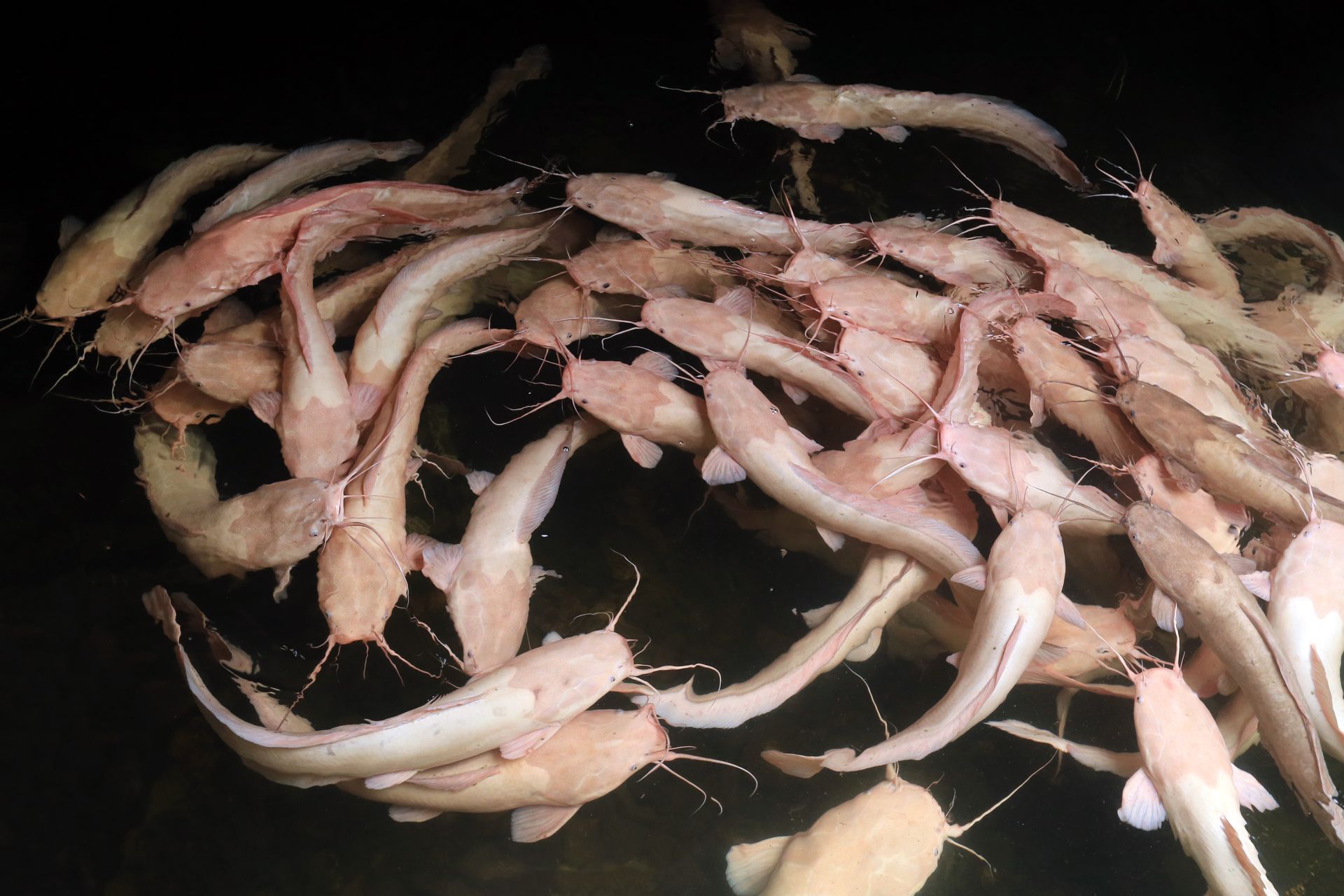
Callichthyids are fairly small catfish, ranging in size from 2cm to 24cm in total length. They have a small mouth and ventral position, surrounded by one or two pairs of well-developed barbels.
The dorsal and pectoral fins have strong spines, which can be venomous in many species, serving as a defense mechanism against predators. These spines are a key feature of the family.
The body of a callichthyid has two rows of overlapping bony plates, or scutes, that provide protection but also allow for some freedom of movement. These scutes connect with the solid bones of the head.
Some species of callichthyids, like the Corydoras genus, are small in size, with a maximum standard length of about 9cm. They have deep bodies and short maxillary barbels, distinguishing them from other callichthyids.
Ecology
Callichthyids can be found in a wide range of habitats, from small oxygen-rich creeks to big rivers and even swampy areas with low oxygen levels.
These catfish are incredibly adaptable and can survive in environments with low oxygen by breathing air at the water's surface. They collect air at the surface and store it in their digestive tracts.
Air stored in their digestive tracts accounts for 75% of the necessary air for neutral buoyancy, which is essential for their survival.
Unlike some other catfish, callichthyids breathe air under all water conditions, not just when oxygen levels are low.
Some callichthyids can even absorb air through their hind guts to move short distances on land.
Classification and Naming
The Callichthyidae family has several distinct genera, each with unique characteristics. The Callichthys genus is one of the original and most well-known.
The Callichthys genus is just one of the many within the Callichthyidae family. There are eight other genera as well.
The eight other genera are: Aspidoras, Brochis, Corydoras, Gastrodermus, Hoplisoma, Megalechis, Osteogaster, and Scleromystax.
Here's a list of the Callichthyidae family's genera, in the same order as mentioned earlier:
- Aspidoras
- Brochis
- Corydoras
- Gastrodermus
- Hoplisoma
- Megalechis
- Osteogaster
- Scleromystax
Featured Images: pexels.com