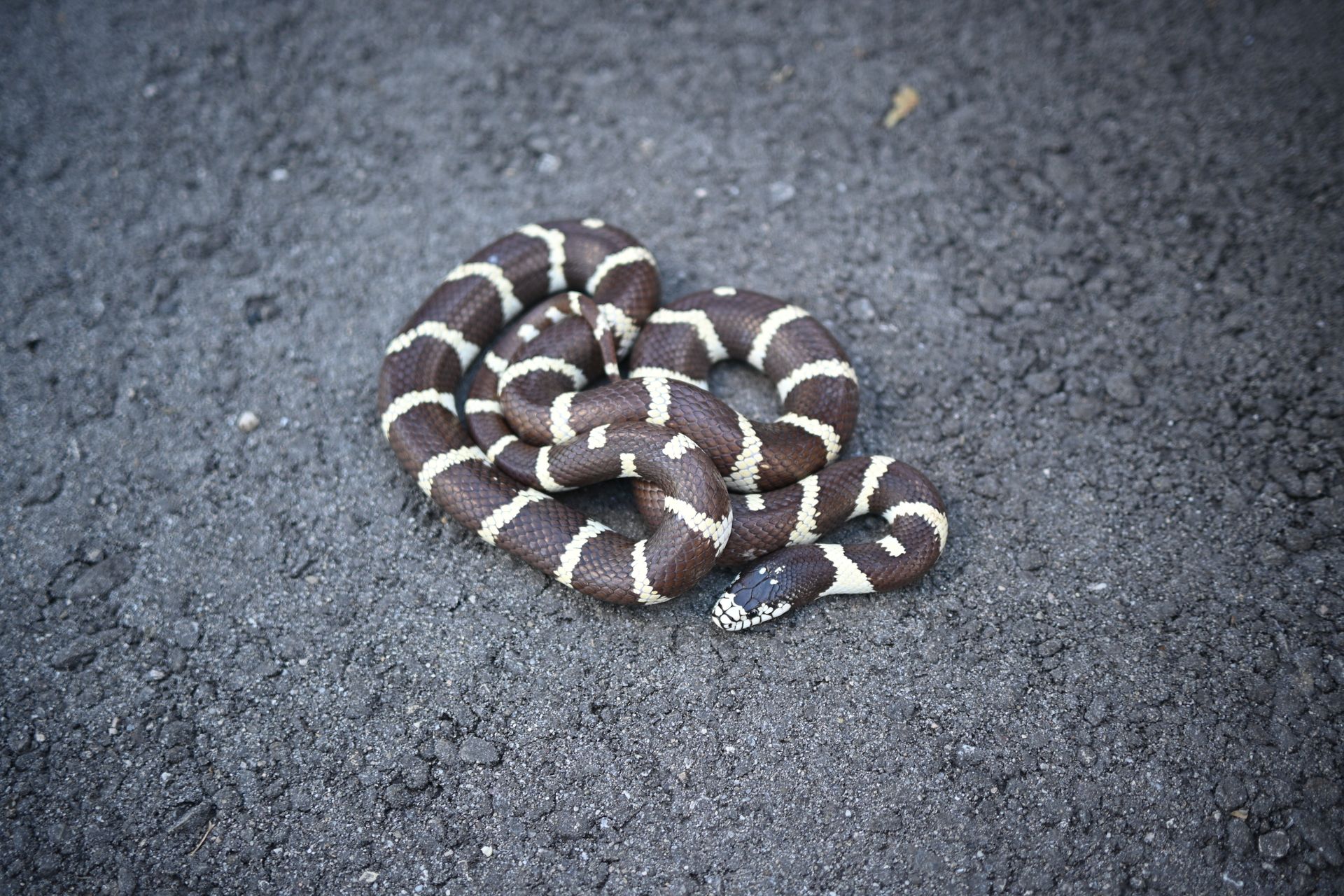
The California King Snake is a unique and fascinating creature that's native to the western United States. They're found in a variety of habitats, including deserts, forests, and grasslands.
These snakes are carnivores and feed on small mammals, birds, and lizards. They're known for their ability to consume other snakes, including venomous species like rattlesnakes.
California King Snakes are relatively large, with adults reaching lengths of up to 5.5 feet. They have a distinctive pattern of bands or blotches on their back, which can vary in color depending on the region.
For your interest: Snakes Find Bird Nests
Range and Habitat
The California kingsnake is found along the West Coast of North America, spanning from Oregon to northwestern Mexico.
They thrive in a wide variety of habitats, including woodland chaparral, grassland, deserts, marshes, and even suburban areas.
These snakes can live in elevations of up to 7,000 ft (2,100 m) in the southeastern Sierra Nevada Mountains.
The optimal temperature range for California kingsnakes is between 80–84 °F, with a humidity level of around 35–60%.
During reproduction, they prefer even warmer temperatures, while during shedding, they prefer higher humidity.
In Arizona, they intergrade with the desert kingsnake (Lampropeltis splendida) and the Mexican black kingsnake (Lampropeltis getula nigrita).
The California kingsnake has also become invasive on the Spanish island of Gran Canaria, with an estimated population of 20,000 individuals by 2014.
Care and Housing
California kingsnakes are popular pets due to their ease of care, attractive appearance, and docile demeanor. They're relatively low maintenance, making them a great choice for beginners.
In captivity, California kingsnakes need a controlled environment to thrive. This means using heat lamps, heating pads, or regulating temperatures in their enclosure to keep them healthy. Temperatures between 70 °F and 85 °F are ideal.
If you're planning to keep a California kingsnake as a pet, be aware that wild-type kingsnakes are technically illegal to sell in California without special permits. However, albino morphs are exempt from this law.
In Captivity

In captivity, California kingsnakes are one of the most popular pet reptiles due to their ease of care and attractive appearance.
Their docile demeanor makes them a great choice for reptile enthusiasts. Many owners also enjoy the natural color and pattern variability between individual snakes.
Snake enthusiasts have selectively bred for a variety of color patterns known as "morphs". These morphs are not only visually appealing but also offer a range of options for owners.
However, wild-type California kingsnakes are technically illegal to sell without special permits in their home state of California. This law is due to a law that prohibits sale of native California species within state lines.
Albino morphs are exempt from this law, making them a popular choice for owners. But it's worth noting that the law is loosely enforced, so it's essential to check local regulations before purchasing a kingsnake.
To ensure the health of their kingsnake, owners use heat lamps, heating pads, and regulate temperatures in their homes. Temperatures between 70 °F and 85 °F are adequate for kingsnakes in captivity.
Size
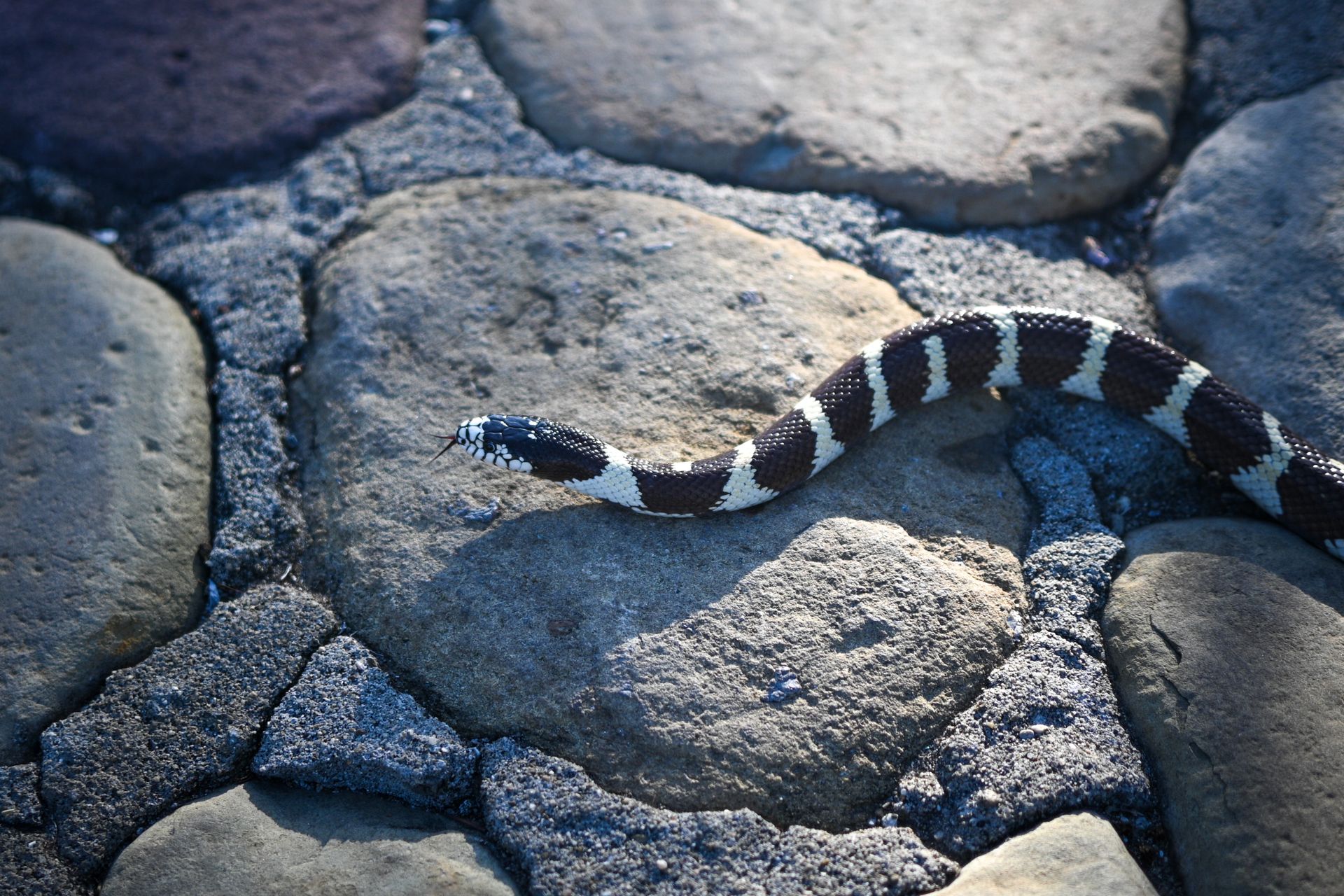
When housing your California kingsnake, make sure to provide a spacious enclosure to accommodate its size. Adult California kingsnakes can reach lengths of up to 7 feet, so a larger tank is a must.
The ideal tank size will depend on the individual snake's size, but a minimum of 6 feet in length is recommended to give your snake room to move around comfortably.
In terms of height, a tank with a height of at least 2 feet will provide your snake with enough space to climb and bask.
On a similar theme: King Shepherd Height
Details:
California Kingsnakes are common throughout not only California but also Arizona and parts of Mexico. They are one of the most popular pet snakes, along with fellow colubrids, corn snakes.
Their predictable pattern of black and white makes them easy to spot and difficult to mistake for other snakes. They are known to be ravenous and easy to feed, which is a plus for new snake owners.
In the wild, Cali Kings prefer to hunt easier prey such as rodents and amphibians. With proper care and caution, they can learn to be handled peacefully and without accidental bites.
Behavior and Patterns
In the wild, California King Snakes are active at dawn and dusk, and can often be seen basking in the sun during the day. They're also known to be nocturnal during hot weather to avoid the heat.
They have a unique way of defending themselves when agitated, coiling their bodies to hide their heads, hissing, and rattling their tails to produce a sound similar to a rattlesnake's rattle. If handled, wild individuals are quick to bite and may excrete musk and fecal contents from their cloaca.
Their coloration helps break up their body outline, making them less noticeable to predators. This is a clever adaptation, similar to a zebra's stripes.
Cool Facts:
California Kingsnakes are known to feed on a variety of prey, including small mammals, birds, and cold-blooded reptiles and amphibians. They've even been observed hunting and eating rattlesnakes by snapping their necks.
Their diet is quite diverse, and their feeding response is eager, which makes them easy pet snakes. They will rarely reject food, which is a big plus for snake owners.
One interesting thing about California Kingsnakes is that they're notorious for biting humans more than other pet snakes. Thankfully, their bites are not venomous.
Here are some interesting facts about their feeding habits:
- They feed on small mammals, birds, and cold-blooded reptiles and amphibians
- Their bites are not venomous, but they can be painful
- They have an eager feeding response and will rarely reject food
Activity Pattern
In the wild, Ca. King Snakes are most active during the warmer months of spring and summer, basking in the sun to regulate their body temperature.
They hibernate, or rather, brumate, during the cooler months of fall and winter.
Ca. King Snakes are precocial, meaning their young hatch with their eyes open and are able to move around on their own.
In a zoo setting, Ca. King Snakes are active year-round, a stark contrast to their natural behavior.
Adaptations
The California kingsnake has some pretty cool adaptations that help it survive in its environment. They can coil their bodies to hide their heads, hiss, and rattle their tails, producing a sound similar to a rattlesnake's rattle when they're agitated.
In fact, wild California kingsnakes are often quick to bite if handled, and they may even excrete musk and fecal contents from their cloaca. This is a defense mechanism to deter predators and protect themselves.
Their coloration is another clever adaptation - it helps break up their body outline, making them less noticeable to predators, much like a zebra's stripes.
During times of hot weather, California kingsnakes become increasingly nocturnal, avoiding the hotter temperatures by being active at night. This is a smart move, as it helps them conserve energy and stay safe.
Scientific Classification
The California king snake's scientific classification is a fascinating topic.
The California king snake is classified under the kingdom Animalia, which is the group of multicellular, eukaryotic organisms that are heterotrophic.
Its phylum is Chordata, a group that includes animals with a notochord, a dorsal nerve cord, pharyngeal slits, and a post-anal tail.
This classification is essential in understanding the snake's evolutionary history and relationships with other animals.
The California king snake belongs to the class Reptilia, a group of cold-blooded animals that lay eggs and have scales.
For another approach, see: Dog Snake Training
Description
California kingsnakes are typically 2.5-3.5 feet long, though they can grow larger.
Their body patterns vary greatly, often including rings, patches, or stripes of dark and light coloration.
Some populations may have longitudinal stripes instead of bands.
California kingsnakes live to be around ten to fifteen years old, and can even surpass twenty years if well cared for in captivity.
Their predators include hawks, eagles, coyotes, skunks, foxes, bobcats, and other kingsnakes.
Their stripes and bands are essential to their survival, camouflaging their body to hide from predators.
Taxonomic Breakdown:
Taxonomic Breakdown is a way to categorize living things into groups based on their characteristics.
The Kingdom is the highest level of classification and for the California King Snake, it's Animalia.
The Phylum is the next level down and for the California King Snake, it's Chordata.
The Class level of classification further refines the group and for the California King Snake, it's Reptilia.
The Order level of classification is used to group organisms based on their physical characteristics and for the California King Snake, it's Squamata.
You might like: Ringneck Snake
The Suborder level of classification is used to group organisms based on their physical characteristics and for the California King Snake, it's Serpentes.
The Family level of classification is used to group organisms based on their physical characteristics and for the California King Snake, it's Colubridae.
The Genus level of classification is used to group organisms based on their physical characteristics and for the California King Snake, it's Lampropeltis.
The Species level of classification is the most specific level and for the California King Snake, it's L. californiae.
Lampropeltis
Lampropeltis is a genus of snakes that includes the California kingsnake.
The California kingsnake is a species of Lampropeltis, specifically Lampropeltis californiae.
This genus is part of the family Colubridae, which includes non-venomous snakes.
California kingsnakes are known to live up to twenty years in captivity, a remarkable lifespan for a snake.
Their scientific classification is as follows: Kingdom Animalia, Phylum Chordata, Class Reptilia, Order Squamata, Suborder Serpentes.
Natural History
The California king snake is a fascinating creature with a rich natural history. They are native to the southwestern United States and northern Mexico.
Their habitat ranges from deserts to forests, with a preference for rocky outcroppings and scrublands. They are solitary animals and only come together to mate.
California king snakes are known for their distinctive pattern of dark blotches on a light background, which helps them blend in with their surroundings. They are also expert hunters, preying on a variety of small mammals, lizards, and snakes.
In the wild, California king snakes are vulnerable to habitat loss and fragmentation, as well as the introduction of non-native species that compete with them for food and resources.
Reptile Care
Reptile care for your California King Snake is a top priority. ReptiChip provides an ideal environment by balancing cleanliness, comfort, and humidity.
A clean enclosure is essential for your snake's well-being. ReptiChip is excellent for moisture retention, which is crucial for many reptiles and amphibians.
Replacing the substrate too frequently can be a hassle. ReptiChip's durability and ease of maintenance mean you'll need to replace it less often.
Odors in the enclosure can be a nuisance. ReptiChip is great at odor absorption, keeping your living space fresh.
Low sodium and potassium levels in the substrate are a must for your snake's health. ReptiChip's low sodium and potassium content reduces the risk of mineral buildup.
The substrate's low tannin content is a bonus. It won't stain your enclosure or your snake, making cleanup a breeze.
Frequently Asked Questions
Are banded California kingsnakes poisonous?
No, banded California kingsnakes are not poisonous. They are harmless to humans, but may bite if threatened or surprised.
Are California kingsnakes good?
California kingsnakes are a great pet option, known for their manageable size, easy care, and affordability. They make an excellent choice for snake enthusiasts, offering a low-maintenance and rewarding pet experience.
Featured Images: pexels.com