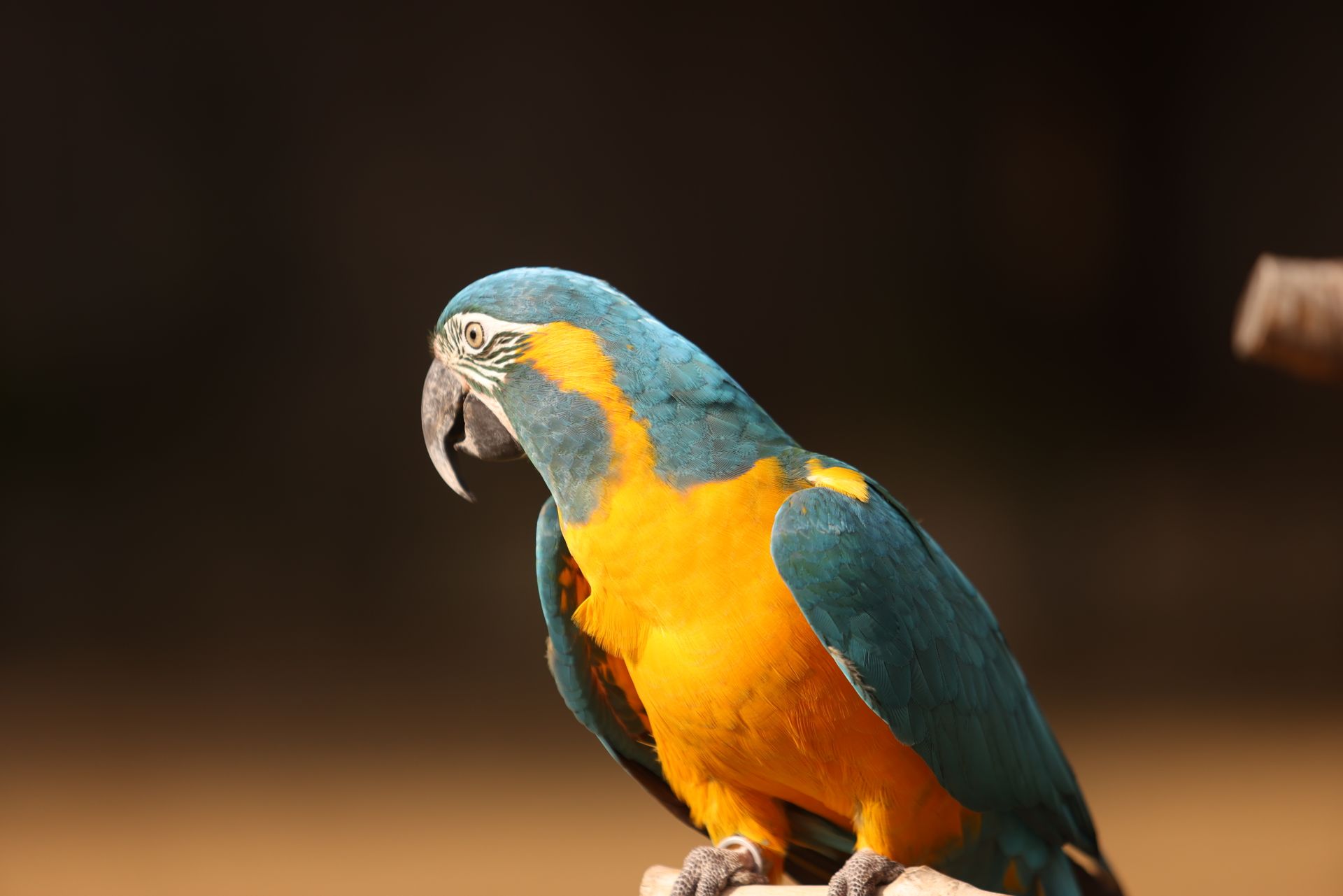
The Blue Throated Macaw is a rare and unique bird species.
Native to Bolivia, this bird has been listed as Critically Endangered since 1992, with a population of less than 700 individuals in the wild.
The Blue Throated Macaw is known for its striking blue throat patch, which is a distinguishing feature of the species.
This bird's diet consists mainly of fruits and seeds, which it forages for in the savannas and grasslands of its native habitat.
On a similar theme: Blue Bird Identification
Taxonomy and Classification
The Blue-throated macaw is part of the genus Ara, which is a collective term for large, long-tailed parrots known as macaws. This genus includes 8 extant species and a few extinct species.
The Ara genus is one of six genera of Central and South American macaws in the tribe Arini, which also includes other long-tailed New World parrots. The tribe Arini is part of the subfamily Arinae of Neotropical parrots in the family Psittacidae of true parrots.
The Blue-throated macaw was originally thought to be a subspecies of the similar-looking Blue-and-yellow macaw, but it's now recognized as a distinct species.
You might like: Great Tailed Grackle vs Crow
Classification
Classification is a crucial part of understanding the taxonomy of a species. It's a way to group living things based on their shared characteristics and evolutionary relationships.
The Blue-throated macaw, for example, is classified as a member of the kingdom Animalia. This is because it's an animal, as opposed to a plant or a fungus.
Here's a breakdown of the Blue-throated macaw's classification:
- Kingdom: Animalia
- Phylum: Chordata
- Subphylum: Vertebrata
- Class: Aves
- Order: Psittaciformes
- Family: Psittacidae
- Genus: Ara
- Species: Ara glaucogularis
The Blue-throated macaw's classification is based on its physical characteristics and evolutionary history. By grouping it with other similar species, we can gain a better understanding of its place in the natural world.
What is a Macaw?
Macaws are a type of parrot found in the Americas, with at least 17 species, including the blue-throated macaw.
The blue-throated macaw is one of these species, known for its brilliant plumage, with bright yellow chest, belly, legs, and under-wing area.
Its wings and head are also blue, and it has blue and white stripes surrounding its eyes.
The blue-throated macaw's name comes from its distinctive blue throat feathers, which resemble a beard.
This feature distinguishes it from its lookalike, the blue-and-yellow macaw.
Broaden your view: Yellow Collared Lovebird
Physical Description
The blue-throated macaw is a stunning bird with vibrant coloration. They have bright turquoise-blue feathers covering their throat, crown, back, and dorsal side of their wings and tail.
Their golden-yellow feathers grow in a stripe between the blue crown and throat on the side of the face and on the ventral side of their body, wings, and tail. This striking contrast between blue and yellow is a key characteristic of the blue-throated macaw.
Adult blue-throated macaws weigh between 600 to 1000 grams, with a length of about 85 cm. They have a wingspan of approximately 0.9 m, or three feet.
One of the most unique features of the blue-throated macaw is the bare facial patch near the base of their large dark-colored bill. This patch has 5 or 6 horizontal stripes of blue feathers that are unique to every individual bird and can be used to identify them.
The iris of a blue-throated macaw changes color with age, starting from black in nestlings, then brown, grey, white, and finally yellow with a golden tint as they mature.
Here's a summary of the blue-throated macaw's physical characteristics:
- Weight: 600-1000 grams
- Length: 85 cm
- Wingspan: 0.9 m (3 feet)
- Unique facial patch with 5-6 horizontal blue stripes
- Iris color changes with age: black, brown, grey, white, yellow, and golden
Distribution and Habitat
The blue-throated macaw is found in a unique and fragile ecosystem. It inhabits the Llano de Moxos of the Beni Department of Bolivia, specifically nesting in "Islas" (islands) of palm trees that dot the level plains.
This species is one of the rarest in the world, with only two areas inhabited by two sub-populations of Ara glaucogularis. One area is to the northwest of Trinidad, the capital city of Beni, and the other is to the south of Trinidad.
The blue-throated macaw's habitat consists of grasslands, marshes, forest islands, and corridors of forests along waterways. They occur most often between the elevations of 200 and 300 m.
Their habitat is dominated by Motacú palms, which are required for the survival of the blue-throated macaw as it feeds and nests in these palms. The Motacú palm is hardy and resistant to damage from cattle, which are present in the area.
Here are some key facts about the blue-throated macaw's habitat:
- Tropical
- Terrestrial
- Savanna or grassland
- 200 to 300 m elevation
Communication and Perception
Blue-throated macaws communicate mostly by sound, emitting a very loud alarming call when they suspect danger, and promptly flying off. They also communicate with each other with quiet caws.
These birds use acoustic communication to attract mates, and bird trappers have even used "caller" bait birds to lure them in. This shows just how important sound is in their social interactions.
Blue-throated macaws perceive their environment through various channels, including visual, tactile, acoustic, and chemical stimuli. This multi-sensory approach helps them navigate their surroundings and interact with each other.
Here are the different perception channels used by blue-throated macaws:
- visual
- tactile
- acoustic
- chemical
It's worth noting that there are no known adverse effects of blue-throated macaws on humans.
Breeding and Reproduction
Blue-throated macaws usually breed once a year, but if the eggs or nestlings are lost, they may produce a second clutch in the same breeding season.
A clutch consists of one to three eggs and incubates for 26 days. This is a crucial period for the developing young, and it's essential for the parents to provide proper care.
Nestlings have a mass of approximately 18 g at hatching and fledge at 13 to 14 weeks. During this time, the parents will continue to feed and care for them until they are capable of foraging by themselves.
Young blue-throated macaws will stay with their parents up to a year before becoming independent.
Lifespan/Longevity
In captivity, blue-throated macaws can live up to 50 years, which is a remarkable lifespan for a bird of its size.
Females take on the majority of parental care responsibilities, which is a crucial aspect of their reproductive cycle.
The lifespan of blue-throated macaws in captivity is impressive, with some individuals living into their 50s.
Here's a breakdown of their lifespan in captivity:
- Range lifespan: up to 50 years
Breeding
Blue-throated macaws usually breed once a year, but if the eggs or nestlings are lost, they may produce a second clutch in the same breeding season.
A clutch consists of one to three eggs and incubates for 26 days. Nestlings have a mass of approximately 18 g at hatching and fledge at 13 to 14 weeks.
The young macaws are still fully dependent upon their parents for food after they fledge until they are capable of foraging by themselves. This can take up to a year, during which time the parents will skip an entire breeding season.
Blue-throated macaws reach sexual maturity at about 5 years of age. This means they have a relatively long period of dependence on their parents before they can breed on their own.
Conservation and Threats
The blue-throated macaw is on the verge of extinction in the wild, with a population of only 50 to 250 individuals. This critically endangered species is listed on the IUCN Red List and is protected by national legislation in Bolivia.
Trapping for the pet trade is the main reason for the decline of the blue-throated macaw population. Humans are the biggest threat to the species, and the wildlife trade remains a significant threat despite a ban on live export in 1984.
A unique perspective: Chestnut Fronted Macaw
Conservation efforts are underway to protect the blue-throated macaw. The World Parrot Trust has volunteers and employees working to monitor nests and protect chicks from predation.
The blue-throated macaw's habitat is also threatened by ranching operations. Cattle can hinder the growth of tree seedlings and trees are sometimes cut down for fuel and fence posts.
Conservation measures, such as creating artificial feathers for traditional headdresses, are helping to reduce the demand for wild macaw feathers. Land purchases and private reserve creation are also protecting the bird's habitat.
A 1.5 million acre reserve was established in 2017 to protect the blue-throated macaw's known population and breeding pairs. This reserve is a significant step towards ensuring the species' survival.
Here's a summary of the blue-throated macaw's conservation status:
- IUCN Red List: Critically Endangered
- CITES: Appendix I
- Estimated population: 50-250 individuals
- Threats: Wildlife trade, ranching operations, habitat loss
Aviculture and Care
If you're thinking of getting a blue throated macaw as a pet, you'll need to know that they require a large enclosure with plenty of space to fly and exercise, ideally a minimum of 2x4x6 feet in size.
Blue throated macaws are known to be loud, so you'll want to consider this when choosing a location for their enclosure.
They thrive in temperatures between 65-75°F (18-24°C) and humidity levels around 50-60%.
These birds are social and require attention from their owners, so be prepared to spend quality time with your blue throated macaw.
In the wild, blue throated macaws live in flocks, so it's essential to provide them with a companion when kept in captivity.
A balanced diet that includes a mix of pellets, fruits, and vegetables is crucial for maintaining their health.
Blue throated macaws have a lifespan of around 30-40 years, so owning one is a long-term commitment.
Macaw Species
Macaw species are known for their vibrant colors and unique characteristics.
The blue-throated macaw is actually the rarest macaw species, with only a few hundred individuals remaining in the wild.
Macaws are found in Central and South America, ranging from Mexico to Argentina.
The blue-throated macaw is native to Bolivia, specifically in the Gran Chaco region.
These birds are highly social and live in flocks in the wild.
The blue-throated macaw is considered a critically endangered species due to habitat loss and other human activities.
Frequently Asked Questions
What is the difference between a blue macaw and a blue-throated macaw?
The blue-throated macaw can be distinguished from the blue macaw by a distinctive blue spot on its throat. This unique feature is the key to identifying the blue-throated macaw.
Featured Images: pexels.com