The Blue Spotted Salamander is a fascinating creature that can be found in Michigan.
They are nocturnal, meaning they are active at night and rest during the day.
In Michigan, the Blue Spotted Salamander is typically found in forests and woodland areas.
These salamanders are relatively small, only growing up to 5-6 inches in length.
Curious to learn more? Check out: Japanese Giant Salamander
Salamander Basics
Blue-spotted salamanders are nocturnal, staying underground during the day and coming out at night to find food.
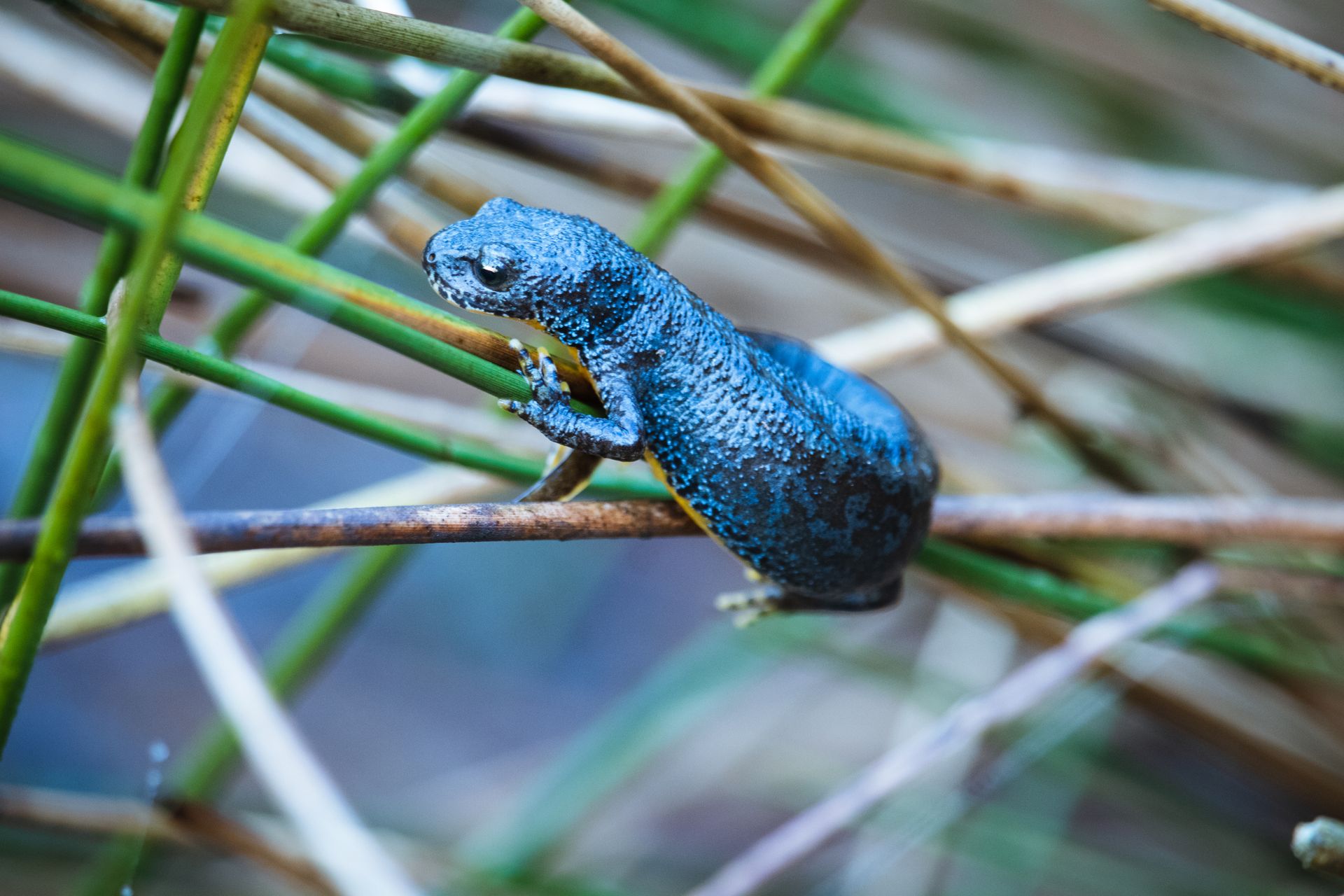
They have distinctive markings, with bluish-black skin featuring blue and white flecks on their back and bluish-white spots on their sides and tail.
Males tend to be smaller than females, and they have longer, flattened tails.
Description
Blue-spotted salamanders typically range in length from 10 to 14 cm, with the tail making up 40% of their total body length.
Males are generally smaller than females, with males being slightly shorter in length.
Their skin is a bluish-black color with characteristic blue and white flecks on their back and bluish-white spots on their sides and tail.
The vent is typically black, which contrasts with the paler belly of these salamanders.
Larvae that have transformed may have yellow splotches, which turn blue once they become terrestrial.
Blue-spotted salamanders have long toes, with four on their front feet and five on their hind feet.
Specimens typically have 12-14 costal grooves.
They have a unique appearance, with elongated bodies and distinctive markings.
Are Salamanders Poisonous?
Salamanders have smooth, moist skin that produces mucous as protection. This mucous carries toxins that can cause swelling and irritation if it comes into contact with human eyes.
Dogs often have a reaction if they chew on or eat a salamander. Younger salamanders produce more toxins than older ones.
Salamander Behavior
Eli Bieri, a freshman at Northern Michigan University, noticed that the blue spotted salamander was disappearing during its spring mating season.
Most people didn't even know they were there, but Eli was happy to share in the magic of their migration.
As part of his research project, Eli observed the blue spotted salamander's migration, which is a crucial part of their life cycle.
The city of Marquette now hosts a Blue Spotted Salamander Festival, which was spearheaded by local Dan Barrington, and features hikes, an art show, and a brewery with a salamander-themed beer.
Habitat
Blue-spotted salamanders are primarily found in moist, deciduous hardwood forests and swampy woodlands with sandy soil.
They can also be found in coniferous forests and fields, showing their adaptability to different environments.
Underbrush, leaf litter, rocks, and logs are commonly used by blue-spotted salamanders for shelter.
Their preference for vernal pools that retain water into mid-summer is crucial for breeding, highlighting the importance of suitable breeding habitats.
Blue-spotted salamanders are philopatric, meaning they tend to stay in their native habitats, making them dependent on the availability of ephemeral pools.
Habitat loss is a significant threat to blue-spotted salamanders, as studies have shown.
Do Salamanders Bite?
Salamanders will bite if they feel threatened. They have a mouthful of teeth, with a range of 55-78, which can cause an uncomfortable nip.
Their bite may be harmless, but it's still a defensive mechanism they use to protect themselves. Salamanders do not carry any venom, so you don't have to worry about a serious reaction.
It's worth noting that salamanders are generally not aggressive, and they prefer to avoid confrontations whenever possible.
Salamander Diet and Reproduction
Blue-spotted salamanders don't have a complex diet, they primarily feed on small invertebrates like insects and worms.
They have a unique mating process where the male deposits a spermatophore, a packet of sperm, which the female must be in close proximity to in order to fertilize her eggs.
Breeding typically occurs in early spring near vernal pools, and females can lay up to 500 eggs yearly, with clutches averaging a dozen eggs.
Eggs take about a month to hatch, and at hatching, larvae have a well-developed mouth and eyes, as well as external gills and broad tail fins.
The larvae live underwater until they transform into the terrestrial form of the salamander, which usually happens by late summer.
Salamander Diet
Salamanders are considered helpful for yards and gardens because they eat a variety of insects, slugs, worms, and other small invertebrates.
They're like little pest control agents, helping to keep your garden healthy and bug-free.
Salamanders have a diverse diet that includes insects and other small invertebrates, making them a valuable asset to any garden or yard.
Reproduction
Blue-spotted salamanders mate through a unique process involving spermatophores, which are packets of sperm deposited by the male.
The male takes hold of the female and rubs her head with his chin to initiate reproduction. This positioning is crucial for the female to fertilize her eggs with the sperm in the spermatophore.
A clutch of eggs can average a dozen, but females may lay up to 500 eggs yearly. They lay these eggs in small agglomerations attached to twigs, rocks, or plants at the edge of a woodland pond or ditch.
Eggs take about one month to hatch, and at hatching, larvae have a well-developed mouth and eyes, as well as external gills and broad tail fins. They also have a more neutral coloring, such as browns, greens, and grays.
On a similar theme: Male Blue Heeler
Front limbs form at two weeks, and hind limbs form at three weeks. This transformation is a crucial step in the larvae's development before they transform into the terrestrial form of the salamander.
The spots on the salamander will also change, turning from yellow to blue as they mature. This transformation typically occurs by late summer, when the salamander has fully transformed to its terrestrial state.
Interestingly, blue-spotted salamanders are associated with unisexual populations of ancient origin. These females often look like blue-spotted salamanders but have hybrid genomes and require sperm from a co-occurring, related species to fertilize their eggs.
Salamander Conservation
Michigan's Presque Isle Park is a haven for blue-spotted salamanders, but they face a major threat: road traffic.
Every spring, thousands of salamanders cross the park's lone road to mate and lay eggs, and unfortunately, many are squished by cars.
In 2019, a biology student counted 429 road-killed salamanders on that stretch of Peter White Drive, which is about 10% to 20% of the park's blue-spotted salamander population.
To mitigate this issue, the park has temporarily closed the road to evening and overnight vehicular traffic, and the result has been impressive: only three road-killed salamanders were counted the following year.
Geographic Range
Blue-spotted salamanders can be found in the northeastern parts of North America.
They inhabit large populations in New England, particularly in the United States.
The Great Lakes in Michigan mark the westernmost edge of their geographic range.
Up into the eastern provinces of Canada, blue-spotted salamanders can also be found.
Donato (2000) and Gilhen (1974) have documented these distribution patterns.
The Salamander Advocate – Eli Bieri
Eli Bieri, a biology student at Northern Michigan University, noticed the demise of the blue spotted salamander during their spring mating season. He started a research project about the Blue Spotted Salamander's migration, counting thousands of salamanders crossing the street in one night.
Eli's research found that 429 salamanders were road-killed on Peter White Drive in the spring of 2019, which is 10% to 20% of the park's blue-spotted salamander population. This alarming number risks permanently depleting the park's population.
Eli's efforts led to the temporary closure of a road in Presque Isle Park to help the salamanders migrate safely. The result was only three road-killed salamanders, which were likely from bicycles or people inadvertently stepping on them.
Eli has since moved on to new projects, but his work on blue spotted salamanders has had a lasting impact. The city of Marquette now hosts a Blue Spotted Salamander Festival, which was spearheaded by local Dan Barrington and his friend Elizabeth "Puck" Bates.
Eli's passion for salamander conservation is inspiring, and his work has shown that even small actions can make a big difference.
Salamander Identification and Classification
The blue-spotted salamander is a member of the Ambystoma genus, which is a group of aquatic salamanders found in North America.
These salamanders have a distinctive appearance, with a brown or grayish-brown color and blue spots on their back.
In Michigan, the blue-spotted salamander is a relatively small species, typically growing to about 4-6 inches in length.
Their bodies are slender and elongated, with a rounded head and a short, broad tail.
The blue-spotted salamander has a unique life cycle, starting as eggs laid in water, then hatching into aquatic larvae that breathe through gills.
As they mature, they undergo metamorphosis and develop lungs, allowing them to live on land.
In Michigan, the blue-spotted salamander is typically found in aquatic environments, such as ponds, lakes, and slow-moving streams.
They tend to congregate in areas with still or slow-moving water, often near vegetation or submerged logs.
Frequently Asked Questions
Is the blue-spotted salamander poisonous?
No, the blue-spotted salamander is not venomous, but its skin is poisonous and can cause irritation if not handled properly. Wash hands thoroughly after contact to avoid any potential issues.
Is it OK to touch a spotted salamander?
No, it's not recommended to touch a spotted salamander, as the oils and lotions on human skin can harm them. If you need to handle them, wet your hands first to minimize the risk.
Featured Images: pexels.com