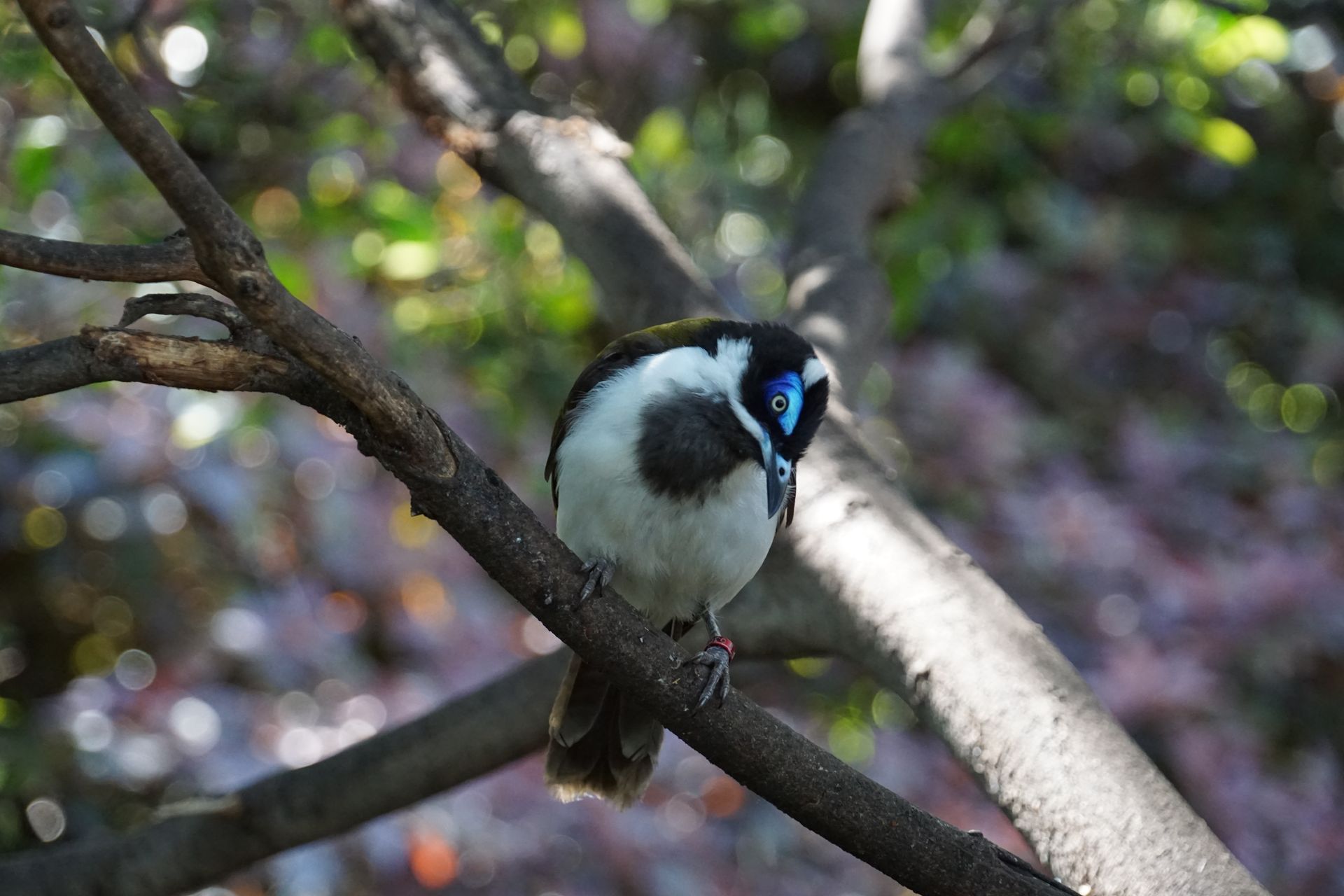
The Blue Faced Honeyeater is a stunning bird native to Australia. They have a distinctive blue patch on their face, which is where they get their name.
These birds are known for their bold and curious nature, often approaching humans for food. They're not afraid to get up close and personal.
In the wild, Blue Faced Honeyeaters can be found in urban and rural areas, particularly in woodlands and gardens with flowering trees. They love nectar-rich flowers, which are a great source of food for them.
They're social birds that often travel in small groups, searching for food and potential mates.
Intriguing read: Blue Cardinal Birds
Taxonomy and Naming
The blue faced honeyeater's taxonomy is quite fascinating. It's a member of the Meliphagidae family, which is a group of birds commonly known as honeyeaters.
These birds are found in the tropical and subtropical regions of Australia, specifically in the northern and eastern parts of the country. The blue faced honeyeater is native to the rainforests and woodlands of these areas.
Its scientific name, Entomyzon cyanotis, is derived from the Greek words "entos", meaning "within", "myza", meaning "to masticate", and "cyanotis", meaning "blue-faced."
Description and Habitat
The blue-faced honeyeater is a large bird, ranging from 26 to 32 cm in length, with a wingspan of 44 cm.
These birds have a distinctive appearance, with broad wings and a medium-sized squarish tail. Their sturdy, slightly downcurved bill is shorter than the skull, measuring 3 to 3.5 cm in length.
The blue-faced honeyeater is easily recognizable by the bare blue skin around its eyes, which is a striking feature. The head and throat are predominantly blackish, with a white stripe around the nape and another from the cheek.
In terms of habitat, these birds are found in tropical, sub-tropical, and wetter temperate or semi-arid zones. They are often seen in open forests and woodlands close to water, as well as monsoon forests, mangroves, and coastal heathlands.
The blue-faced honeyeater is also known to inhabit banana plantations, orchards, farmlands, and urban parks, gardens, and golf courses. It's not uncommon to see them in these areas, especially in tropical regions where they're known as the "banana-bird".
Description
The blue-faced honeyeater is a large bird, ranging from 26 to 32 cm in length, with a wingspan of 44 cm. It weighs around 105 g and has a sturdy, slightly downcurved bill.
Its plumage is predominantly blackish with a white stripe around the nape and another from the cheek. The upperparts, including the mantle, back, and wings, are a golden-olive colour.
The underparts are white, and the bird is easily recognised by the bare blue skin around its eyes. The head and throat are otherwise blackish.
Juvenile birds have a grey head, chin, and central parts of their breasts, with brown upperparts, and otherwise white underparts. After their next moult, they more closely resemble adults.
The blue-faced honeyeater has a distinctive blue facial patch, which is usually greenish in birds six months and older. This patch turns darker blue beneath the eye before assuming the adult blue facial patch by around 16 months of age.
A unique perspective: White Blue Heeler Puppy
Habitat
The Blue-faced Honeyeater is found in tropical, sub-tropical and wetter temperate or semi-arid zones. It's a pretty diverse range of habitats.
It's mostly found in open forests and woodlands close to water. I've seen them flitting around the edges of rivers and lakes in these types of areas.
Monsoon forests, mangroves and coastal heathlands are also home to this bird. These are unique ecosystems that support a wide variety of plant and animal life.
The Blue-faced Honeyeater is often seen in banana plantations, orchards, farm lands and in urban parks, gardens and golf courses. It's not uncommon to spot them in these areas, especially if there are fruit trees or flowers around.
In Australia, this species can be found in northern and eastern mainland Australia, from the Kimberley region, Western Australia to near Adelaide, South Australia. It's also found in Papua New Guinea.
It's worth noting that the Blue-faced Honeyeater is considered sedentary in the north of its range, and locally nomadic in the south. This means that some populations may stay in one area year-round, while others may make seasonal movements.
Breeding and Feeding
The blue-faced honeyeater is a fascinating bird species that thrives in various environments. They breed throughout their range, with the breeding season spanning from June to January.
They typically raise one or two broods during this time, with the female alone incubating the eggs for 16 or 17 days. The chicks are altricial, born blind and covered in sparse brown down, but they develop quickly, opening their eyes by four days and growing pin feathers from their wings by day six.
Both parents feed the young, and sometimes they receive assistance from helper birds. The Pacific koel and pallid cuckoo have been known to be brood parasites, while the laughing kookaburra preys on broods.
Their diet consists mainly of insects, which they catch by sallying, probing, or gleaning. They also consume plant material, such as pollen, berries, and nectar, from various sources, including cultivated crops like grapes.
In particular, the birds prefer feeding at cup-shaped sources, like flowers or brush-shaped inflorescences. They're known to be inquisitive and friendly, often invading campsites in search of edible items.
Here are some key facts about the breeding and feeding habits of the blue-faced honeyeater:
- Breeding season: June to January
- Clutch size: Two, rarely three
- Incubation: 16 days
Breeding

The breeding habits of the blue-faced honeyeater are quite fascinating. They probably breed throughout their range, with a breeding season that spans from June to January.
One or two broods are raised during this time, and the nest is an untidy, deep bowl of sticks and bits of bark in the fork of a tree. They often renovate and use the old nests of other species, like the grey-crowned babbler, noisy miner, and red wattlebird.
The female blue-faced honeyeater lays two or, rarely, three eggs, which are 22 × 32 mm in size and buff-pink splotched with red-brown or purplish colours. The female alone incubates the eggs over a period of 16 or 17 days.
The chicks are altricial, meaning they're born blind and covered only by sparse tufts of brown down on their backs, shoulders, and parts of the wings. By four days, they open their eyes, and pin feathers emerge from their wings on day six.
Intriguing read: Brown Blue Heeler

Both parents feed the young, and are sometimes assisted by helper birds. The Pacific koel and pallid cuckoo have been recorded as brood parasites of the blue-faced honeyeater, and the laughing kookaburra has been recorded as preying on broods.
Here's a summary of the breeding season and clutch size:
- Breeding season: June to February
- Clutch size: Two, rarely three
- Incubation: 16 days
Feeding and Diet
Blue-faced Honeyeaters are generally found foraging in small groups of up to seven birds, occasionally forming larger flocks of up to 30 individuals.
Their diet consists mainly of insects, including cockroaches, termites, and various types of beetles, as well as flies, moths, bees, ants, and spiders. They also catch small lizards.
In addition to insects, they eat plant material like pollen, berries, and nectar from native plants such as grasstrees and scarlet gum. Cultivated crops like grapes are also a favorite.
These birds tend to prefer feeding at cup-shaped sources like flowers, followed by brush-shaped inflorescences like banksias or melaleucas. They're very inquisitive and friendly, often invading campsites in search of edible items.
Parent birds feed their young on insects, fruit, and nectar, and have even been recorded regurgitating milk to them.
In The Wild
Blue-faced honeyeaters mainly eat insects, nectar, and fruit, and they're often found near banana plantations, orchards, and farmlands, earning them the nickname "banana bird".
They form groups to forage for food together, and their diet includes cockroaches, beetles, and grasshoppers found amongst the branches and foliage of the forest.
In the wild, they live in forests, open woodland, and wet areas, mainly in the north and east of Australia.
They breed in groups and form breeding pairs, with young from previous clutches sometimes helping to feed new chicks.
Their breeding season runs from June to February, and a clutch of eggs contains two or, more rarely, three eggs.
Incubation is approximately 16-17 days, after which both parents feed the chicks, and older siblings may help feed the hatchlings.
Young blue-faced honeyeaters stay in the nest for around 23 days before fledging.
Frequently Asked Questions
How long do blue-faced honeyeaters live?
Blue-faced honeyeaters typically live for up to 10 years in the wild. Their lifespan can vary depending on various factors, including habitat and diet.
What bird has blue around its eyes?
The Blue-faced Honeyeater has a distinctive large bright blue patch around its eyes, which changes color from yellow to green to blue as the bird matures. This striking feature makes the Blue-faced Honeyeater instantly recognizable.
Featured Images: pexels.com