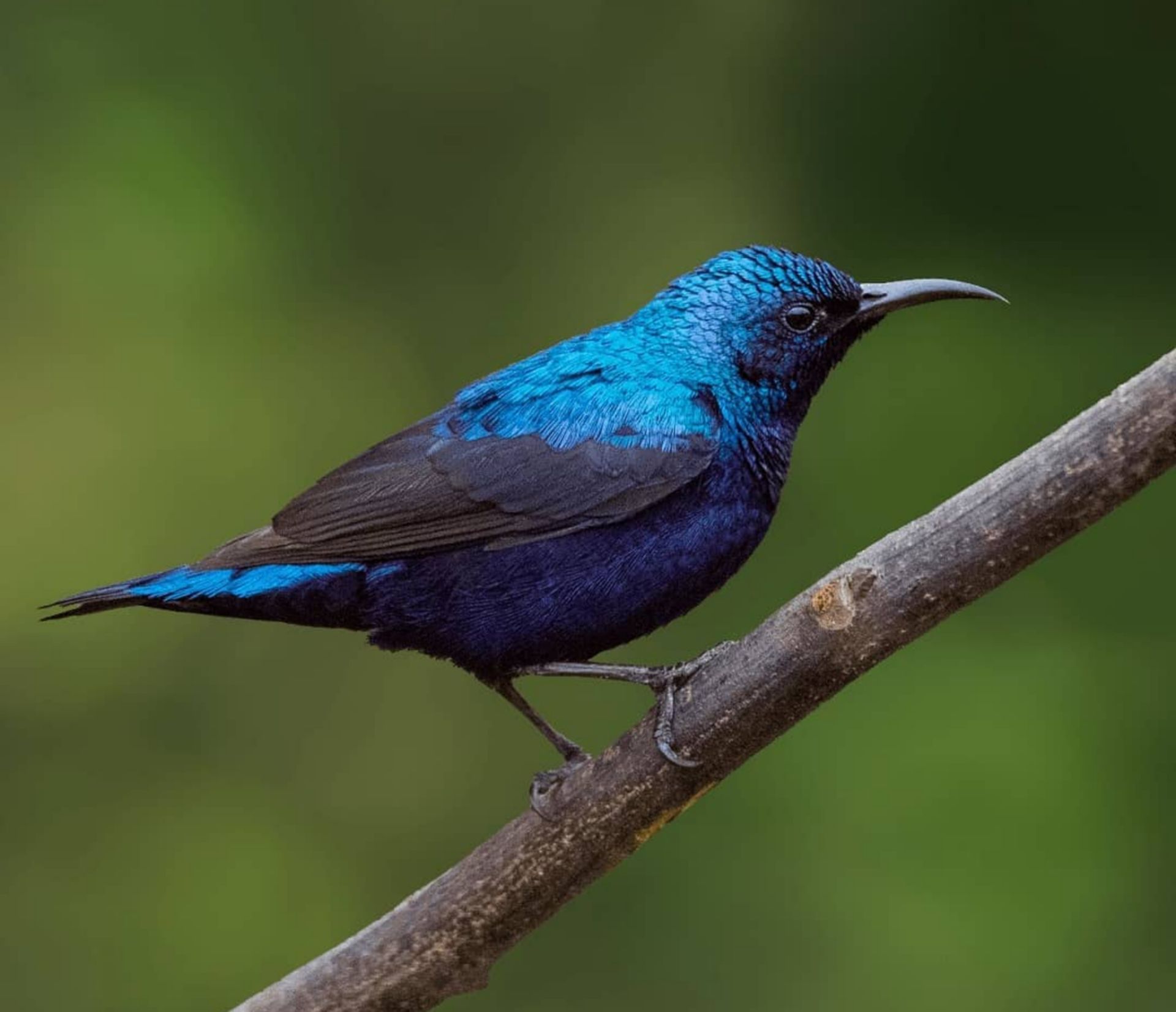
The Black Chinned Hummingbird is a small but mighty bird, weighing in at just 0.2 ounces.
They are found in the southwestern United States and Mexico, where they inhabit scrublands, deserts, and backyards with nectar-rich flowers.
These birds are known for their distinctive black throat patch, which gives them their name and makes them easily identifiable.
They are social birds and can often be seen in pairs or small groups, flitting from flower to flower in search of food.
Physical Description
The black-chinned hummingbird is a tiny bird, weighing between 2.7 to 4.2 grams. Their wingspan can range from 40 to 49 mm, making them incredibly agile in flight.
One of the most distinctive features of the black-chinned hummingbird is their straight bill. Adult males have a black face and chin, with a metallic purple throat patch that shines in the light. Females, on the other hand, have a duller, bronze-green face and throat.
Black-chinned hummingbirds are also known for their iridescent feathers, which appear to change color depending on the angle of the light. Males have a bronze-green back, while females and juveniles have a green iridescent back as well.
The throat patch of a hummingbird is called a gorget, and in the case of the black-chinned hummingbird, it's a black patch with a purple lower band. This can be a helpful identification point, especially in low-light conditions.
Here are some key physical features of the black-chinned hummingbird:
- Weight: 2.7 to 4.2 grams
- Wingspan: 40 to 49 mm
- Bilateral symmetry
- Endothermic and homoiothermic
In terms of size, the black-chinned hummingbird is approximately 8.25 cm (3.25 in) long. They have a long, straight, and slender bill, with a dark forked tail in adults and a rounded tail with white tips in females.
It's worth noting that young black-chinned hummingbirds are born almost featherless, but grow a complete set of feathers within three weeks of hatching. They begin replacing their feathers in November after migrating for the winter, and have a completely new set of feathers before their first year of age.
Distribution and Habitat
Black-chinned Hummingbirds are found in most of the western United States, reaching north into Canada in Alberta and British Columbia, east to Oklahoma, and as far south as Mexico.
They can be found in a variety of habitats, including mountains, woodlands, orchards, meadows, and chaparral. The males and females of this species use different habitats from one another for breeding territories.
Black-chinned Hummingbirds are highly adaptable and live in a range of habitats, including arid canyons, high mountains, scrublands, forests, and woodlands, and along rivers.
In addition to these natural habitats, they will also nest in urban and suburban areas if they are offered tall trees and flowering shrubs and vines.
Here are some common habitats where Black-chinned Hummingbirds are found:
- Arid canyons
- High mountains
- Scrublands
- Forests
- Woodlands
- Along rivers
- Urban and suburban areas
Black-chinned Hummingbird females build their nests at various heights, often fairly low (4-8 feet from the ground) but can be as high as 30 feet.
Behavior and Diet
Black-chinned Hummingbirds are skilled at catching small insects in flight, and they can even pluck them from leaves while hovering in mid-air.
They eat a variety of insects, including those suspended in spider webs, which they'll readily catch and eat.
In cold weather, Black-chinned Hummingbirds may consume up to three times their body weight in nectar per day, but they can survive without nectar if there's an ample supply of insects.
It's also worth noting that they'll eat spiders themselves, which sometimes get caught in the air on fine threads.
Hummingbird Diet
Black-chinned Hummingbirds eat a variety of foods, including nectar from flowers, small insects, spiders, and sugar water in feeders. They can consume up to three times their body weight in nectar per day.
In cold weather, they may rely more heavily on nectar, but they can survive without it if there's an ample supply of insects. They catch small insects in flight or hover and pluck them from leaves.
Spiders are also on the menu, and hummingbirds will catch and eat them, even if they're suspended on fine threads in the air. They'll also take insects trapped in spider webs.
If you want to attract hummingbirds to your yard, consider planting native flowers that provide nectar. This can reduce the need for sugar water feeders, which should be cleaned frequently to prevent mold from growing.
Hummingbird Sounds
Black-chinned Hummingbirds are known for their distinctive sounds, which can be a great way to identify them. Their calls and wingbeats produce a unique sound that's often heard.
Their song is described as "warbling" and "high-pitched", but it's worth noting that there have only been two reports of a male Black-chinned Hummingbird singing.
You can listen to some of their sounds on the xeno-canto website, where you can also find more vocalizations of the Black-chinned Hummingbird.
Conservation and Ecology
Black-chinned hummingbirds are listed as a species of "Least Concern" on the IUCN Red List, but are protected under the US Migratory Bird Act.
The US Migratory Bird Act makes it illegal to possess, import, export, or sell deceased hummingbirds, their parts, nests, or eggs without a valid permit. This is a crucial step in conserving these beautiful birds.
Loss of local habitat is a significant problem for black-chinned hummingbirds, but efforts are being made to protect natural riparian habitats. In Mexico, researchers are investigating the size of breeding and wintering habitats to better understand the needs of this species.
Here are some key conservation statuses of the black-chinned hummingbird:
- IUCN Red List: Least Concern
- US Migratory Bird Act: Protected
- US Federal List: No special status
- CITES: Appendix II
In addition to habitat loss, threats to black-chinned hummingbirds include candidiasis, a yeast infection that can destroy their tongues and bill tips.
Conservation Status
The conservation status of black-chinned hummingbirds is a topic of interest. They are listed as a species of "Least Concern" on the IUCN Red List.
However, they are protected under the US Migratory Bird Act, which makes it illegal to possess, import, export, or sell deceased hummingbirds, their parts, nests, or eggs except with a valid permit. The US Federal List does not give them any special status.
Trade is a controlled threat, thanks to CITES, which lists black-chinned hummingbirds in Appendix II. This means that while they are not threatened with extinction, trade must be regulated.
One major threat to their populations is a yeast infection called candidiasis, which can destroy their tongues and bill tips. Loss of local habitat is also a problem, but efforts are being made to protect natural riparian habitats.
Here's a summary of their conservation status:
- IUCN Red List: Least Concern
- US Migratory Bird Act: Protected
- US Federal List: No special status
- CITES: Appendix II
Ecological Role
Black-chinned Hummingbirds play a vital role in pollination, and they've got a sweet deal with certain plants. They forage on desert honeysuckle, larkspur, and thistle, which benefits both the birds and the plants.
These plants have adapted to rely on hummingbirds for pollination, just like bees do with flowers. It's a win-win situation for both parties.
Roadrunners, jays, orioles, and tanagers are just a few of the birds that see Black-chinned Hummingbirds as a meal. They're predators that can threaten the hummingbirds' survival.
Find This Bird
If you're trying to spot a Black-chinned Hummingbird in the wild, listen for its distinctive humming wings, which can be a dead giveaway of its presence.
These birds often perch on tiny bare branches at the tops of dead or live trees, so keep an eye out for them in these areas.
After a feeding bout, Black-chinned Hummingbirds tend to return to a favorite perch, making it easier to track them down.
They can be quite tricky to follow as they dart and weave among flowering shrubs and insect swarms, but their return to a favorite perch can provide a welcome break in the chase.
Frequently Asked Questions
How can you tell a ruby throat from a Black-chinned Hummingbird?
To tell a Ruby-throated Hummingbird from a Black-chinned Hummingbird, look for a longer tail extending beyond the wingtips in Ruby-throated Hummingbirds, while Black-chinned Hummingbirds have longer wings that almost or slightly surpass the tail. Source: [www.allaboutbirds.org](http://www.allaboutbirds.org)
How do you tell the difference between male and female Black-chinned Hummingbirds?
To identify a male Black-chinned Hummingbird, look for a velvety black throat with a thin, iridescent purple base. Females can be distinguished by their pale throat and white-tipped outer tail feathers.
Featured Images: pexels.com