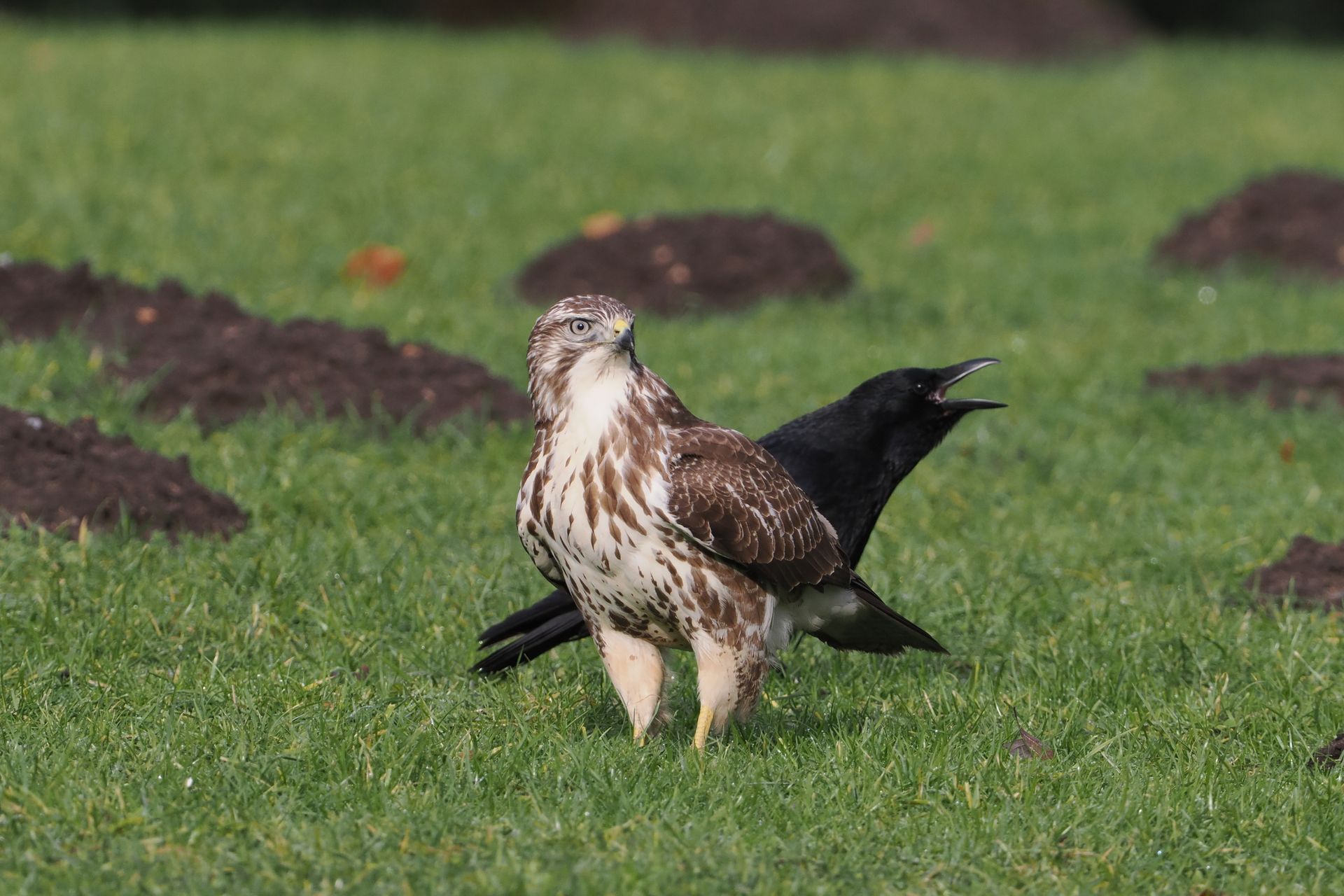
The Black Breasted Buzzard is a fascinating bird of prey that's native to Australia. It's a medium-sized raptor with a distinctive black plumage and a broad wingspan.
One of its most notable characteristics is its unique appearance, with a black back and wings, and a pale underside. This coloration helps the bird blend in with its surroundings.
In terms of size, the Black Breasted Buzzard is relatively small, measuring around 55-60 cm in length. Its broad wingspan, however, allows it to soar for long periods of time.
These birds are known for their impressive hunting skills, using their sharp talons and hooked beaks to catch small mammals and reptiles.
Habitat and Distribution
The black-breasted buzzard is a bird that's well adapted to life in the dry, open spaces of inland Australia. It's found in areas with less than 500 mm annual rainfall, which is a key factor in its limited distribution.
The buzzard's range stretches from north-eastern South Australia to northern Queensland, the Northern Territory, and the north-western corner of Western Australia. It's a wide but sparsely distributed area.
In terms of specific habitats, the black-breasted buzzard is most commonly observed in riparian forests and tall-open woodlands surrounded by mid-dense shrublands. This type of habitat provides the perfect balance of shelter and open space.
The buzzard has a significant preference for River Red Gum open woodland, which is a common feature of the central Australian landscape. This is where you'll often find them soaring overhead or perched in a tree.
You can spot black-breasted buzzards in lightly timbered plains, open country, and tree-lined waterways throughout inland Australia and in semi-arid or arid regions.
Conservation and Status
The black-breasted buzzard is listed as Vulnerable in New South Wales and Rare in South Australia.
Conservation efforts are crucial for the survival of this species, with a significant decline in Australian raptor species since European settlement in the late 1700s.
The global population estimate for the black-breasted buzzard is uncertain, varying between 1000–10,000 individuals.
Historic records indicate the black-breasted buzzard became extinct in some areas of its former range by as early as the 1930s.
Causes of population declines in raptor species of the arid and semi-arid regions of Australia include broad-scale landscape changes due to extensive pastoralism and clearing of native vegetation.
Overgrazing by stock, feral animals, and increased kangaroo populations have also contributed to the decline of the black-breasted buzzard.
The introduction of destructive feral predators such as the house cat and red fox has further threatened the species.
Inadvertent poisoning of raptors through ingestion of prey killed by toxins is a well-known threat to raptor species worldwide and a likely contributor to their decline in Australia.
Climate change leading to increased periods of drought in the arid and semi-arid areas of Australia is a concern for the survival of many raptor species, including the black-breasted buzzard.
A program of landscape conservation that engages all land managers and stakeholders and includes the protection of existing habitat and revegetation of lost habitat, is considered the first step in protecting the black-breasted buzzard.
Behavior and Diet
The Black-breasted Buzzard is a skilled hunter, known for its ability to crack eggs with its bill, and even uses a small rock to break open larger eggs.
This raptor is a common sight in its range, soaring high and gliding low in search of prey, which includes ground birds, lizards, rabbits, and carrion.
The Black-breasted Buzzard's diet consists of small and large animals, and it's not picky about where it finds its food, snatching it from the ground, trees, or even in the air while gliding at speed.
Its wingspan can reach up to 1.5 meters, allowing it to cover a lot of ground and spot potential prey from a distance.
The Black-breasted Buzzard's unique hunting style involves soaring high and then gliding low to snatch prey from the ground or trees, making it a formidable hunter in its environment.
Feeding and Diet
The Black-breasted Buzzard is a skilled hunter, using its impressive wingspan to soar high and glide low in search of prey. It's not uncommon to see them swooping down to snatch food from the ground, from trees, or even in the air.
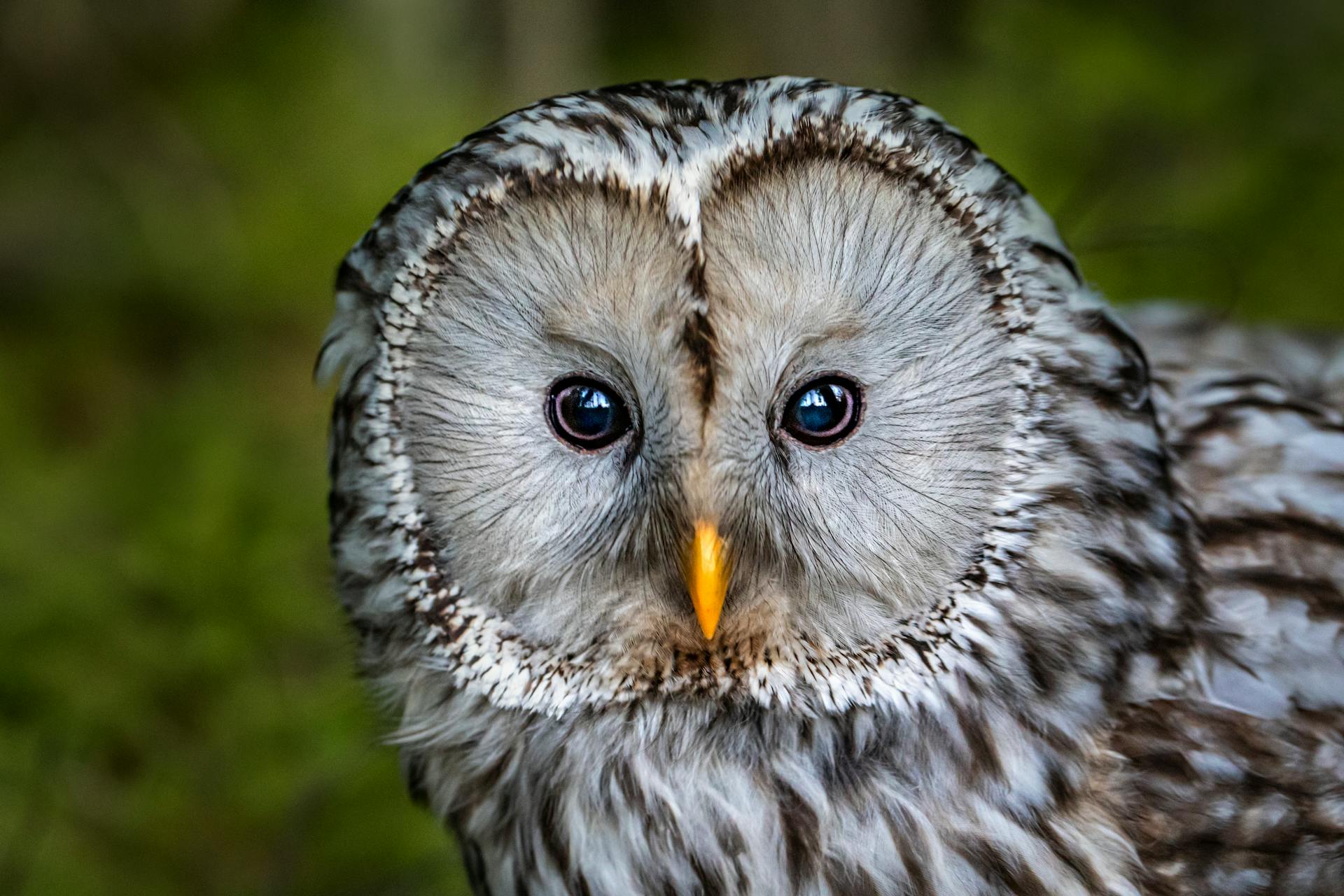
They primarily feed on rabbits, ground birds, lizards, and carrion, which they can spot from a distance thanks to their sharp eyesight. This raptor's diet is quite diverse, reflecting the varied landscape of its native Australia.
One of the most fascinating aspects of the Black-breasted Buzzard's feeding behavior is its use of stones to crack open eggs. They'll pick up a small rock and hurl it at the egg until it breaks open, allowing them to access the contents.
To give you a better idea of their diet, here's a breakdown of their typical prey:
By adapting to its environment and making use of its unique skills, the Black-breasted Buzzard has become a successful and widespread hunter in the Australian landscape.
Breeding Behaviours
Black-breasted Buzzards are fascinating birds, and their breeding habits are quite unique. They breed throughout their range, but rarely east of about longitude 148 degrees.
Their breeding season varies depending on the location, with birds in the south and centre breeding from August to September, and those in the north breeding from May to July.
The female Black-breasted Buzzard lays two eggs, which both parents take turns incubating for 40 days.
After the eggs hatch, the young birds stay in the nest for about 60 days, relying on their parents for food and protection.
Classification and Identification
The Black-breasted Buzzard is a large dark raptor with a very short, square-tipped tail.
Females are larger than males, and they can weigh up to 1,330 grams, while males weigh around 1,196 grams.
This species is striking in appearance, with a mainly black colouring on the underside and white panels near the end of the wings.
The Black-breasted Buzzard has a wingspan of 141 to 156 centimeters, making it a distinctive sight in flight.
Birds in the immature and juvenile phases of growth display pale brown colouring, with dark to black streaks increasing with age.
Adult birds may be individually identified during flight by broken or missing flight feathers, or when perched closely together by subtle differences in the red of the back and shoulders.
The Black-breasted Buzzard is also known as the Black-breasted Kite, due to its kite-like appearance in flight.
Its call is a repeated hoarse yelping or short sharp yap or yelp, which can be heard in the wild.
Featured Images: pexels.com