Black birds are a diverse group of birds that can be found in many parts of the world. They come in a wide range of sizes and shapes, from the small and agile to the large and majestic.
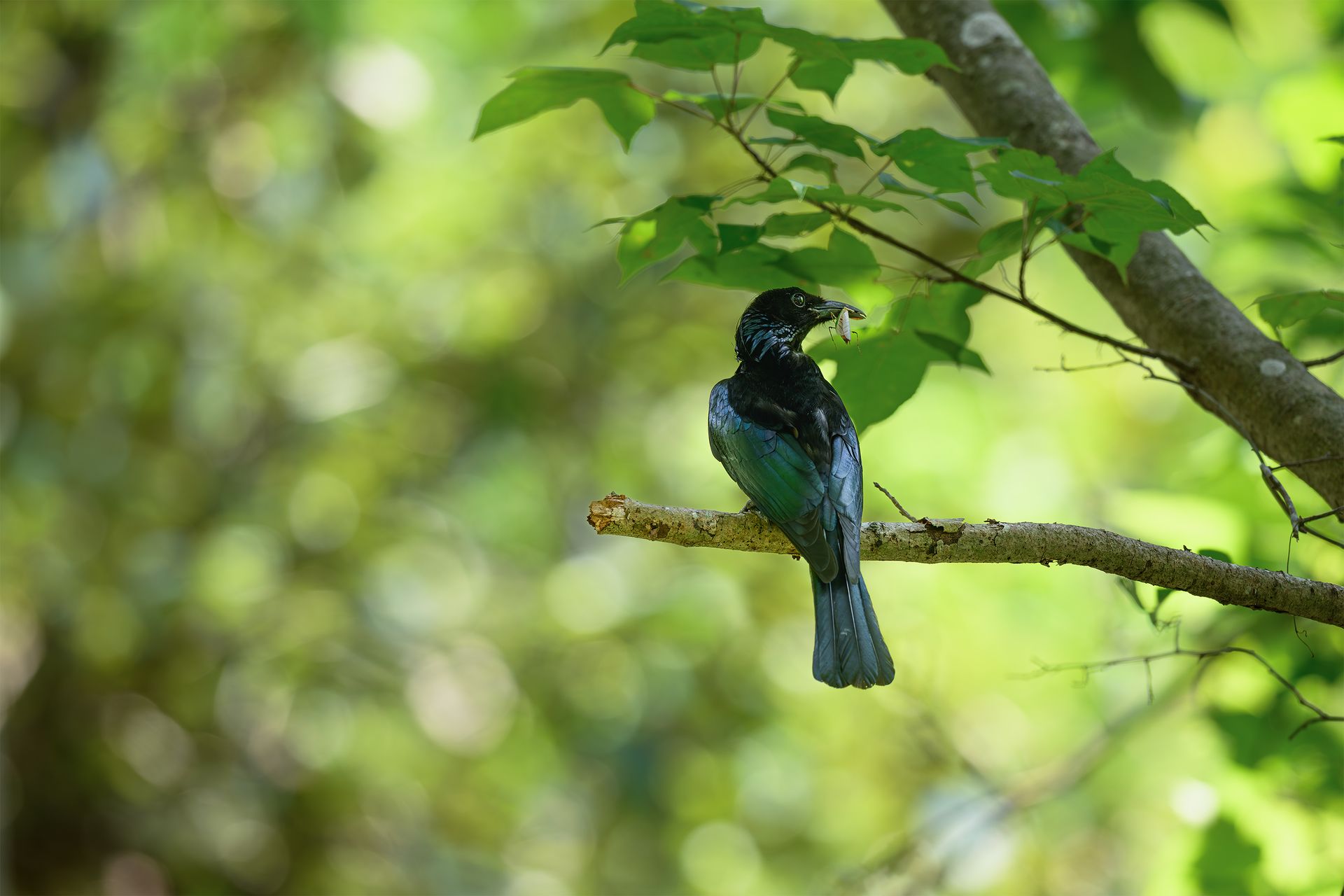
One of the most distinctive features of black birds is their glossy feathers, which can appear to be black, blue, or purple in different lighting conditions. The glossy feathers are a result of the structure of the bird's feathers, which refract light and give them a shiny appearance.
Some black birds are known for their bright yellow or orange beaks, which can be a striking contrast to their dark plumage. The bright beaks are often used for foraging and eating, and can be a key factor in a bird's ability to survive and thrive.
The American Crow is a common black bird species found in North America, known for its intelligence and problem-solving abilities.
Physical Characteristics
Identifying black birds can be tricky, but one of the most effective ways to start is by observing their physical characteristics.
Size and shape are crucial factors to consider. A bird is often too distant or silhouetted to accurately make out any details, so it's best to start with these basics.
A bird's size can help rule out certain species. For example, if you're trying to identify a black bird, observing that it's larger than a Northern Cardinal can help you narrow down the possibilities.
The length of the tail or beak is also an important factor. Observe the size and length of these features to get a better idea of the bird's identity.
By comparing the size of the bird in question to birds you're already familiar with, you can start to eliminate possibilities and get a better sense of what you're looking at.
Habitat and Behavior
In the US, black birds can be found in various habitats, including suburban areas, forested areas, fields, and open spaces. Some species, like Common Grackles, European Starlings, and American Crows, are more likely to be spotted near urban or suburban settlements.
These birds can be found in different parts of the country, but their ranges vary. For example, Common Grackles are not usually seen in the Western United States, and Common Ravens are not generally found in the East.
Be aware of your locational bias when birding out-of-town, as some birds may not be present in areas you're familiar with.
Habitat
Birds can be found in a variety of habitats, including urban and suburban areas, forests, fields, and open spaces.
Some birds, like Common Grackles, European Starlings, and American Crows, are more likely to be spotted near urban or suburban settlements.
Be aware of your locational bias when birding out-of-town, as birds that are common in your region may not be present in other areas.
Common Grackles, for example, are not usually seen in the Western United States.
Common Ravens, on the other hand, are not generally found in the East.
Some birds, like the European Starlings, can be found in open habitats such as coastal scrub, grasslands, fields, meadows, lawns, golf courses, parks, and city streets.
This means that you can spot them in a wide range of environments, from rural areas to urban centers.
Bird Sounds
Birds can be quite loud, especially the blackbird, which makes very loud calls that involve various clucking and rattling sounds.
Male blackbirds are known for their distinctive song, a fluty, melodic whistle that can be heard after dark under artificial light.
In fact, the blackbird's song is so distinctive that it's often confused with other night singers like nightingales, robins, and song thrushes.
Blackbird Species
The Blackbird species is a fascinating one. The scientific name of the blackbird is Turdus merula, which comes from Latin, with "Turdus" meaning thrush and "merula" meaning 'the blackbird'.
In fact, the term "blackbird" refers to a specific species, but it's worth noting that there are other birds with similar names, such as the Red-winged Blackbird, which has the scientific name Agelaius phoeniceus.
The Red-winged Blackbird is listed as being of Least Concern status, and is part of the Icteridae family.
A fresh viewpoint: Bird Identification Chart
Red-winged (Agelaius Phoeniceus)
The Red-winged Blackbird is a bird species that's part of the Icteridae family. One of the notable things about this species is that it's listed as being of Least Concern status.
The Red-winged Blackbird is a species that's often found in wetlands and fields, where it can be seen foraging for food.
American Crow
The American Crow is one of the most well-known black birds in the world, and it's incredibly common, found all over the place.
They are very intelligent birds, and although they aren't quite as large as ravens, they still have a very prominent presence.
American Crows will eat practically anything, from seeds and fish all the way to human trash.
They are well-known for how well they have adapted to human areas, and some are even known to befriend humans, too!
In fact, they are so adaptable that they can thrive in a variety of environments, including agricultural areas and even cemeteries, just like the Common Grackle.
Vulture (Coragyps atratus)
The American Black Vulture, also known as the Black Vulture, is a type of black bird found in the eastern, southern, and southwestern continental United States.
These birds are quite distinctive in appearance, and you can often spot them close by Turkey Vultures.
They're also one of the more aggressive types of vultures, so it's a good idea to keep your distance.
The Black Vulture can be found in southern and eastern parts of the U.S., but it's worth noting that it's not exclusive to North America, as it can also be found in South America.
If you're out and about and see some black birds, keep your eyes peeled to see if you can spot one of these vultures for yourself!
Euphagus Carolinus
The Rusty Blackbird, scientifically known as Euphagus carolinus, is a vulnerable species.
It's found predominantly in the eastern and northern continental United States and throughout Canada.
These birds can also be spotted on the Pacific west coast, specifically from California to Washington.
Their range extends further north, all the way to northern Alaska on the Pacific west coast.
Oystercatcher (Haematopus Bachmani)
The Black Oystercatcher is a fascinating bird species that's worth getting to know.
It's found along the Pacific west coast from California to Washington and west around to Alaska.
These birds are quite adaptable, thriving in a variety of coastal habitats, including rocky shores and beaches.
Their distinctive black plumage is a striking feature, making them easy to spot in their natural habitat.
You might be able to catch a glimpse of one of these birds while exploring the coastline, particularly during low tide when they're foraging for food.
Common Raven
The Common Raven is one of the most well-known types of black birds in the world.
They are very similar to crows, but they are much larger.
These haunting and mysterious birds are incredibly intelligent and cunning.
Their intelligence and cunning nature can sometimes be seen in their ability to imitate human speech eerily well.
Ravens can actually be semi-domesticated, but this is only advised if you have a lot of time, outdoor space, and attention you can give them.
They deserve the care and attention, as they are truly remarkable birds.
Bobolink (Dolichonyx oryzivorus)
The Bobolink is a fascinating bird species that's worth getting to know.
Both males and females of this species look the same for most of the year.
Between the months of March and August, the males' underbelly and face are completely black.
For the rest of the year, the males' underbelly and face are likely to be a different color, but the exact shade is not specified in the article.
Magpies Pica Hudsonia
The Black-Billed Magpie is a stunning bird with a unique appearance. They appear to be all black from far away, but up close, you'll notice their iridescent blue and black coloring.
These magpies are incredibly curious and intelligent creatures, often displaying a level of intelligence similar to ravens. They're also very loud and tend to be talkative, making them a fascinating bird to observe.
You can spot Black-Billed Magpies in the Northern Rockies and even in urban areas of Canada, where they tend to hang out in cities and towns. They're one of the more common black birds you'll see in these regions.
Swifts (Cypseloides niger)
Swifts are a unique and fascinating group of birds, and one of the most interesting species is the Black Swift.
They can usually be found on the west coast of the US, as well as in Canada and even in some parts of Mexico.
Black Swifts are the largest type of swift in the world.
They only eat when they are flying, catching their food as they fly.
They perform complicated maneuvers when they are flying, and they tend to stick to damp areas such as cliffs or the coast.
Phainopepla (Phainopepla Nitens)
The Phainopepla is a unique-looking black bird found in the Southwestern US, easily recognizable by its very tall crest.
These birds tend to stick to forested areas and lowlands, which is where you're most likely to spot them.
The males' crest is noticeably taller than the females', giving them a distinct appearance.
Females, on the other hand, have a dark gray color rather than full black, making them a bit harder to distinguish.
Phainopeplas primarily feed on berries, which makes up a big part of their diet.
Scientific Information
The scientific name of the blackbird is Turdus merula.
Turdus comes from Latin and means thrush.
Merula also comes from Latin, and means 'the blackbird.'
Blackbirds are most frequently seen in gardens during February.
According to Garden BirdWatch data, they are seen in around 97% of gardens during this time.
Identification and Variations
Brewer's Blackbirds are medium-sized with fairly long legs and a rounded tail, and males have a glossy black plumage with a piercing yellow eye.
Females are plain brown, darkest on the wings and tail, and some show a metallic greenish sheen on the back in the right light.
The Rusty Blackbird is smaller and has a shorter tail than the Common Grackle, and both sexes have thin, slightly decurved bills and a pale eye.
Males have a greenish gloss, while females are buffy colored with a gray rump.
Juveniles are a warm brown with spotted plumage.
Identify Birds
When identifying birds, it's essential to consider their plumage patterns, which can vary depending on the species, sex, and season.
Some birds, like the American Crow and Common Raven, are black from head to toe, making them relatively easy to identify.
The European Starling, on the other hand, changes appearance depending on sex and season, so it's crucial to take these differences into account.
Common Grackles may appear black from a distance, but up close, their glossy blue-purple heads, bronze bodies, and yellow eyes become apparent.
In contrast, Brewer's Blackbirds are black with a straight bill, while females are plain brown with a dark eye.
Male Brewer's Blackbirds have a piercing yellow eye and a purple iridescence on the head grading to blue-green iridescence on the body, depending on lighting conditions.
To identify blackbirds, look for the adult male's black plumage and orange-yellow eye-ring and bill, which appear during the breeding season.
Females are brown, often with a paler throat patch, and juveniles are a warm brown with spotted plumage.
A dull bill and no eye-ring on an adult male blackbird at the beginning of the breeding season may indicate a winter visitor.
The Brown-headed Cowbird and European Starling are two species that change appearance depending on sex and season, making identification more complex.
The contrast between brown and black plumage on male Brown-headed Cowbirds is a telling detail that can help with identification.
By paying attention to these visual differences, you can differentiate between various bird species and become a more confident bird identifier.
Rusty Bird
The rusty blackbird is a bird of contrasts, with males sporting a sleek black plumage and a greenish gloss, while females are a warm buffy color with a gray rump.
They can be distinguished from other blackbirds by their thin, slightly decurved bills and pale eyes, a feature that sets them apart from the red-winged blackbird's dark eye.
Rusty blackbirds are smaller and have shorter tails than common grackles, making them a bit more compact in appearance.
In Pennsylvania, they can be spotted as a regular passage migrant and uncommon winter visitor, often found in wet fields, swamp edges, and wet woods.
Their diet consists mainly of invertebrates, berries, and mast, which they forage for in very shallow water, often turning over leaves with their beak under the water surface.
The rusty blackbird's migratory route takes them through the Great Lakes region and Mid-Atlantic states, including Pennsylvania, where they can be seen in the southern counties during the winter months.
This bird is notoriously difficult to study due to its habitat in the boreal forests and southern swamps, but conservation efforts are underway to learn more about this species and address the steep decline in its population.
Cause of White Feathers in Birds
In some cases, birds can display unusual plumage, like a blackbird with white feathers.
Leucism is a condition that causes a lack of melanistic pigment in feathering, resulting in unusual coloration.
If you spot an individual with unusual feathers in your garden, you can report it to the BTO's simple Abnormal Plumage Survey questionnaire.
The British Trust for Ornithology (BTO) is a UK charity dedicated to understanding birds and their changing populations.
Their vision is of a world where people are inspired by birds and informed by science.
Featured Images: pexels.com