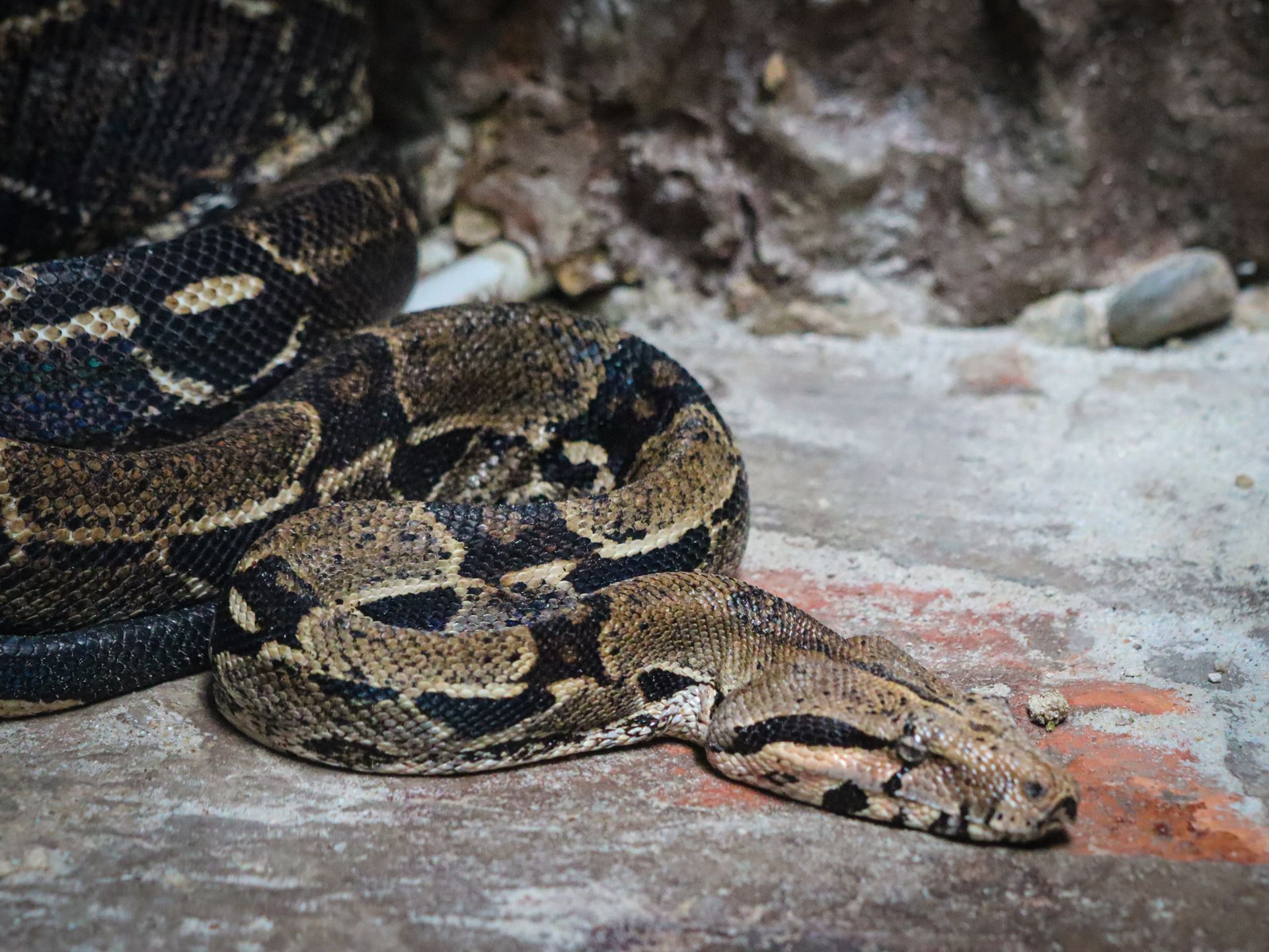
The big boa constrictor snake is an impressive animal, capable of growing up to 12 feet in length.
Native to the tropical regions of Central and South America, these snakes have adapted to thrive in a variety of environments.
Their ability to squeeze their prey to death is a unique feature, allowing them to survive in areas with limited food sources.
In the wild, big boa constrictors are skilled hunters, using their sharp senses to track down unsuspecting rodents and birds.
Physical Characteristics
The boa constrictor is a large snake with a thick body, typically growing up to 10 feet in length, although some individuals have been reported to reach lengths of over 18 feet.
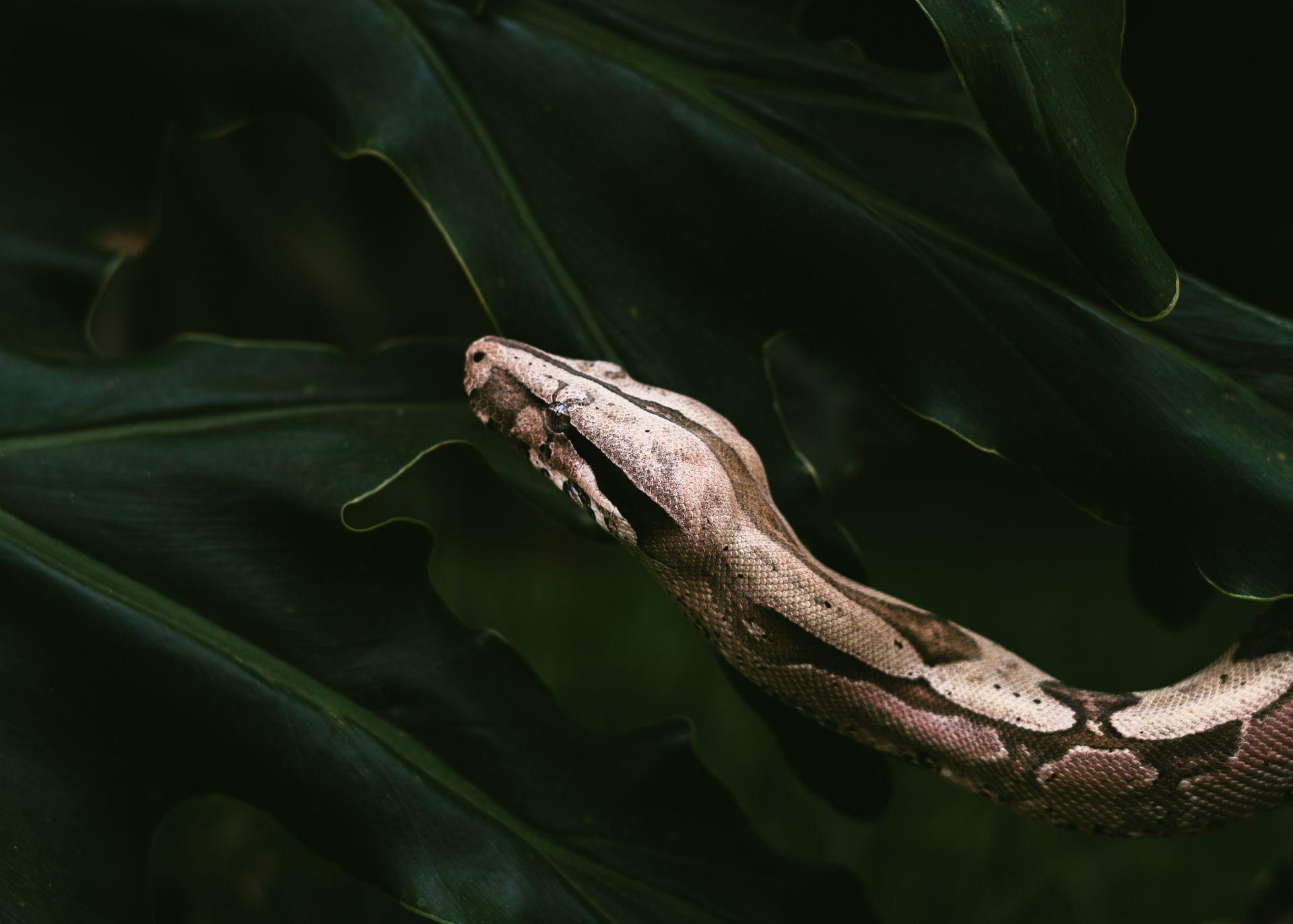
Its head is long and triangular, with distinctive dark streaks running from the eyes to the back of the jaw and another streak along the top.
The basic coloration of the boa constrictor is deep brown-and-black markings on a pale brown-and-gray background, although colors and markings can vary widely among subspecies and individuals.
Some subspecies, such as the Boa constrictor ortonii from Peru, have red markings on their tails, while others, like the Argentine boa constrictor, have a silvery gray color with a network pattern.
The boa constrictor's body is designed for constriction, with coils that can exert a deadly amount of pressure on its prey.
Here are some key physical characteristics of the boa constrictor:
- Adult length: typically 10 feet (3 metres), up to 18 feet (5.5 metres)
- Head shape: long and triangular
- Coloration: deep brown-and-black markings on a pale brown-and-gray background
- Subspecies variations: red markings on the tail, silvery gray color with a network pattern
Habitat and Behavior
Boa constrictors can thrive in a wide range of environmental conditions, from tropical rainforests to arid semidesert country.
They prefer to live in rainforests due to the humidity and temperature, natural cover from predators, and abundance of potential prey.
Boa constrictors are very capable swimmers and are commonly found in or along rivers and streams.
In fact, they often occupy the burrows of medium-sized mammals, where they can hide from potential predators.
Boa constrictors are found in many countries north of 35°S in South America, including Colombia, Ecuador, Peru, and Brazil.
Life Cycle and Conservation
Boa constrictors are listed under CITES Appendix II, except for the B. c. occidentalis subspecies, which is listed in CITES Appendix I.
Their populations have been impacted by human and animal predation, as well as over-collection for the pet and snakeskin trades, in some regions.
However, most boa constrictor populations are not at immediate risk of extinction, which is why they're listed in Appendix II rather than Appendix I.
Subspecies
The Boa constrictor has several subspecies, but many of them are poorly differentiated and may be redefined with further research. Some subspecies are based more on location than on biological differences.
The red-tailed boa constrictor is the most widely distributed subspecies, found in South America except for the ranges of the other three subspecies. It's also known as the red-tailed boa.
The long-tailed boa constrictor is found in northern Peru, and is also known as the long-tailed boa. This subspecies is specifically adapted to its habitat in northern Peru.
The Argentine boa constrictor is found in Argentina and Paraguay, and is also known as the Argentine boa. This subspecies has a distinct geographic range.
The Orton's boa constrictor is found in northwestern Peru, and is also known as Orton's boa. The subspecific name ortonii is in honor of American naturalist James Orton.
Here's a list of some of the recognized subspecies of Boa constrictor:
- B. c. constrictor (red-tailed boa constrictor)
- B. c. longicauda (long-tailed boa constrictor)
- B. c. occidentalis (Argentine boa constrictor)
- B. c. ortonii (Orton's boa constrictor)
Reproduction and Development
The process of reproduction in this species is quite fascinating, and it starts with the formation of a unique structure called a "polyp", which is essentially a small, sessile colony of individuals.
These polyps can reproduce both sexually and asexually, with the latter method involving the release of free-swimming larvae that settle and grow into new polyps.
The larvae go through a complex process of metamorphosis, during which they transform into juvenile polyps that eventually grow into mature individuals.
The entire life cycle of this species can take anywhere from a few months to several years to complete, depending on various environmental factors.
This species has a remarkable ability to regenerate lost or damaged body parts, which is a testament to its remarkable resilience and adaptability.
Take a look at this: How Big Do Rottweilers Grow
Conservation
Boa constrictors are listed under CITES Appendix II, except for B. c. occidentalis, which is listed in CITES Appendix I.
Conservation efforts are necessary due to the impact of human predation and over-collection for the exotic pet and snakeskin trades, which have severely hit boa constrictor numbers in some regions.
Most boa constrictor populations are not under threat of immediate extinction, which is why they are listed in Appendix II rather than Appendix I.
Boa constrictors may be an invasive species in Florida and Aruba, highlighting the need for careful management and regulation of their populations in these areas.
Frequently Asked Questions
What is the largest boa constrictor?
The largest boa constrictor ever recorded measured 18 feet in length. This exceptional size is a rare occurrence in the species.
Is a boa constrictor aggressive?
No, boa constrictors are not typically aggressive, but they can still cause harm if handled incorrectly.
Is a 4x2x2 big enough for a boa?
A 4x2x2 enclosure provides ample space for a boa to move around and exhibit natural behaviors. However, the suitability of this size depends on the boa's age, size, and activity level.
Which is bigger Anaconda or boa?
Anacondas can grow up to 30 feet, while most boas typically reach 18 feet or less.
Featured Images: pexels.com