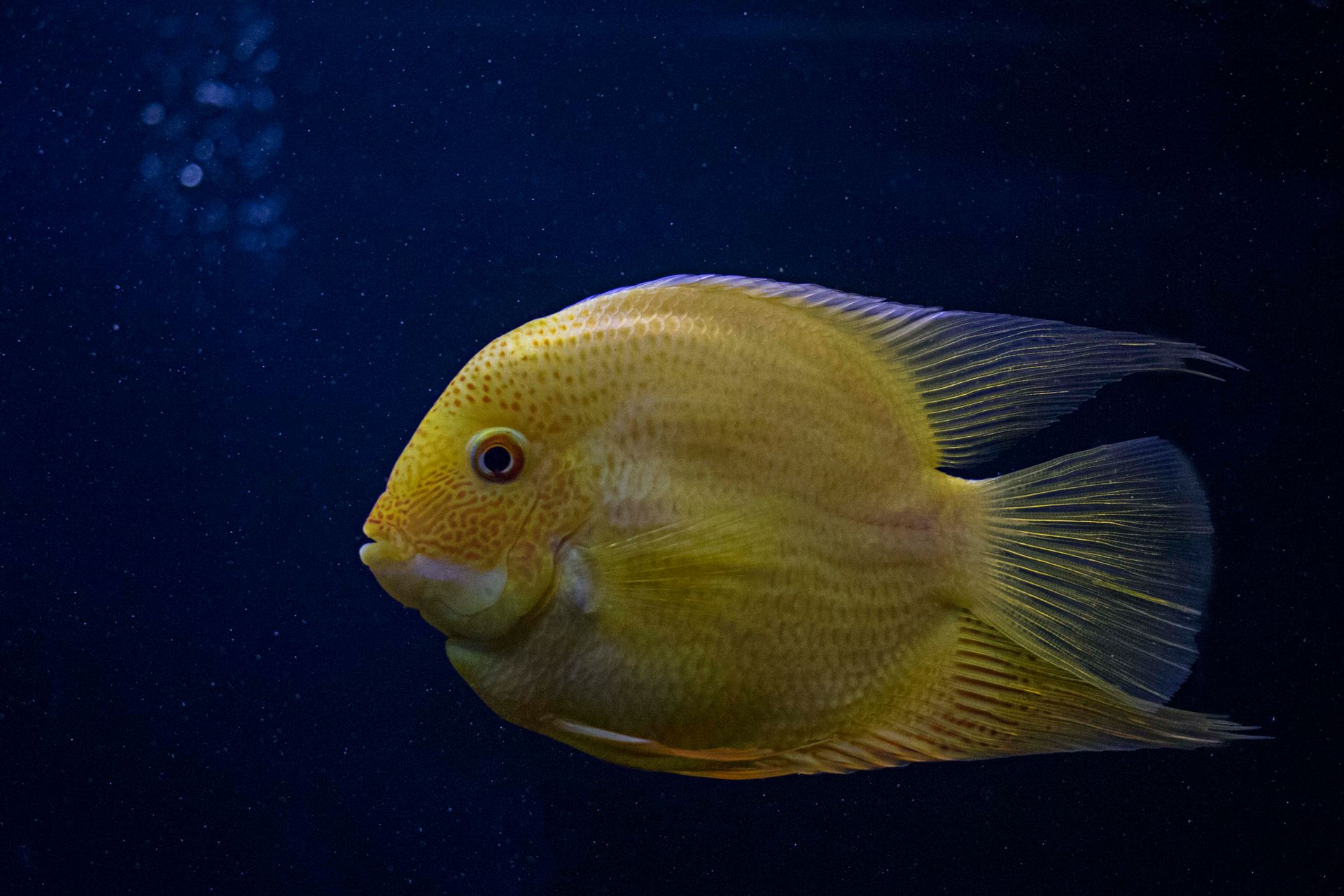
The Bathybates are a group of deepwater cichlids that can be found in Lake Tanganyika, a massive freshwater lake in East Africa.
They inhabit the deepest parts of the lake, where the water is cold and dark.
Bathybates are a relatively small group of fish, with most species growing to a maximum length of about 10-15 centimeters.
These fish have adapted to life in the deep water by developing large eyes and a sensitive sense of smell, which helps them detect food in the dimly lit environment.
Explore further: Lake Tanganyika Fish
Habitat and Distribution
Bathybates minor is found in the open waters of Lake Tanganyika in Africa, typically at depths between 120 and 200 meters.
Lake Tanganyika has a rocky bottom with little underwater vegetation, and the edges of the lake are often bare without much vegetation.
Bathybates minor lives in a tropical climate without seasonal flooding or droughts.
This unique environment is home to Bathybates minor, a predatory fish that feeds on smaller fish such as clupeids.
Curious to learn more? Check out: Lake Tanganyika Fish Tank
Aquarium Care
To keep Bathybates minor happy and healthy, you'll want to set up a spacious aquarium with plenty of open swimming space.
A minimum aquarium size of 200 centimeters in length is recommended, especially if you plan to keep multiple individuals.
Use a sand or gravel substrate to create a comfortable environment for your fish. Avoid too many plants, as these fish prefer open water.
The ideal water temperature for Bathybates minor is between 22°C and 26°C. This temperature range will help them thrive.
A pH of 8.5 to 9.0 and a hardness of 10 to 18 °dGH are also essential for their well-being.
When choosing tankmates, select large, robust Tanganyika cichlids like Tropheus duboisi, which can coexist peacefully with Bathybates minor.
Breeding and Reproduction
Bathybates minor is a maternal mouthbrooder, which means the females incubate the eggs in their mouths.
The males of the species become more intensely colored during spawning, with black stripes clearly visible.
There is little documented information on the breeding of Bathybates minor in aquariums, making it a challenging species to breed.
Characteristics and Traits
Bathybates minor has an elongated, fusiform body with a pointed head and a retractable mouth.
The body's basic color is silvery, with a brown to yellowish hue on the back.
Males have four horizontal black stripes that are especially visible during the breeding season.
Females can reach a maximum length of about 20 centimeters, which is often much larger than males.
Males typically don't grow larger than 12 centimeters.
Bathybates minor is a peaceful fish that lives in schools.
They are not aggressive and can live well with other large, robust Tanganyika cichlids.
These fish are nocturnal and only become active when it gets dark.
They are pelagic, or open water dwellers, and usually swim in the middle waters of the aquarium.
Scientific and Cultural Significance
Bathybates have a unique scientific significance due to their ability to survive in deep, oxygen-poor waters.
Their discovery has expanded our understanding of fish adaptability and the diversity of life in African lakes.
Bathybates are found in the deep waters of Lake Malawi, a region known for its extreme depths and low oxygen levels.
Scientists are fascinated by their ability to thrive in these conditions, making them an important subject of study.
Their unique physiological features allow them to extract oxygen from the water more efficiently, a trait that's essential for their survival.
Breeding and Raising Bathybates
Breeding Bathybates can be a challenging task, especially since there's limited information available on the subject. Bathybates minor, for instance, is a maternal mouthbrooder, which means the females will incubate the eggs in their mouths.
During spawning, the males of Bathybates minor become more intensely colored, with black stripes clearly visible, indicating the start of the breeding process.
The specific details about breeding conditions for Bathybates minor, such as the size of the breeding tank, water quality, lighting, and filter type, are not available in the sources.
It's essential to note that breeding Bathybates requires a deep understanding of their specific needs and behaviors, which can be difficult to determine without proper research and experience.
If you're interested in breeding Bathybates, you may want to consider the following species: Bathybates minor, Bathybates fasciatus, and their related species.
Here's a list of Bathybates species mentioned in the article:
- Bathybates minor
- Bathybates fasciatus
Keep in mind that breeding these species can be a complex process, and it's crucial to research their specific needs and requirements before attempting to breed them.
Featured Images: pexels.com


