The Australasian Swamphen is a bird species that's quite unique in its appearance and behavior.
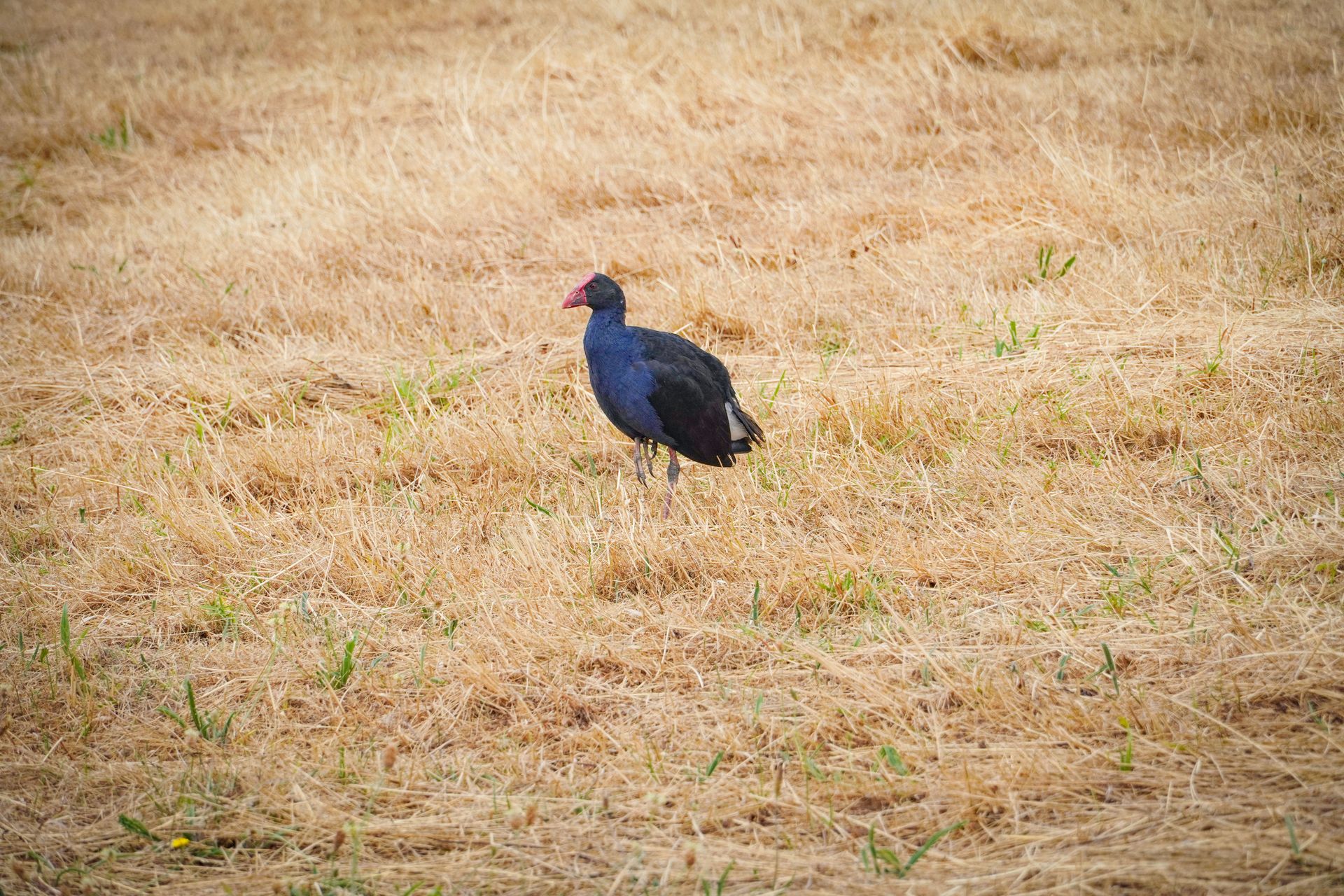
This bird has a distinctive blue and red plumage, with a long neck and legs, making it a striking sight in its natural habitat.
The Australasian Swamphen is found in Australia, New Zealand, and nearby islands, where it inhabits wetlands, grasslands, and agricultural areas.
Its diet consists mainly of aquatic plants, seeds, and insects, which it forages for in its surroundings.
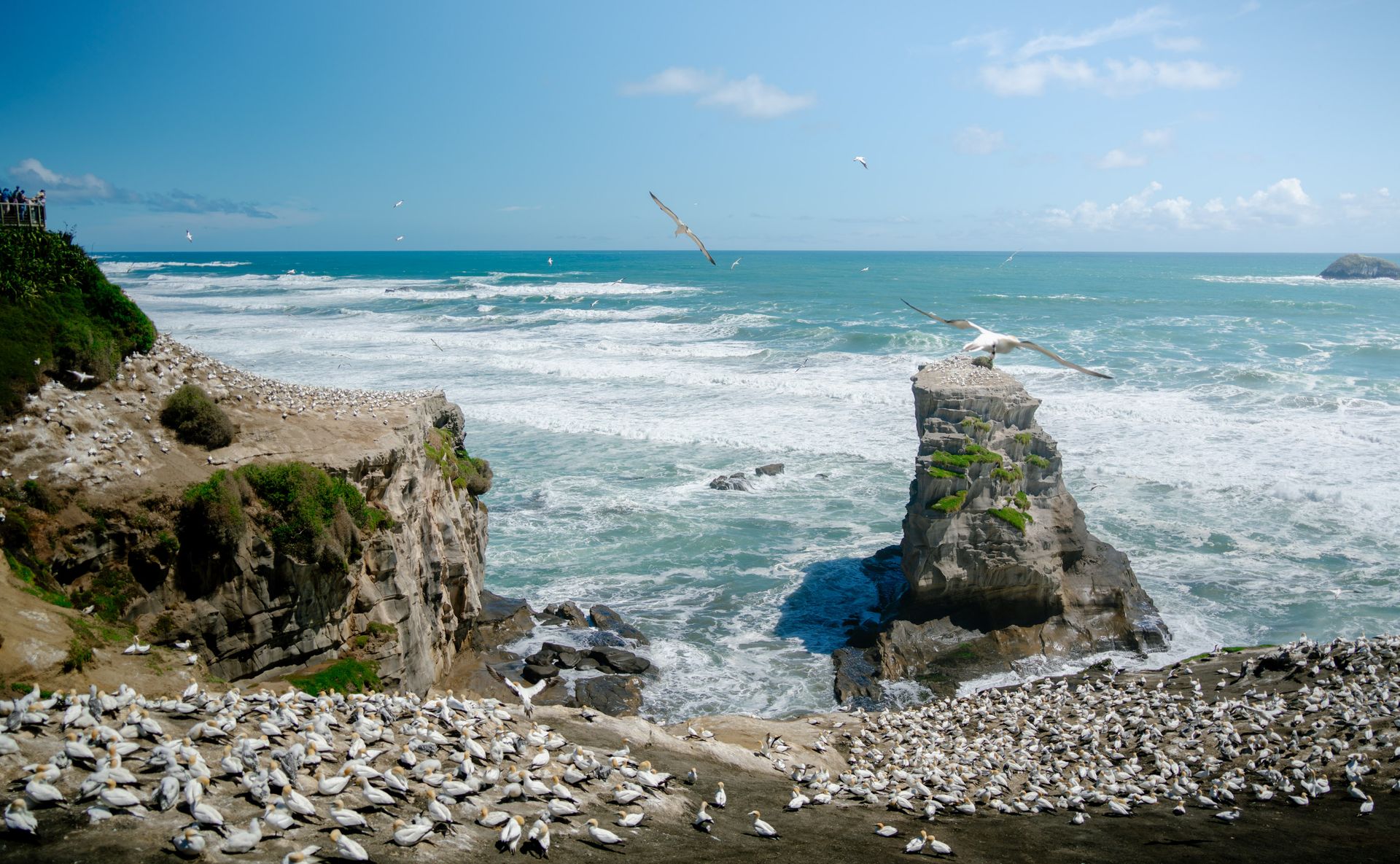
A different take: Australasian Gannet
Physical Characteristics
The Australasian swamphen is a striking bird, standing about 51 cm tall. Its dark plumage features black upper-parts that contrast beautifully with its purple throat and breast.
One of the most distinctive features of the Australasian swamphen is its large, bright red bill. This vibrant color helps to set it apart from other birds in the area.
Its frontal shield is relatively small and extends from the culmen, giving the bird a unique appearance. This shield is a key identifying feature of the Australasian swamphen.
Variations in size exist across subspecies, with some populations being slightly larger than others. This means that the overall size of the bird can vary slightly depending on the region.
The New Zealand population, along with the green-yellow swamphens in Tasmania, are possibly slightly larger than mainland Australian birds.
Consider reading: New Zealand Birds Also Known as Owl Parrots
Distribution and Habitat
The Australasian swamphen is a bird that thrives in wetland environments. It can be seen walking along the water's edge or through reeds and rushes with its distinctive gait.
These birds are found in a variety of habitats, including swamps and marshes across Southeast Asia, Australia, and New Zealand. They're also common in estuaries, salt marshes, and along riverbanks.
Their large feet allow them to traverse swampy terrain without sinking, and they're known for their speed, making them swift runners across their diverse habitats.
Dispersal
P. porphyrio subspecies are capable of dispersing and colonizing new areas across extensive bodies of water. They have successfully established populations numerous times.
A dead bird was found on L'Esperance Rock, a tiny, isolated rock in the Kermadec group of New Zealand, more than 200 km from the nearest established population. This demonstrates their ability to fly great distances over the sea.
Habitat
The Australasian swamphen can be found in a variety of wetland environments. These include swamps, marshes, and wet lowlands.
In New Zealand, the pūkeko thrives in wet lowlands and breeds in swamps. They also utilize other habitats such as pastures, crops, farm ponds, and road verges.
Their large feet allow them to traverse swampy terrain without sinking. This makes them well adapted to their environment.
The swamphen is common in estuaries, salt marshes, and along riverbanks. They can be seen walking along the water's edge or through reeds and rushes.
In New Zealand, these birds are found in low-lying wetlands with vegetation like flax, raupo, and rushes. This adaptability has enabled them to exploit feeding opportunities that arose following large-scale lowland clearance and swamp drainage over the past 150 years.
Samoa
In Samoa, the swamphen is called manuali'i, which literally means "chiefly bird". This name reflects the bird's unique status in Samoan culture.
The swamphen's reddish face, beak, and legs made it a prized possession among Samoan chiefs. They were the only ones allowed to keep such birds as pets.
In old Samoa, keeping a swamphen as a pet was a symbol of wealth and status. Early European sailors noticed that swamphens were often tethered and caged, treated like royalty by their Samoan owners.
Some Samoans believed the swamphen was an incarnation of a mischievous demon called Vave.
Species and Classification
The Australasian swamphen is a fascinating bird species with a complex classification. It has five subspecies distributed across various regions, including Sulawesi, the Moluccas, and New Guinea.
These subspecies are: P. m. melanopterus, P. m. pelewensis, P. m. melanotus, P. m. bellus, and P. m. samoensis.
The Australasian swamphen is also known to vary slightly in size and coloration across its range, with some subspecies having distinctive characteristics such as a cerulean blue throat and breast.
Here are the subspecies and their corresponding regions:
- P. m. melanopterus – northern and south-eastern Sulawesi, the Moluccas, Lesser Sundas and New Guinea region.
- P. m. pelewensis – Palau (western Caroline Islands, western Micronesia).
- P. m. melanotus – northern and eastern Australia, Tasmania, Lord Howe and Norfolk Islands, as well as the North, South, Stewart, Kermadec and Chatham Islands of New Zealand.
- P. m. bellus – far south-west Australia.
- P. m. samoensis – Admiralty Islands to New Caledonia, Solomon Islands, Fiji and Samoa.
The species was previously considered a subspecies of the purple swamphen, but is now recognized as a distinct species.
Behavior and Social Structure
Australasian swamphens are quite fascinating when it comes to their behavior and social structure. They exhibit a complex polygynandrous mating system, where both sexes mate with multiple partners, and groups typically consist of three to seven breeding males and one or two breeding females.
Breeding females lay their eggs in a single nest, resulting in joint laying, a rare avian breeding system. This collective parental care is unique and allows for individual recognition within the shared nest.
However, joint laying comes with reproductive costs, and studies have shown that when total clutch sizes are large, a lower percentage of eggs hatch.
Feeding and Foraging
Swamphens are opportunistic feeders, supplementing their diet with animal matter, primarily invertebrates. They also consume plant material, including stems, shoots, leaves, and seeds of various grasses, sedges, rushes, and clover.
Their diet is quite diverse, and they've been known to prey on larger vertebrate species like pied stilt eggs, Eurasian blackbird chicks, and pāteke and mallard ducklings in New Zealand.
In addition to natural environments, swamphens also forage on roadsides, where they seek out invertebrates struck by vehicles and graze on grass shoots from mown verges. They ingest grit to aid in processing food in their gizzards.
Swamphens are bold foragers and have a history of raiding gardens for crops like kumara and taro. This behavior has continued as they adapted to European farmland by feeding on grain and vegetable crops.
Their foraging activities can sometimes result in the uprooting of vegetation, including tree seedlings and crops, which has led to pūkeko being culled under permit in certain areas.
Breeding
Breeding is a complex and fascinating process for swamphens. They exhibit a polygynandrous mating system, where both sexes mate with multiple partners.
In a typical group, you'll find three to seven breeding males and one or two breeding females. These females are unique in that they lay their eggs in a single nest, a rare behavior in the avian world.
Each female's eggs differ in color and size, allowing for individual recognition within the shared nest. This joint laying system comes with reproductive costs, however, as studies have shown that when total clutch sizes are large, a lower percentage of eggs hatch.
Group participation in copulation and same-sex sexual behavior is also common among swamphens. This behavior helps synchronize sexual cycles, enabling multiple females to lay in the same nest simultaneously.
Swamphens build multiple nests, with males responsible for constructing 'trial' nests about a month before laying. Ultimately, one nest is chosen for laying, although occasionally two nests are used.
In New Zealand, the Australasian swamphen breeds between August and March, with most eggs laid between August and February.
Territoriality and Dominance
Australasian swamphens, like the pūkeko, exhibit complex territorial and dominance behaviour. They defend their home range as an all-purpose territory, and all members of a group participate in territory defence.
Defence transitions to a space-related dominance system at the boundaries of these territories. This means that individuals within the group have a specific role to play in defending their territory.
Dominance hierarchies are well established in pūkeko groups, influencing the order of female breeders. Dominant individuals enjoy priority access to resources and play different roles in parental care and territory defence.
In fact, dominant males copulate frequently to ensure paternity, while subordinate males do not guard their mates or interrupt the copulations of rivals.
Conservation and Human Impact
The Australasian swamphen's conservation status is a mixed bag. The IUCN lists it as Least Concern, but certain subspecies are considered endangered.
Some populations, like the one in Palau, are vulnerable due to their limited range. On the other hand, populations in New Zealand and Australia have actually increased thanks to the creation of new artificial lakes and ponds.
Conservation Status
The Australasian swamphen's conservation status is a complex issue, with some populations thriving while others are struggling.
The International Union for Conservation of Nature (IUCN) lists the Australasian swamphen as Least Concern.
However, certain subspecies, such as the one endemic to Palau, have been considered endangered.
In New Zealand and Australia, populations have expanded due to the creation of new artificial lakes and ponds, which has helped the species to flourish in these areas.
Readers also liked: Australasian Harrier
Cultural Significance and Human Relationship
In New Zealand and Australia, populations of this species have expanded due to the creation of new artificial lakes and ponds. This highlights the impact of human activities on their habitats.
The subspecies endemic to Palau has been considered endangered. However, a 2005 survey found that the subspecies is at least still common, although potentially threatened.
Featured Images: pexels.com