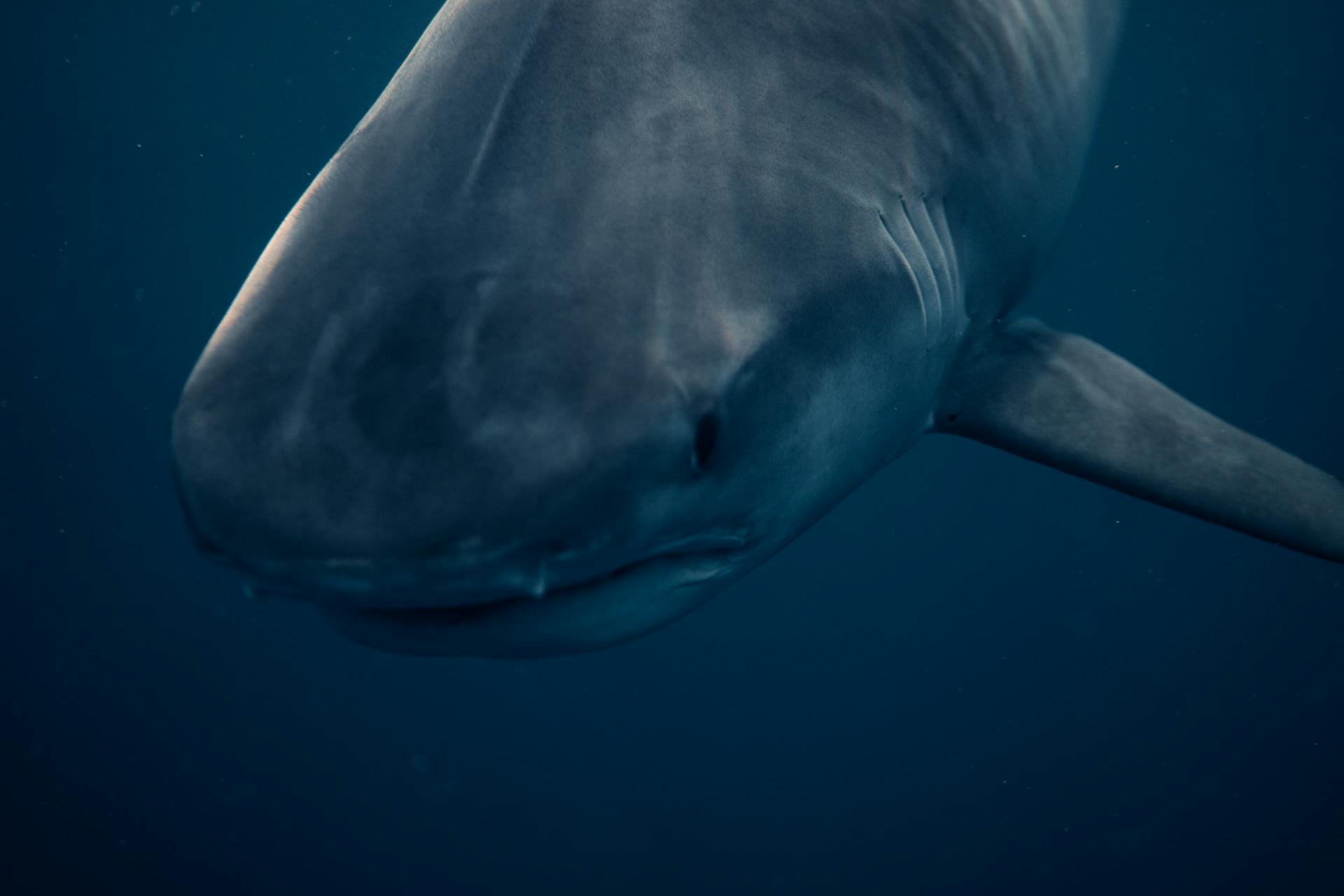
Great white sharks are apex predators, but their populations are declining due to various threats.
Entanglement in fishing gear is a significant threat to great white sharks, with over 50% of the species' population being caught accidentally in longlines and gillnets.
Habitat loss is also a major concern, as coastal development and pollution are reducing the availability of suitable habitats for great white sharks.
Conservation efforts are underway to protect great white shark populations, but more needs to be done to address the scale of the problem.
Are Great White Sharks Endangered?
Great white sharks are a vulnerable species that need protection. They're listed as vulnerable by the World Conservation Union, but their global population is estimated to be less than 3,500 individuals.
The number of great white sharks has declined significantly over the past few decades, with a 75% drop off the U.S. Atlantic coast in the 1980s and 90s due to commercial and long line fishing. This decline has been attributed to accidental catches by fishing vessels seeking tuna and other commercial fish.
Commercial and long line fishing have been major contributors to the decline of great white shark populations. However, since the mid 2000s, great white sharks have appeared to have a comeback along the U.S. Atlantic coast.
Great white sharks are still found in significant numbers off the coasts of Australia, Canada, and the United States. However, their numbers are most threatened off the coast of South Africa.
Here's a comparison of the estimated global populations of great white sharks and other endangered species:
The Convention on International Trade in Endangered Species has given white sharks its second strongest conservation rating due to accidental catches by fishermen. This highlights the need for continued protection and conservation efforts to ensure the long-term survival of this species.
Threats to Great White Sharks
Great white sharks are highly susceptible to the threats of fishing and other human activities due to their slow reproductive rate and small number of offspring.
Their populations are declining at an alarming rate, with an estimated 80% decline in North America over the past 14 years.
Most shark species, including great whites, take a long time to reach reproductive maturity, making them vulnerable to overfishing.
The International Union for the Conservation of Nature and Natural Resources (IUCN) reports that 32% of pelagic sharks and rays are threatened with extinction.
Regulatory protections introduced in the 1990s, such as prohibiting white shark fishing and imposing regulations on gill net gear, have helped increase juvenile white shark populations in some areas.
However, these protections are not enough to reverse the decline of great white shark populations, and more needs to be done to protect these magnificent creatures.
The loss of great white sharks would have a ripple effect on the entire marine ecosystem, making it even more challenging to protect other species.
Conservation Efforts
Conservation efforts are underway to protect the great white shark population. In 2004, the United Nations Convention on International Trade on Endangered Species (CITES) outlawed most international trade of great white jaws, teeth, fins, and meat.
Regulations are in place to prevent overfishing and protect the species. In 1991, South Africa was the first country to ban commercial hunting of great white sharks, followed by Namibia, Australia, the United States, Malta, and New Zealand.
Great white sharks are categorized as vulnerable on the International Union for Conservation of Nature (IUCN) Red List. They are listed by CITES in Appendix II, which lists species not necessarily threatened with extinction now but that may become so unless trade is closely controlled.
In the United States, white sharks are a prohibited species, with no retention allowed in all U.S. waters and fisheries. There are no commercial fisheries for white sharks, but they are occasionally caught as bycatch.
Conservationists and the ecotourism industry are working together to increase education and change attitudes towards great white sharks. Guadalupe Island, designated as a Biosphere Reserve by the Mexican government in 2005, has seen an increase in white shark population since then.
Regulations on gill net gear in the 1990s may have contributed to the apparent increase in juvenile white shark populations off the California coast. Researchers have also observed an increase in numbers of adult white sharks at Farallon Island in the northeast Pacific.
Decline in Great White Shark Population
The decline in great white shark population is a pressing concern. A study in South Africa found that the number of great white sharks off the coast has dropped by 50% in the past six years, with only 350-520 individuals remaining.
This decline is largely due to human interference, including shark nets used to protect swimmers and surfers, which killed over 1,000 great whites off the Durban coast in 30 years. Additionally, trophy hunting and pollution have also taken a toll on the population.
Researchers have also found that the South African great white shark population has the lowest genetic diversity of all white shark populations globally, making breeding more problematic and increasing the likelihood of illness.
According to a marine biologist, Sara Andreotti, "We are already in a situation where our number of breeders is below the minimum level required for a population to survive." This highlights the urgent need for conservation efforts to protect this iconic species.
Here's a breakdown of the decline in great white shark population in different regions:
- South Africa: 50% decline in 6 years, with only 350-520 individuals remaining
- California coast: Incidental catch of white sharks in gill nets has increased, but population still declining
- Farallon Island and San Miguel Island: Increase in white shark population, possibly due to increasing seal populations
- Guadalupe Island: Increase in white shark population due to conservation efforts and ecotourism
Orcas Blamed for Decline
Orcas have been identified as a major reason behind the decline of great white sharks in South African waters.
Between 2010 and 2016, shark spotters recorded around 205 great white sharks living along the coastal sites of False Bay and Gansbaai, which lie off the eastern shore of Cape Town.
The disappearance of great whites had previously been blamed on illegal hunting, climate change, and overfishing, but a government report found that the sharks vanished around the same time two killer whales arrived in the area in 2015.
Shark spotters initially reported declines in shark sightings in the area in 2017 when they found the remains of five sharks killed by orcas in the Gansbaai area.
Each and every time that this happened, there was an immediate drop and gap in white shark sightings, according to Alison Kock, a marine biologist and one of the authors of the report.
A US-based study found that the mere presence of orcas in the water led to a noticeable absence of great white sharks.
The orca is slightly bigger but weighs much more than the great white shark, with male orcas weighing 7 to 10 tons.
The biggest great white sharks weigh about 2.5 tons, which is significantly less than the weight of an orca.
Less Common in South Africa
Great White Sharks are rarely seen in South Africa's cool waters, particularly in Gansbaai, which was once known as the great white shark capital of the world.
Sara Andreotti, a marine biologist, recalls that just a few years ago, you'd see five to 20 great white sharks a day during peak season. Now, you'd be lucky to see that many in an entire year.
The decline of great white sharks has been rather abrupt, with sightings dropping rapidly over the past five years. It's a sad loss for the ecosystem.
Long-line fishing is believed to be one of the main culprits behind the decline. This type of fishing targets smaller shark species, which are then exported to Australia for fish and chips.
The problem is that these smaller shark species are also the food source of great white sharks. By depleting their food resources, we're making it harder for great whites to survive.
Fishermen often inadvertently catch sharks while trying to catch other fish like hake. This "collateral damage" can have a significant impact on the shark population.
Over 100 miles away in False Bay, the shark population has also declined dramatically. Seferino Gelderbloem, a shark spotter, has seen a significant decrease in great white sightings over the past 12 years.
Without great white sharks to keep the seal population in check, the ecosystem is becoming imbalanced. More seals mean more fish are being eaten, which can have a ripple effect throughout the ocean.
In fact, marine biologist Mary Rowlinson warns that if we don't have top predators like great white sharks, our oceans will eventually die. It's a stark reminder of the importance of protecting these incredible creatures.
Frequently Asked Questions
Do 25 foot great whites exist?
While there's no confirmed sighting of a 25-foot great white, bites on whale carcasses in Australia suggest they may exist. However, the largest reliably measured white shark was only 21 feet.
Featured Images: pexels.com