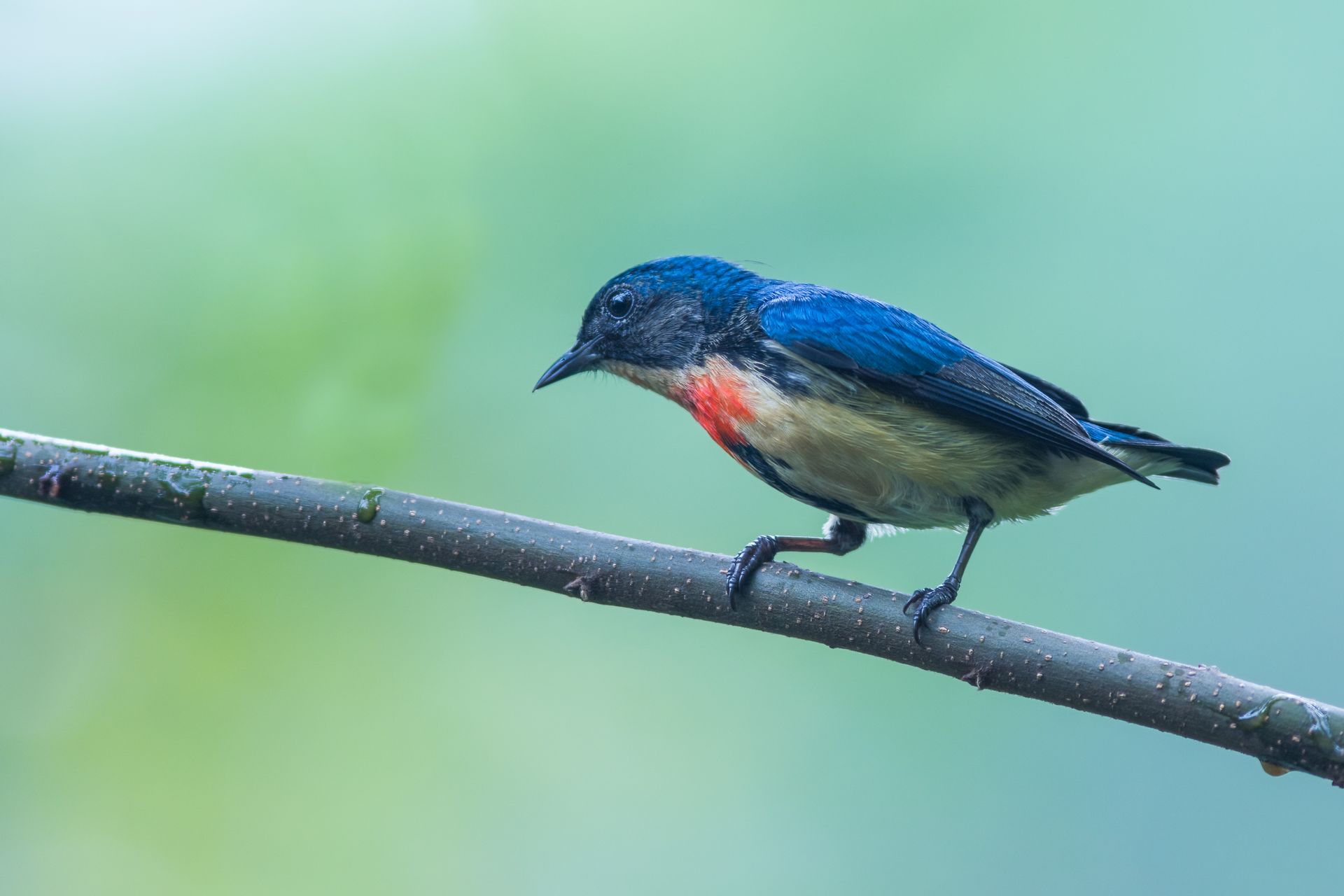
Anthochaera birds are a type of honeyeater native to Australia, specifically found in the country's southeastern regions.
They have distinctive black and white plumage, with a grey back and wings.
Anthochaera birds are known for their bold and curious nature, often approaching humans for food.
Their diet consists mainly of nectar, pollen, and insects, which they gather from flowers and trees.
Taxonomy
The genus Anthochaera was introduced in 1827 by naturalists Nicholas Aylward Vigors and Thomas Horsfield. They derived the name from the Greek words "anthos" meaning flower or bloom and "khairō" meaning to enjoy.
The type species of the genus was designated as the little wattlebird by German ornithologist Hans Friedrich Gadow in 1884. This species is still a part of the Anthochaera genus today.
The regent honeyeater was formerly placed in its own genus, Xanthomyza, but was moved to Anthochaera in a 2004 molecular phylogenetic study. This study helped to clarify the relationships between different species within the genus.
The genus Anthochaera is sister group to the species Acanthagenys rufogularis, the spiny-cheeked honeyeater, separated as a monotypic genus. This means that Anthochaera and Acanthagenys share a common ancestor.
Here are the species within the Anthochaera genus, along with their common names:
The red wattlebird was first described as the wattled bee-eater by Irish surgeon and naturalist John White in 1790.
Species and Distribution
The genus Anthochaera is a fascinating group of birds, and their distribution is quite widespread across Australia. The Red wattlebird, for example, can be found in southeast Queensland, New South Wales, Victoria, South Australia, and southwest Western Australia.
There are five species within the genus Anthochaera, each with its unique characteristics and distribution. The Little wattlebird, on the other hand, is found in coastal and sub-coastal south-eastern Australia.
The Yellow wattlebird is exclusive to Tasmania, making it a unique find for bird enthusiasts. The Western wattlebird, as its name suggests, is found in south-western Australia.
Here's a list of the species within the genus Anthochaera, along with their distribution:
The Regent honeyeater, which is also part of the genus Anthochaera, can be found in south-eastern Australia.
What Are Wattles?
Wattles are soft, fleshy parts that hang from a bird's cheeks, neck, or throat.
They're often wrinkled and can be brightly colored, which might be why birds use them to show off or attract a mate.
Only two species, the yellow wattlebird and the red wattlebird, have wattles among the five species in the Anthochaera group.
Birds likely use their wattles to attract a mate, which is a pretty clever way to get noticed!
Identification and Characteristics
The Red Wattlebird is a large, noisy honeyeater with a distinctive fleshy reddish wattle on the side of its neck.
The plumage is grey-brown on the body, with prominent white streaks and yellow on the belly. The face is pale and the tail is long with a white-tip.
Young Red Wattlebirds are duller than the adult and have a brown, rather than reddish, eye. The wattle is also very small and pale.
The sexes of the Red Wattlebird are similar in size and plumage, with adults ranging from 33 to 37 centimetres in length and weighing 100-120 grams.
The Red Wattlebird has a distinctive pinkish-red wattle that dangles from the lower rear corner of the ear coverts on either side of the neck. The iris of the eye is orange-red to crimson.
The Red Wattlebird is one of the largest nectar-feeding birds in the world, and the second largest species of honeyeater native to Australia.
Behavior and Breeding
The red wattlebird is a social bird that can be found in pairs, small family groups, or alone during the breeding season. It's not uncommon to see them gather in larger groups of up to several hundred birds over winter.
They're quite aggressive and territorial, defending their nest and food sources against other birds. They'll call, snap at tails, or fly at other birds, sometimes even scuffling with members of the same species or other large honeyeaters in the air.
Red wattlebirds will often mob and chase larger species, such as Australian magpies, butcherbirds, and crows. They're not picky, and will even go after small raptors like the collared sparrowhawk.
Behaviour
The red wattlebird is a loud and active bird, often found in pairs, small family groups, or alone during the breeding season.
It's not uncommon to see them gather in larger groups of up to several hundred birds over winter. They fly straight or with a slightly undulating pattern, alternating between gliding and flapping their wings with quick shallow beats, at or slightly above the level of the tree canopy.
On the ground, they move by hopping and cocking their tail upwards slightly. The red wattlebird is a fiercely territorial bird, defending its nest and sources of food against other birds.
It will call at, snap at the tails of, or fly at other birds, sometimes scuffling with members of the same species or other large honeyeaters in the air. Displacement is a dominant display in which a red wattlebird will land on a perch that has been immediately vacated by another bird.
In a horizontal appeasement posture, a smaller red wattlebird will lower its head, flutter its wings, and edge closer to the other bird, side-on to the aggressor.
Breeding
The red wattlebird breeds throughout its range, with nesting taking place between July and December, though occasionally outside these months, if conditions are favourable. One or two broods are laid each year.
Red wattlebirds generally nest as solitary pairs, with the nest located between 2 and 16 metres above ground, usually in the forked branches of a tree—generally a eucalypt.
The nest is a cup-shaped structure formed from sticks and leaves, lined with bark, grass, and hair. A study in Eastwood State Forest found that red wattlebirds preferred to nest in manna gum (Eucalyptus viminalis) and apple box (E. bridgesiana).
A clutch of two or three pale brown- and lavender-spotted pinkish eggs are normally laid, measuring 33 mm × 22 mm, and are a tapered oval in shape.
The eggs are normally incubated by both parents, but sometimes just by the female. They hatch after 16–21 days, and the chicks are born almost naked, with a small amount of grey down on their head and body.
The nestlings are fed by both parents, and occasionally immature birds will contribute. Their eyes open at around 7 days, and they fledge 15–20 days after hatching.
Habitat and Distribution
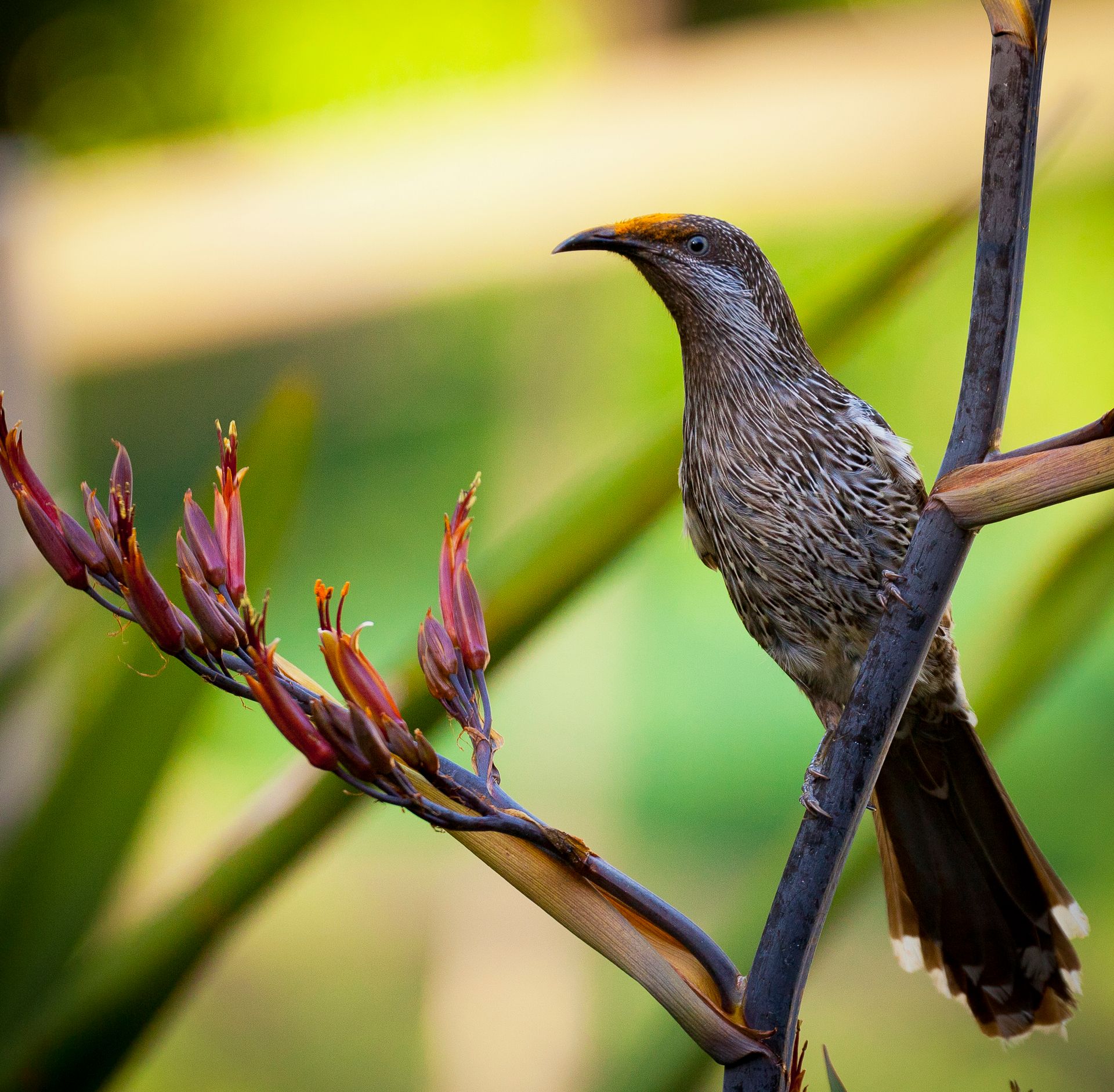
The Anthochaera genus is found in various parts of Australia, with species ranging from the southeastern regions to the southwest.
The Red wattlebird, for example, can be found in southeast Queensland, New South Wales, Victoria, South Australia, and southwest Western Australia. Its wide distribution allows it to thrive in different environments.
The Little wattlebird, on the other hand, lives along the coast and nearby areas of southeastern Australia, giving it a more limited but still diverse range.
Tasmania is home to the Yellow wattlebird, which can be found nowhere else. This unique distribution makes it an interesting species to study.
The Western wattlebird lives in southwestern Australia, sharing its habitat with the Red wattlebird. Their overlapping ranges allow them to coexist and adapt to their environment.
Here is a summary of the distribution of the different Anthochaera species:
Sounds and Calls
The Red Wattlebird is known for its distinctive and often unmusical calls, including coughs and a harsh 'yac a yac' sound.
These calls can be loud and carry over long distances, making the Red Wattlebird a vocal bird species. They have a range of calls, including a loud 'chok' sound that's often harsh and guttural.
The male Red Wattlebird produces a loud cackle, which is particularly loud between 1 and 3 kHz frequency, and has been described as having a squawking, coughing or hiccuping sound.
The female Red Wattlebird makes a whistling call, which consists of up to five rapid whistles that may or may not ascend in tone, and are repeated 3-4 times.
Red Wattlebirds are also known to utter a single 'chock' note, which is thought to be a contact call, and can be harsh and guttural or have 4-5 harmonics.
They give a harsh call when trying to distract intruders from the vicinity of the nest or when picked up, often trying to flap or peck the handler, and also use a lower-pitched staccato call with a frequency of 1.1-2.2 kHz.
Frequently Asked Questions
Why is it called a wattlebird?
The Red Wattlebird gets its name from the distinctive fleshy reddish wattle on its neck. This colorful feature is a key identifier of the species.
Featured Images: pexels.com


