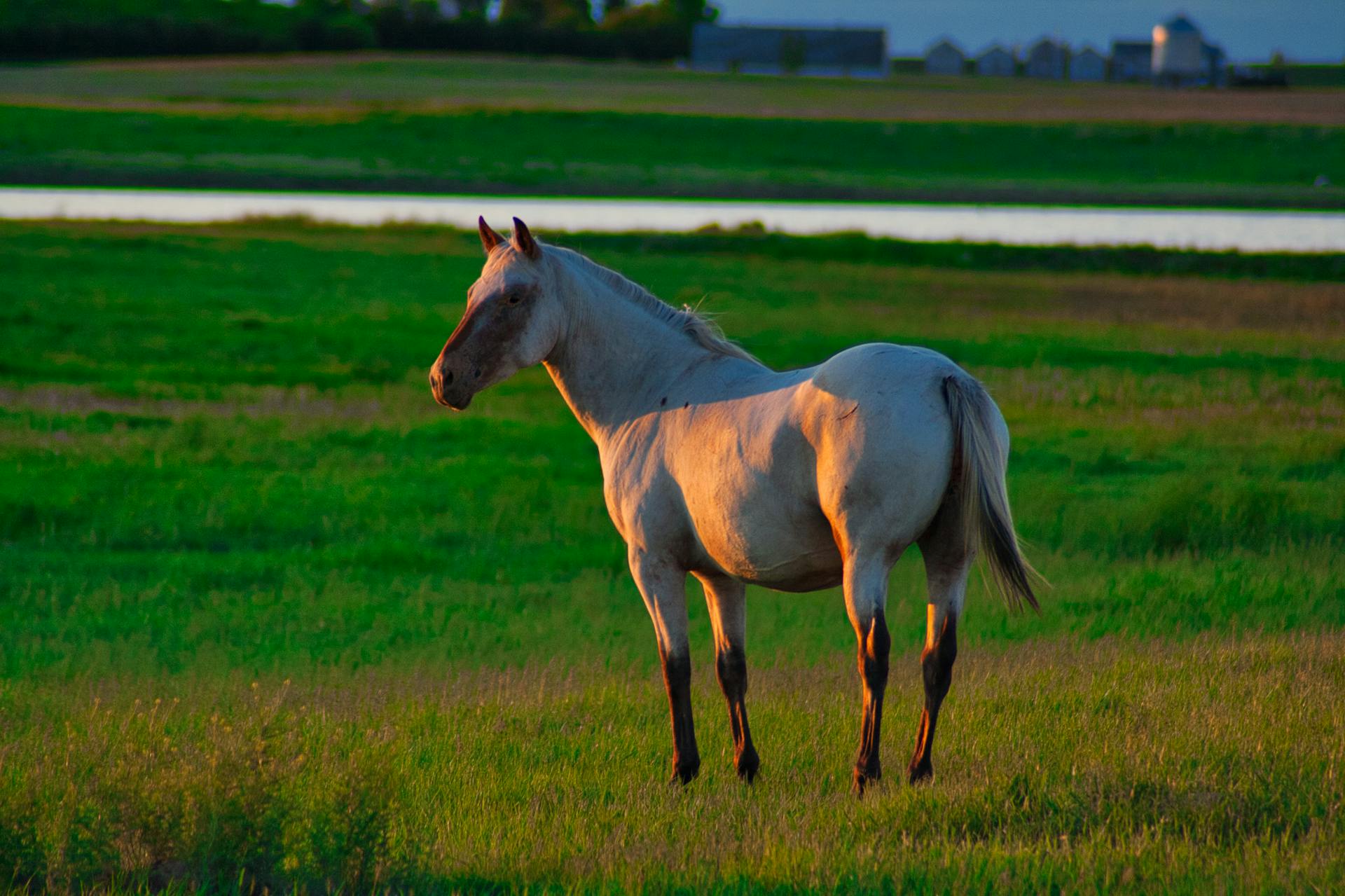
The American Indian Horse is an incredibly resilient breed that has thrived for centuries.
They are known for their striking appearance, with a compact, muscular body and a distinctive head shape featuring a straight or slightly concave profile and a Roman nose.
Their intelligence and strong work ethic make them a pleasure to train and handle.
The American Indian Horse is a versatile breed that excels in a variety of disciplines, including trail riding, endurance riding, and Western pleasure riding.
For your interest: Horse Breed
Characteristics
American Indian Horses generally range in height from 13 to 16 hands, with weights between 700 and 1,000 pounds. They can be any coat color and come in pinto and leopard spotting patterns.
These horses are hardy and surefooted, making them well-suited for rugged terrain. They're also intelligent and friendly, which is a great combination for a riding partner.
Some American Indian Horses may be gaited, which means they have a unique gait that's comfortable for riders. This is a great feature for long-distance riding.
If this caught your attention, see: Indian Great Bustard
Here's a breakdown of the different classes of American Indian Horses:
- Class O: Horses with a recorded pedigree chart that can be traced to American Indian tribes or families.
- Class A: Horses with unknown bloodlines, but meet the breed standard. This can include grade horses or horses of unknown bloodlines.
- Class AA: Horses that are over four years old, have been inspected for conformation, and are at least half-O in breeding or of exceptional O type.
- Class M: Horses of "modern" type, with registered parents from breeds considered to be descended from the original type.
- Class P: Ponies with the proper type characteristics, which might include pedigreed breeding or unknown ancestry.
These horses are low maintenance and can survive on their own, making them a great choice for those who want a self-sufficient companion.
History and Background
The American Indian Horse has a rich and diverse background. The breed originated from horses brought to America by the Spanish Conquistadors in the 16th century.
These horses were prized by Native American tribes for their hardiness, agility, and endurance. They were used for transportation, hunting, and warfare.
The American Indian Horse was developed by various Native American tribes for their own use. They were considered a valuable commodity and were traded between tribes.
The breed nearly became extinct after the arrival of the Europeans, who brought their own horses to the continent. However, through the efforts of a few dedicated breeders, the American Indian Horse was revived in the 20th century.
The Native Americans worshiped these horses as if they were God, and they played a significant role in their daily lives.
Suggestion: What Is the Best Horse Breed
Horse Breeds and Composition
The American Indian horse is a unique breed with a rich history, and its composition reflects its adaptability and strength.
The breed is believed to have originated from horses brought over by Spanish conquistadors in the 16th century.
These horses were crossed with native horses to create a hardy and resilient breed that could withstand the harsh conditions of the American West.
The American Indian horse is known for its small to medium size, typically weighing between 900 and 1,200 pounds.
It has a muscular build, a straight or slightly convex profile, and a short, compact body.
The breed is often associated with the Native American tribes of the Great Plains, who valued its strength, agility, and endurance.
The American Indian horse is a versatile breed, used for a variety of tasks including riding, packing, and working on ranches.
Take a look at this: Native American Indian Horse Names
Horse Information
The American Indian Horse is a breed that originated in the United States, specifically among the Native American tribes.
They are known for their intelligence, agility, and strong work ethic, making them well-suited for various tasks such as herding and riding.
These horses are typically between 13.2 and 16 hands high and weigh between 900 and 1,200 pounds.
They come in a variety of colors, including bay, black, brown, chestnut, gray, palomino, and roan.
Their lifespan is around 25-30 years, making them a long-term companion for many horse owners.
Their strong work ethic and intelligence also make them a popular choice for trail riding and endurance competitions.
Horse and Buffalo
The introduction of horses to the Plains Indians revolutionized their buffalo hunt, making it faster and more efficient.
Before horses, Native hunters pursued buffalo on foot, which was a perilous and laborious task.
A favorite hunting horse could be trained to ride right into the stampeding buffalo herd, making hunting a much safer and more successful endeavor.
The newfound speed and efficiency of hunting on horseback provided an abundance of high-quality meat, hides for tipis and clothing, and rawhide for shields and boxes.
With the help of a draggable wooden sledge called a travois, horses could transport entire villages and their possessions to follow the seasonal hunt.
Tribes gained more wealth and freedom with the introduction of the horse, lifting some of the daily burden from women, giving them more time to create works of art and sacred objects.
Size
The American Indian Horse is a breed known for its compact size. They typically stand between 13 and 15 hands high.
Their small stature is a result of being bred in the rugged terrain of the American West, where large horses would have been difficult to manage.
Frequently Asked Questions
Which horse breed was most used by Native Americans?
Appaloosa horses were a popular choice among Native Americans for various tasks, including bison hunting and as quick war horses.
What is an Indian horse called?
An Indian horse is also known as a mustang, cow pony, buffalo horse, or Spanish pony. It has multiple names reflecting its versatility and origins.
Featured Images: pexels.com