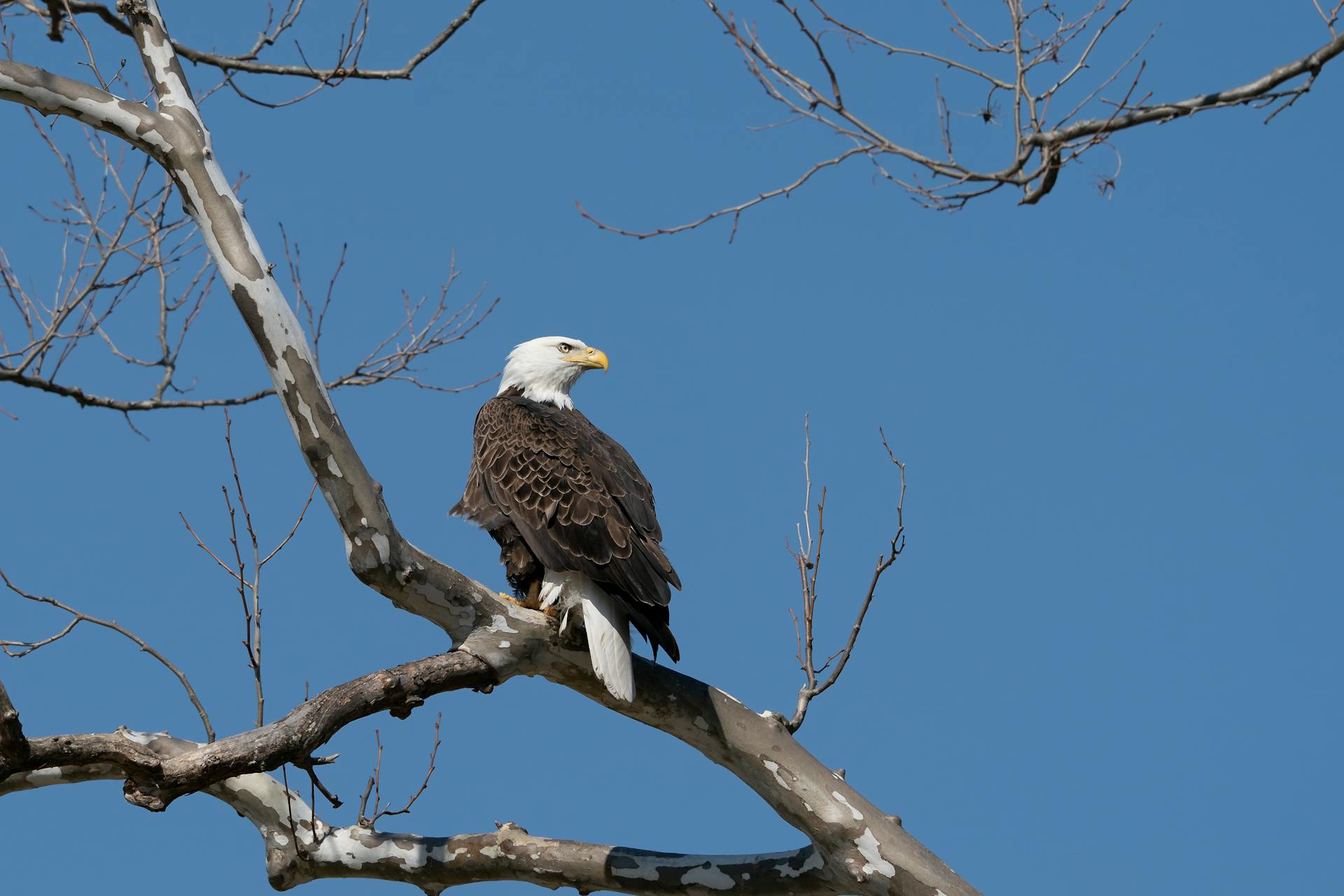
The American Bald Eagle is a majestic bird, and understanding its classification and habitat is essential to appreciating its grandeur.
As a bird of prey, the American Bald Eagle belongs to the family Accipitridae.
These birds are known to inhabit a variety of environments, from coastal regions to inland areas.
Their habitat ranges from the Arctic tundra to the southeastern United States, with a preference for areas with abundant water sources.
The American Bald Eagle's wingspan can reach up to 7.5 feet, making it one of the largest birds in North America.
Related reading: What Is Birds in Madagascar Prey
Classification
The American Bald Eagle is classified under the Kingdom Animalia, which includes all animals. This kingdom is further divided into Phylum Chordata, which comprises animals with a backbone.
The Bald Eagle's classification is as follows:
- Kingdom: Animalia
- Phylum: Chordata
- Subphylum: Vertebrata
- Class: Aves
- Order: Falconiformes
- Family: Accipitridae
- Genus: Haliaeetus
- Species: Haliaeetus leucocephalus
The Bald Eagle is a member of the Accipitridae family, which includes eagles, hawks, and kites.
Taxonomy
The bald eagle's taxonomy is a fascinating topic. The species was originally described by Linnaeus in his work Systema Naturae.
There are two recognized subspecies of bald eagle: H. l. leucocephalus and H. l. washingtoniensis. The nominate subspecies, H. l. leucocephalus, is found in the southern United States and Baja California.
The two subspecies are separated by approximately latitude 38° N, roughly the latitude of San Francisco. H. l. washingtoniensis, the northern subspecies, is larger than H. l. leucocephalus and is found in the northern United States, Canada, and Alaska.
Here's a quick comparison of the two subspecies:
The bald eagle forms a species pair with the Eurasian white-tailed eagle.
Description
Bald eagles are a large bird species, with adult body lengths ranging from 71 to 96 centimeters.
Their wingspan can be quite impressive, measuring anywhere from 168 to 244 centimeters.
In terms of weight, adult bald eagles can range from 3 to 6.3 kilograms.
Females are generally larger than males, with a wingspan of up to 2.44 meters and a weight of approximately 5.8 kilograms.
Males, on the other hand, may weigh around 4.1 kilograms.
The size of the bird can vary depending on its location, with the smallest specimens found in Florida and the largest in Alaska.
Adult bald eagles have a distinctive appearance, with an evenly brown body and a white head and tail.
Their beak, feet, and irises are a bright yellow, and they have large, hooked beaks.
Immature bald eagles, on the other hand, are completely brown except for their yellow feet.
They have a more protruding head with a larger bill, straighter edged wings, and a stiffer wing beat.
Here's a quick comparison of the physical characteristics of adult and immature bald eagles:
Physical Description
The American Bald Eagle is an iconic bird species, and its physical description is a fascinating topic. These birds go through 4 distinct maturation stages, each comprising one year of their life.
In their first year, their bodies, eyes, and beaks are dark brown, although their underwing coverts and axillaries are white. The coloration of their head feathers lighten in their 3rd year, and by their 4th year, their body becomes mostly dark with some beige around their eyes and crown.
Adult Bald Eagles are extremely large birds with characteristically yellow eyes and bills, white heads and tails, and dark brown bodies. They have a wingspan of 178 to 229 cm, and their bodies are 79 to 94 cm long.
Here are the average physical measurements of an adult Bald Eagle:
Their plumage alone weighs about 700 grams, which is twice as much as their skeleton. If lost, their flight feathers may take 2 to 3 years to replace.
Bald Eagle Details
Bald eagles are majestic birds with a rich history in the United States. They've been the national symbol since 1782.
Their name "bald eagle" actually comes from an old English word, "balde", meaning white, which refers to their white head.
Female bald eagles are slightly larger than males, with bodies that can reach three feet long and wingspans of up to eight feet.
Eagle nests, called aeries, are built at the top of tall trees to keep eggs safe from predators.
Babies, or eaglets, are born light gray and turn brown as they mature, eventually developing their normal white heads and tails by the age of four to five years.
Bald eagles can soar to incredible heights of over 10,000 feet and spot fish up to a mile away with their exceptional eyesight.
Habitat and Distribution
The bald eagle's habitat preferences are pretty specific. They need large bodies of open water with an abundance of fish, such as rivers, lakes, and seacoasts.
These bodies of water should have a circumference of at least 11 kilometers (7 miles) for the bald eagles to thrive. Lakes with an area of more than 10 km² (3.8 square miles) are ideal for breeding.
To nest and roost, bald eagles require old-growth and mature stands of coniferous or hardwood trees. These trees need to have good visibility and be close to prey, but the species or height of the tree isn't as important as having a sufficient number of large trees surrounding the water.
If this caught your attention, see: Largest Salt Water Crocodile
Bald eagles prefer forests with a canopy cover of less than 60 percent, and as low as 20 percent, to ensure they have a clear view of their surroundings. They also need to be in close proximity to water.
The bald eagle's natural range covers most of North America, including most of Canada, all of the continental United States, and northern Mexico. It's the only sea eagle native to North America.
Bald eagles are extremely sensitive to human activity and tend to avoid areas with high human disturbance. They prefer sites at least 1.2 kilometers (0.75 miles) away from low-density human disturbance and 1.8 kilometers (1.2 miles) away from medium- to high-density human disturbance.
Suggestion: Are North Carolina Frogs Poisonous to Dogs
Frequently Asked Questions
What are the 7 levels of classification for a bald eagle?
The 7 levels of classification for a bald eagle are: Kingdom, Class, Order, Family, Genus, Species, and none for the phylum or kingdom Animalia is the kingdom.
Featured Images: pexels.com