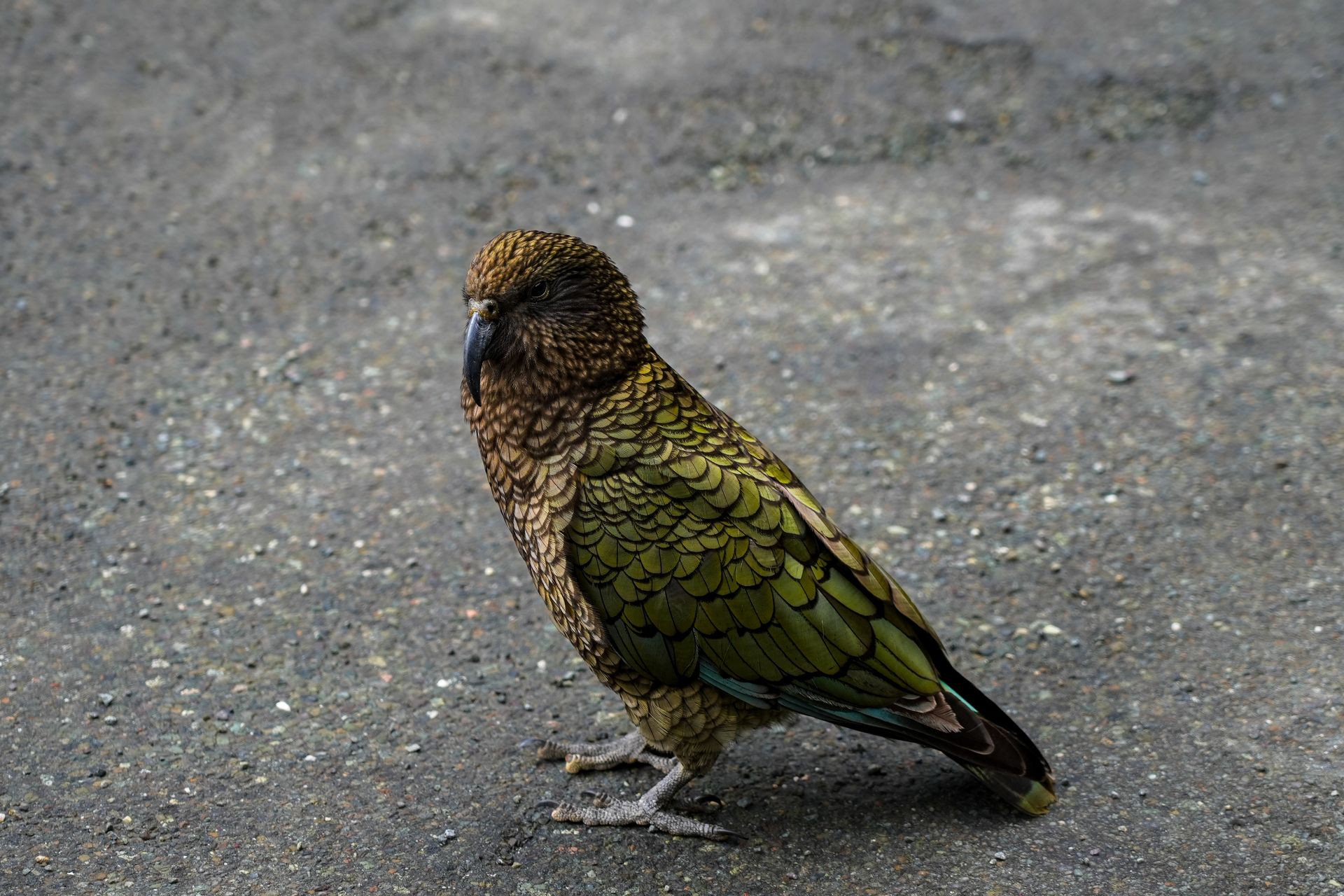
The Kea is one of the most iconic alpine parrots in New Zealand. They're known for their intelligence and curious nature.
Keas are found in the South Island's mountainous regions, where they inhabit areas with beech forests and rocky outcrops. Their habitat ranges from 400 to 1,800 meters above sea level.
Keas are highly adaptable birds, and they've been observed scavenging for food in the presence of humans. They're also known to raid cars and campsites in search of food or shiny objects.
See what others are reading: New Zealand Birds Also Known as Owl Parrots
Conservation
Conservation efforts are underway to protect the unique alpine parrot of New Zealand.
In the Matukituki Valley, bird keepers like Jasmine are working to conserve the kea population.
Jasmine's journey to Mt Aspiring National Park involves banding and fitting transmitters to wild kea.
This hands-on approach helps researchers understand the kea's behavior and habitat needs.
Passing with Flying Colors: Putting Our Kea to the Test
Our Kea are known for their intelligence, and one way to see this in action is by observing them solve problems. They have been observed using sticks to retrieve food from hard-to-reach places.
These parrots are also incredibly curious, often investigating their surroundings with great enthusiasm. They have been known to open car doors and even investigate the contents of campers' trash.
Their intelligence is not just limited to problem-solving, but also extends to their ability to learn from experience. In the wild, Kea have been observed using tools to obtain food, such as using rocks to crack open shells.
Kea are also known for their playful nature, often engaging in games of chase and other forms of play. This playful behavior is an important aspect of their social development.
Their playful nature also extends to their interactions with humans, where they have been known to engage in playful interactions with visitors.
Encountering Kea
Keas are known to be fearless and explorative, often approaching people in search of food or to investigate their belongings. They're not picky eaters and have been known to rummage through tourists' backpacks, bags, and coolers.
In fact, they've even been observed stripping off rubber areas from cars, such as around windows and antennas. They seem to see cars as chew toys!
If you're planning to visit the South Island of New Zealand, you might be lucky enough to spot a Kea in the wild. They're most commonly found in the mountains of the southern alps, particularly on the western side, where they inhabit high altitude forests and alpine areas.
Meet the Kea: New Zealand's Naughty Bird
The Kea is a protected species native to the forested and alpine region of New Zealand's South Island.
They're also known as the "naughty alpine parrot" due to their fearless and explorative nature.
Keas are olive-green parrots with splashes of bright orange feathers under their wings.
Their long, narrow, curved beaks are perfect for picking things apart.
These birds have been known to rummage through tourists' backpacks, bags, coolers, shoes, and ski equipment.
Keas have even been spotted stripping off the rubber areas of cars, such as around the windows, and antennas as if cars were chew toys.
They're considered highly destructive when in captivity, which is why they were rarely captured in the wild for the pet trade.
Where to See a Kea?
If you're looking to spot a Kea in the wild, head to the South Island of New Zealand, specifically the mountains of the southern alps on the western side.
Keas can be found in high altitude forests and alpine areas, so be prepared to venture into some rugged terrain.
You can spot Keas around people, as they're known to hunt for food and steal stuff from unsuspecting hikers or tourists.
They often hang out around huts, stores, car parks, or even lunch tables at ski fields.
I've been lucky enough to spot a Kea at Arthurs Pass, where they're known to frequent the general store, waiting for scraps of food from tourists.
If you're hiking the Kepler Track, you'll likely see heaps of Keas, like I did.
Kea Biology
Keas are highly intelligent birds, known to use tools to obtain food and solve problems.
They have a large beak, strong and curved, perfect for cracking open seeds and nuts.
Keas are also known for their exceptional memory, allowing them to recall the location of food caches.
Their wingspan can reach up to 90 centimeters, making them quite agile in flight.
Keas are monogamous birds, often forming long-term pair bonds with their mates.
Taxonomy and Naming
The kea's scientific name, Nestor notabilis, has a fascinating story behind it. The Latin binomial specific epithet "notabilis" means "noteworthy".
John Gould, an ornithologist, first described the kea in 1856, based on specimens provided by Walter Mantell. Mantell had obtained the birds in Murihiku and was told about the kea by elderly Māori eight years earlier.
The kea's common name is derived from the Māori language, and is thought to be an onomatopoeic representation of their in-flight call – "keee aaa". In New Zealand English, the word "kea" is both singular and plural.
The kea is part of the genus Nestor, which contains four species: the New Zealand kākā, the kea, the extinct Norfolk kākā, and the extinct Chatham kākā.
Distribution and Habitat
The kea is one of nine living endemic parrot species in New Zealand.
Kea can be found in a variety of habitats, from lowland river valleys to alpine regions of the South Island.
Their preferred habitat is the southern beech (Nothofagus) forests in the alpine ridge.
Kea are not found in the North Island, except for occasional vagrants.
A fresh viewpoint: South Island Kokako
Diet and Feeding
The kea's diet is quite impressive, as it feeds on over 40 plant species, which is a testament to its adaptability and opportunistic nature. The kea is an omnivore, which means it eats both plants and animals.
One of the most interesting things about the kea's diet is its ability to feed on a wide range of animals, including beetle larvae, grasshoppers, land snails, and even mammals like sheep, rabbits, and mice. It's not picky, to say the least.
The kea has been known to break open shearwater nests to feed on the chicks, which is quite a clever and sneaky behavior. It's also been observed using tools to aid in its preening habits, such as wedging pebbles between its tongue and lower mandible.
In addition to its natural diet, the kea has also taken advantage of human garbage and "gifts" of food, which is not ideal but a reality in many parts of the world. This opportunistic behavior is likely a result of the kea's adaptability and its ability to thrive in a variety of environments.
It's worth noting that the kea's diet has changed over time, with some reports suggesting it used to feed on moa in a similar way to how it feeds on other animals today. This highlights the kea's ability to adapt to changing environments and exploit new food sources.
Here's a brief overview of the kea's diet:
- Over 40 plant species
- Beetle larvae
- Grasshoppers
- Land snails
- Mammals (sheep, rabbits, mice)
- Shearwater chicks
- Carcasses (flesh and bone marrow)
- Human garbage
Frequently Asked Questions
What New Zealand parrot attacks sheep?
The kea, a native New Zealand parrot, is known to attack living sheep. This unusual behavior has earned the kea notoriety and sparked interest in learning more about this fascinating bird.
Featured Images: pexels.com