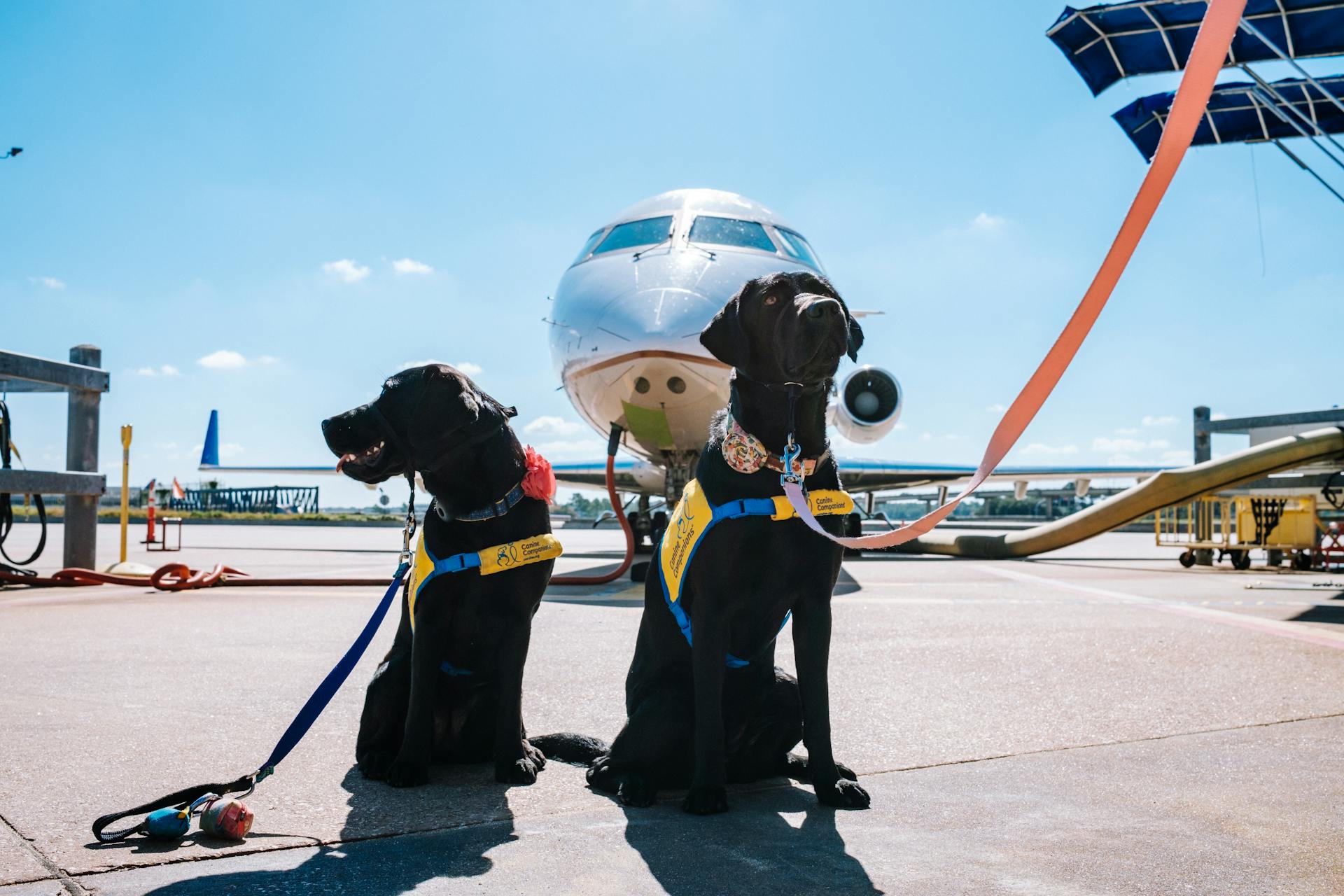
Alert service dogs play a vital role in health management, helping individuals with conditions such as diabetes, epilepsy, and post-traumatic stress disorder (PTSD).
Their keen sense of smell can detect changes in their handler's body chemistry, alerting them to potential health issues. This early detection can prevent serious complications.
For people with diabetes, alert service dogs can detect changes in blood sugar levels, alerting their handler to take action. Some dogs can even detect the onset of a seizure in individuals with epilepsy.
These dogs are trained to respond to specific commands and can provide a sense of security and independence for their handlers.
See what others are reading: Mental Health Service Dogs California
History and Research
The use of service dogs has a rich history that dates back to the 1860s, when Florence Nightingale found that animal companionship was beneficial to her patients.
Service dogs have been used in many capacities to help people recover from and manage illness, disability, and other conditions.
In the wake of World War I, training schools for service animals first became popularized in Germany, and soon after, other countries such as Switzerland, Great Britain, and the United States followed suit.
Many of the service dogs who came out of these training programs were paired with veterans, particularly after World War II when rising demand led to many more training schools being opened around the country.
Research has shown that service dogs are effective in helping people with disabilities achieve greater independence, require less assistance from other people, and improve functioning in many areas.
Trained service animals can go much further with the aid they provide, and extensive research has demonstrated their ability to boost key neurotransmitters like dopamine, oxytocin, endorphins, and serotonin, all of which are essential to our sense of well-being.
Some researchers are now exploring the possibility of service dogs detecting health conditions such as strokes and cancer, with promising results from initial studies.
Check this out: Can Schools Deny Service Dogs
Medical Response Training & Certification
Medical response dogs are trained to assist individuals with medical disabilities, and their training can vary depending on the organization or handler.
They may be trained to alert their handlers to conditions before they occur, such as detecting changes in blood sugar levels in diabetic individuals.
Medical response dogs are also trained to perform tasks that help alleviate their handlers' symptoms, like bringing medications or providing mobility assistance.
There are no breed or size restrictions for medical response dogs, as long as they have a work-loving personality and are properly socialized.
In the United States, medical response dogs are protected by ADA law, which guarantees them access to any facility where the public is allowed to enter.
Establishments cannot inquire about or request proof of an assistance dog handler's disability or require documentation of the dog's training.
The rules for air travel with assistance dogs differ from ADA laws and are set by the U.S. Department of Transportation.
In 2020, the U.S. Department of Transportation established rules allowing airlines to require forms attesting to the dog's health, temperament, training, and ability to relieve itself in a sanitary manner.
Medical Alert Service Dogs can be trained for various disabilities, including epilepsy, syncope, P.O.T.S., diabetes, and allergies.
Additional reading: How Do Service Dogs Know When to Alert
Medical Response Dogs
Medical response dogs are trained to assist individuals with medical disabilities, such as diabetes or epilepsy. They can be trained by an organization or by their handler.
These dogs are not limited to specific breeds or sizes, as long as they have a work-loving personality and are properly socialized to work in public. Medical response dogs can be trained to detect changes in their handler's body, such as high or low blood sugar levels.
Some medical response dogs are trained to alert their handlers to conditions before they occur, while others are trained to help manage symptoms. They may also be trained to bring medications or a telephone, provide bracing and mobility assistance, or perform other tasks.
Medical response dogs are protected under ADA law in the United States, which guarantees them access to any facility where the public is allowed to enter. However, laws concerning assistance dogs and air travel differ from ADA laws and are set by the U.S. Department of Transportation.
For another approach, see: Are Psychiatric Service Dogs Covered under the Ada
Here are some examples of tasks that medical response dogs can be trained to perform:
- Alerting Family Members.
- Alert Handler to Another Person or Child Crying/Calling/Yelling.
- Alerting for Help.
- Alerting to Alarms.
- Alert to Allergen in Food.
- Alert to Allergen in the Area.
- Alerting to Approaching Car.
- Alert to Car Horn.
- Alerting to Dangerous Medical Levels in the Body (Blood Pressure, Cortisol, etc).
- Alert to Doorbell/Knocking.
- Alerting to Handler’s Name Being Called.
- Alert to Intruder.
- Alerting to Person Coming Up Behind.
- Alert to Phone.
- Alerting to Seizures.
- Alert to Siren.
- Alerting to Sounds.
- Alert to Unheard Dropped Item.
- High Blood Sugar Alert.
- Alert to Heartrate changes.
- Alerting to Blood pressure changes.
- Alert to fainting.
Medical Animals
Medical animals, like medical response dogs, are trained to assist individuals with medical disabilities. They can detect changes in their handler's condition before it occurs, such as diabetes alert dogs detecting low or high blood sugar levels.
Medical response dogs can be trained by an organization or by their handler, and they must have a work-loving personality and be properly socialized to work in public. There are no breed or size restrictions for medical response dogs, only those related to the tasks they need to perform.
These dogs can be trained to perform various tasks, such as bringing medications or a telephone, providing bracing and mobility assistance, or alerting their handler to a medical condition. Medical response dogs are allowed public accessibility in areas with laws protecting the usage of guide dogs and other assistance dogs.
Medical Alert Service Dogs can be trained for a variety of disabilities, including epilepsy, syncope, P.O.T.S., diabetes, and allergies such as shellfish, nuts, or latex.
Curious to learn more? Check out: Diabetes Alert Dogs
Epilepsy
Epilepsy alert service dogs, also known as seizure alert dogs, are trained to recognize the physical indicators of a seizure and respond in various ways. They can be trained to trigger a medical alert device, alert another family member, retrieve medications, or help draw the person out of a seizure.
These dogs can be trained to detect changes in their handler's behavior or physical condition, such as muscle spasms or slowed responses to environmental stimuli, which can signal an impending seizure. They can then alert the individual or respond when the person becomes non-responsive to get them help.
Medical alert service dogs for epilepsy can be trained by an organization or by their handler, and they must be of a particular work-loving personality and be properly socialized if expected to work in public.
In the United States, individuals with epilepsy alert service dogs are guaranteed access to any facility in which the public is allowed to enter, according to ADA law.
Broaden your view: Seizure Service Dogs
Alert Service Dog Tasks
Alert service dogs are trained to alert their handlers to various situations, providing them with independence and confidence. They can alert their handlers to sounds such as smoke or fire alarms, phone ringing, door bells, and sirens.
Some common alert tasks include alerting to people walking up from behind, name being called, and police, fire, and ambulance sirens. These tasks can be crucial for individuals with hearing impairments or those who need to be aware of their surroundings at all times.
Alert service dogs can also be trained to alert their handlers to medical conditions such as high blood sugar levels, heartrate changes, and blood pressure changes. This can be especially helpful for individuals with diabetes or other medical conditions that require close monitoring.
Here is a list of some common alert tasks that alert service dogs can be trained to perform:
- Alert to Smoke/Fire Alarm.
- Alerting to Phone Ringing.
- Alerting to Door Bell.
- Alert to Door Knocking.
- Alerting to Police, Fire and Ambulance Sirens.
- Alert to People Walking Up from Behind.
- Alerting to Name Being Called.
- Alerting to Alarms.
- Alert to Allergen in Food.
- Alert to Allergen in the Area.
- Alerting to Approaching Car.
- Alert to Car Horn.
- Alerting to Dangerous Medical Levels in the Body (Blood Pressure, Cortisol, etc).
- Alert to Doorbell/Knocking.
- Alerting to Handler’s Name Being Called.
- Alert to Intruder.
- Alerting to Person Coming Up Behind.
- Alert to Phone.
- Alerting to Seizures.
- Alert to Siren.
- Alerting to Sounds.
- Alert to Unheard Dropped Item.
- High Blood Sugar Alert.
- Alert to Heartrate changes.
- Alerting to Blood pressure changes.
- Alert to fainting.
These are just a few examples of the many alert tasks that alert service dogs can be trained to perform. With proper training and socialization, these dogs can be invaluable companions for individuals with a variety of needs.
See what others are reading: How Does a Drug Dog Alert
Animals in Diabetes Management
Diabetic service dogs are trained to detect changes in their owner's blood sugar levels. They can sense these changes through their owner's breath, saliva, and sweat.
Dogs are rewarded during training every time they detect a low blood sugar sample. This helps them associate the scent with the need for action.
A diabetic alert dog's training is tailored to their owner's specific needs. Some dogs are trained to paw, nudge, lick, or stare at their owner to alert them of a blood sugar drop or spike.
Dogs can be trained to bring a blood glucose monitor to their owner. This is especially helpful if their owner is unable to check their levels themselves.
Severe hyperglycemia and hypoglycemia can cause similar symptoms, such as dizziness, confusion, and drowsiness. A diabetic service dog can alert their owner to these changes before it's too late.
Insulin is a common treatment for diabetes, but it can cause hypoglycemia as a side effect. A diabetic service dog can help their owner manage this risk.
See what others are reading: Paws for a Cause Service Dogs
Reliability and Benefits
Diabetic service dogs are successful in alerting their owners about low blood sugar more often than normal blood sugar levels.
Several studies have shown that these dogs vary greatly in their accuracy, with some performing no better than chance. However, they can detect hypoglycemia in their owners when those people have no symptoms.
A 2016 study found that diabetic alert dogs were often accurate in detecting low blood sugar, but less so than a continuous glucose monitor.
Their owners report feeling very satisfied with their dogs, trusting them to alert them during a low blood sugar event and feeling that their blood sugar control has improved.
Some reported benefits of diabetic service dogs include:
- Less time spent worrying about hypoglycemia and hyperglycemia
- Ability to take part in more physical activities
- Improved blood sugar control
- Fewer episodes of passing out from low blood sugar
- Fewer events for which paramedics (911) had to be called
- Greater independence
- Improved quality of life
Are Reliable
Reliable diabetic service dogs are a topic of ongoing research, and the results are mixed. Some studies have found that they are successful in alerting owners to low blood sugar, especially when the owner has no symptoms.
A 2016 study showed that diabetic alert dogs can detect hypoglycemia in their owners when those people would not have otherwise known that their blood sugar was low. This is a significant advantage, especially for people who experience frequent or unpredictable low blood sugar episodes.
If this caught your attention, see: When Do Service Dogs Retire
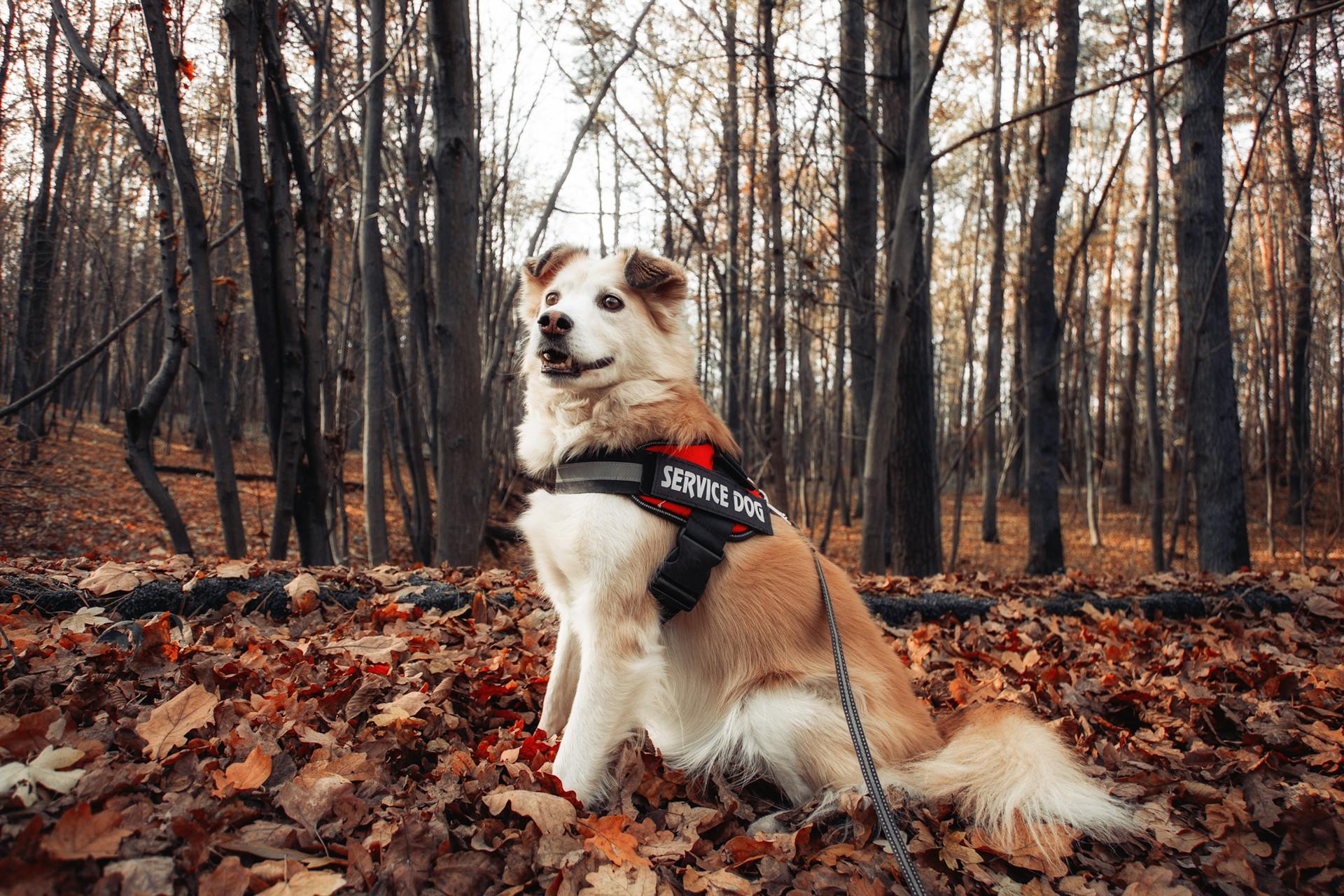
However, other researchers have found that diabetic alert dogs varied greatly in their accuracy, with many performing no better than chance. This suggests that not all dogs are equally reliable, and owners should be aware of this variability.
Despite these limitations, many owners report feeling very satisfied with their diabetic service dogs. They trust their dogs to alert them during a low blood sugar event and feel that their blood sugar control has improved.
Here are some benefits that owners have reported:
- Less time spent worrying about hypoglycemia and hyperglycemia
- Ability to take part in more physical activities
- Improved blood sugar control
- Fewer episodes of passing out from low blood sugar
- Fewer events for which paramedics (911) had to be called
- Greater independence
- Improved quality of life
It's essential to remember that diabetic alert dogs can't replace responsible individual management of the condition. Owners will still need to monitor and treat their blood sugar regularly, and a dog is not a substitute for medical treatment.
Challenges with
Challenges with diabetic alert dogs are real, and one of the main reasons is that their accuracy is much lower at night when they're trying to alert you to a low blood sugar level while they're sleeping.

Dogs need to sleep, too, which can make it tricky for them to accurately detect changes in your blood sugar levels during these hours.
Typically, diabetic alert dogs can cost between $8,000 and $20,000 initially, which is a significant investment.
Ongoing expenses, like veterinarian bills and buying food, can add up over time.
Some dogs may need additional training from time to time to ensure they can still detect changes in your blood sugar levels.
You might like: Do Service Dogs Need to Be Registered
Featured Images: pexels.com