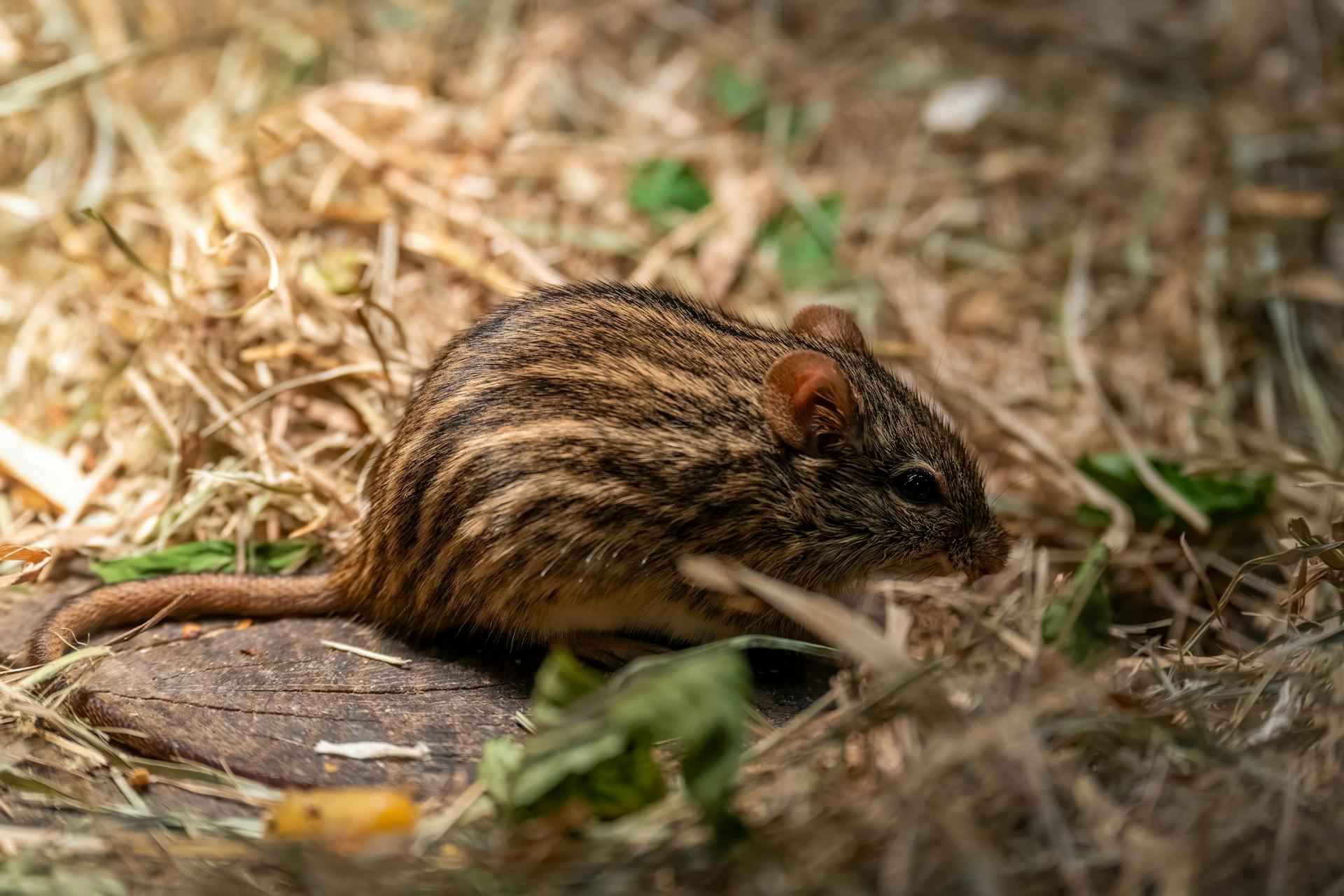
The African Spiny Mouse is a small rodent that's native to the deserts and savannas of sub-Saharan Africa. They have a stocky build and a long, pointed snout.
These adorable creatures are nocturnal, which means they're most active at night. This is likely due to the harsh conditions during the day, with temperatures often reaching scorching highs.
African Spiny Mice are known for their impressive jumping ability, with some individuals able to leap up to 6 feet in a single bound. This helps them navigate their arid environments with ease.
They have a unique appearance, with long, thin hairs that give them a spiny appearance. This distinctive look is a key identifier for the species.
Physical Characteristics
African spiny mice have a lifespan of 2 to 4 years, although some can live up to 7 years in captivity. They are known for their distinctive physical characteristics, which set them apart from other rodents.
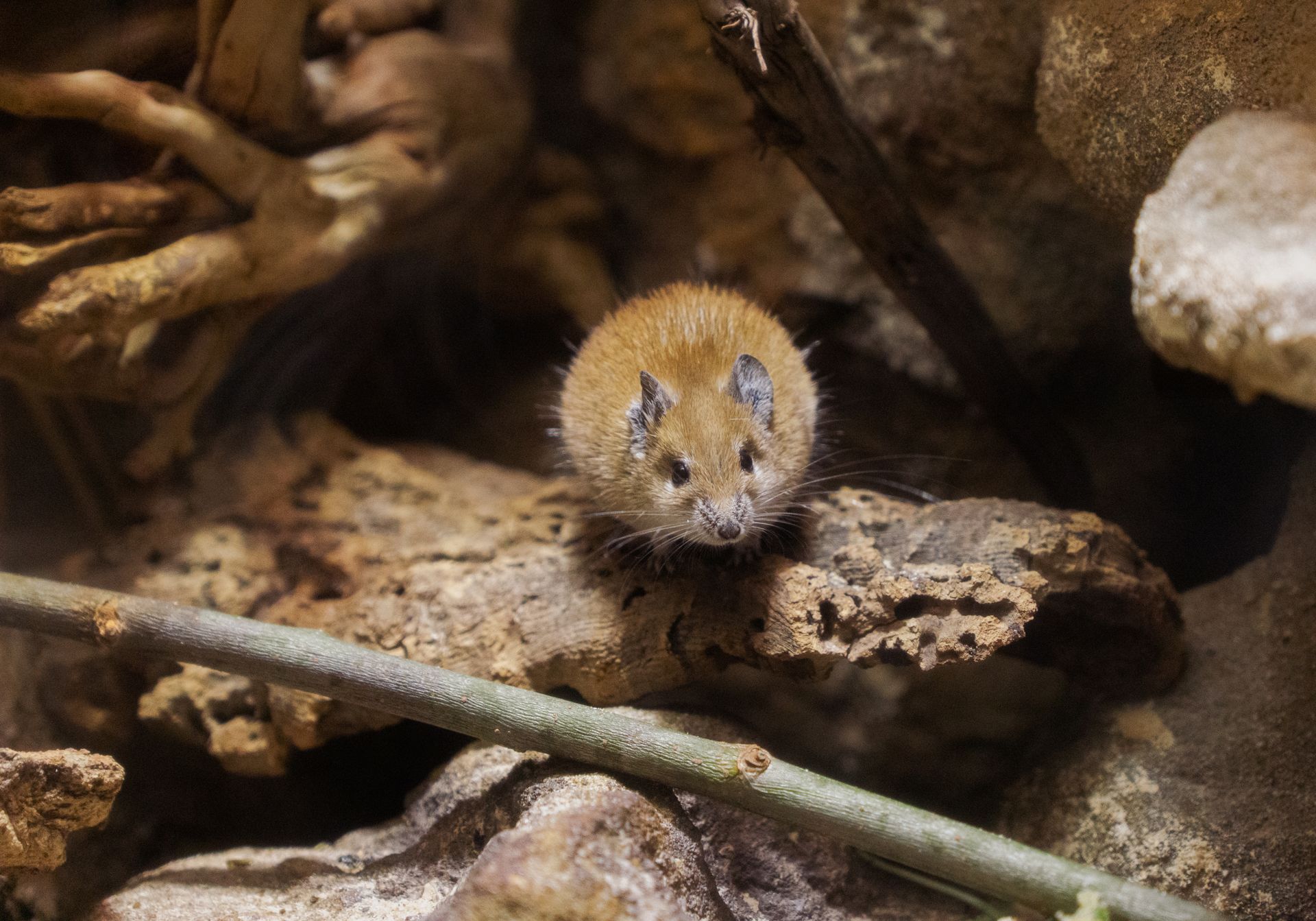
Their large ears, big black eyes, and long noses with prominent whiskers make them easily recognizable. Males are slightly larger than females, and they typically weigh between 30 and 50 grams on a 14% protein diet.
Adult African spiny mice have a body length of 9 to 13 centimeters, with a tail that's slightly less than or equal to 100% of their body length. Their tail is scaly with small hairs.
The color and location of spiny hairs can help distinguish between different species of African spiny mice. For example, A. cahirinus has a light-brown dorsal coat and cream-colored undersides, with spiny hairs present from their tails to halfway up their back.
Here's a summary of the physical characteristics of African spiny mice:
These physical characteristics are just a few of the many interesting features of African spiny mice.
Habitat and Distribution
African spiny mice can be found in a wide range of habitats, from semidry to arid regions across Africa, the Middle East, and Asia. They thrive in rocky areas, like rock canyons, near cliffs, and in the crevices of buildings.
These spiny mice are not fond of sandy areas and tend to avoid altitudes above 1500 meters. They can occasionally be found in gravelly washes and human habitation, where they use crevices in buildings for shelter.
Cairo spiny mice, in particular, are found throughout northern Africa, from the western Sahara in Mauritania and Morocco east to Egypt, Ethiopia, Eritrea, and Sudan. They are most commonly found on the ground and in burrows, but will occasionally climb.
Here's a breakdown of their habitat preferences:
- Habitat Regions: temperate, terrestrial
- Terrestrial Biomes: desert or dune, savanna or grassland
- Range elevation: up to 1500 meters (4921.26 ft)
Habitat
Spiny mice can be found in a variety of habitats, including rocky canyons, near cliffs, and near human habitation where they use crevices in buildings. They tend to avoid sandy areas and prefer gravelly washes.
They are mostly found on the ground and in burrows, but they do occasionally climb. Cairo spiny mice, in particular, are known to live in arid, rocky habitats.
Spiny mice have a preference for rocky outcroppings and can be found in areas with ample crevices for daytime shelter. They can also be found in the crevices of buildings.
Here are some key habitat characteristics of spiny mice:
- Habitat Regions: temperate, terrestrial
- Terrestrial Biomes: desert or dune, savanna or grassland
- Range elevation: 1500 meters (4921.26 feet)
Geographic Range
The Cairo spiny mice are found in a vast geographic range, spanning across northern Africa. They inhabit areas from the western Sahara in Mauritania and Morocco, stretching east to Egypt, Ethiopia, Eritrea, and Sudan.
Their biogeographic regions include the Palearctic and Ethiopian regions.
Behavior and Communication
African spiny mice are very social animals that tend to congregate into small groups. Each group has one dominant male who will fight if he is challenged by other males within the group.
These groups have a unique way of avoiding competition, with different species foraging at different times of the day. For example, some are nocturnal while others are diurnal.
Here are some key behaviors of African spiny mice:
- terricolous
- nocturnal
- motile
- sedentary
- social
They also use chemical signals to communicate with each other, likely to warn others of dangerous predators.
Behavior
Cairo spiny mice are very social animals that tend to congregate into small groups. Each group has one dominant male who will fight if he is challenged by other males within the group.
They have found ways to avoid competition with other species of spiny mice. Acomys cahirinus, for example, is nocturnal, while Acomys russatus is diurnal.
Here's a quick rundown of some key behaviors exhibited by Cairo spiny mice:
- terricolous
- nocturnal
- motile
- sedentary
- social
These behaviors play a crucial role in their daily lives, allowing them to coexist with other spiny mouse species.
Communication and Perception
Cairo spiny mice use chemical signals to warn others of predators, but we don't know much about the specific chemicals they produce.
These mice have multiple ways to perceive their environment, including visual, tactile, and acoustic senses.
Chemical signals are just one part of their communication strategy. It's likely that they use their other senses to gather information about their surroundings too.
Here are the different perception channels used by Cairo spiny mice:
- visual
- tactile
- acoustic
- chemical
They live in a range of habitats, from sub-Saharan Africa to Madagascar.
Conservation and Taxonomy
The Cairo spiny mouse, a fascinating creature found in Africa, has a relatively stable conservation status. They are not considered threatened.
The Cairo spiny mouse's taxonomy is quite complex, but it falls under the following categories: Theria, Placentalia, Boreoeutheria, Euarchontoglires, Rodentia, Supramyomorpha, Myomorphi, Muroidea, Muridae, Deomyinae, Acomys, and Acomys.
Here's a quick rundown of their conservation status with various organizations:
- IUCN Red List: Least Concern
- US Federal List: No special status
- CITES: No special status
- State of Michigan List: No special status
Conservation Status
The Cairo spiny mice are currently not considered threatened, which is a positive sign for their conservation status.
According to the IUCN Red List, they are listed as Least Concern, indicating that they are not considered to be at risk of extinction.
The US Federal List, State of Michigan List, and CITES have also classified the Cairo spiny mice as having no special status, which means they are not protected under these laws.
Here are the conservation status classifications for the Cairo spiny mice in a quick reference format:
- IUCN Red List: Least Concern
- US Federal List: No special status
- CITES: No special status
- State of Michigan List: No special status
Taxonomy
Taxonomy is the process of grouping living things based on their characteristics and evolutionary relationships. The taxonomy of a species is crucial for conservation efforts.
Acomys, the genus we're focusing on, belongs to the subclass Theria and the infraclass Placentalia. This means they give birth to live young and have a placenta during pregnancy.
Here's a breakdown of Acomys' taxonomy:
Acomys spinosissimus, a specific species, was first described by W. C. H. Peters in 1852.
General Information
African spiny mice typically live for 2 to 4 years in the wild, although some have been known to live up to 7 years in captivity.
They have distinctive physical characteristics, including large ears, large black eyes, and long noses with prominent whiskers.
Males are slightly larger than females, and on a 14% protein diet, 6-month-old adults typically weigh between 30 and 50 grams.
In fact, I've heard that some African spiny mice can reach weights of up to 100 grams, but this is usually on special diets designed to prevent obesity.
Their adult body length, from nose to rump, ranges from 9 to 13 centimeters, with their tail being slightly less than or equal to 100% of their body length.
The color and location of their spiny hairs can help identify different species of African spiny mice.
For more insights, see: Can African Dwarf Frogs Live with Bettas
Health and Nutrition
African spiny mice are prone to obesity due to a tendency to overeat, making a balanced diet crucial for their health.
Their diet should be monitored closely, as nearly 15% to 30% of A. cahirinus can spontaneously become diabetic on a high-fat diet.
A 3:1 mixture of low-protein mouse pellets and black-oil sunflower seeds is a suitable diet for spiny mice, as it provides a balanced mix of protein and fat.
Spiny mice preferentially eat sunflower seeds first, followed by the mouse pellets, so it's essential to provide a varied diet to keep them interested in their food.
If this caught your attention, see: African Sideneck Turtle Diet
Lifespan/Longevity
Cairo spiny mice have a relatively long lifespan, living up to 4 years in captivity. This is a remarkable feat for such a small creature.
In fact, this is one of the longest lifespans we've seen in a small mammal of this species. Their longevity is likely due to the quality of care they receive in captivity.
Here's a quick rundown of their lifespan in captivity:
- Range lifespan: up to 4 years
Unfortunately, we don't have information on how long they live in the wild.
Spiny Mice Heal Quickly to Defend Self
Spiny mice have an incredible ability to heal quickly, which is crucial for their survival. They can regenerate their skin and muscle tissue in just a few days.
This remarkable healing process is made possible by the presence of stem cells in their bodies. These stem cells can differentiate into different types of cells, such as skin and muscle cells, to repair damaged tissue.
Spiny mice are also able to regenerate their teeth and claws, which helps them to defend themselves against predators. Their ability to heal quickly also helps them to recover from injuries and infections.
Their remarkable healing abilities are a testament to the incredible resilience of these small animals.
Nutrition
Spiny mice are omnivorous, which means they eat a variety of foods including insects, snails, and seeds.
A balanced diet is crucial for spiny mice, but it's not as simple as just feeding them whatever they like. Captive colonies have been maintained on a variety of foodstuffs, but there's no one-size-fits-all diet that's preferred.

Spiny mice can easily become obese due to a tendency to overeat, which is a major health concern. In fact, nearly 15% to 30% of A. cahirinus can spontaneously become diabetic on mouse chow and fatty seeds.
To keep spiny mice healthy, it's essential to limit their fat intake. A 3:1 mixture of low-protein mouse pellets and black-oil sunflower seeds is a good starting point. The pellets have a protein content of 14.3% and a fat content of 4%, while the sunflower seeds have a minimum protein content of 14% and a minimum fat content of 20%.
Spiny mice tend to prefer eating sunflower seeds first, followed by the mouse pellets. This is likely due to the higher fat and protein content of the seeds.
Disease Monitoring
Monitoring your health is crucial to preventing and managing diseases. Regular check-ups with your doctor can help identify potential issues early on.
According to research, high blood pressure is a leading cause of heart disease, which can be detected through regular blood pressure checks.
The American Heart Association recommends that adults have their blood pressure checked at least once a year. This simple test can make a big difference in your overall health.
Certain lifestyle choices, such as a diet high in sodium, can increase your blood pressure. Limiting sodium intake to less than 2,300 milligrams per day can help keep your blood pressure in check.
Regular physical activity can also help lower blood pressure and reduce the risk of heart disease. Aim for at least 150 minutes of moderate-intensity exercise per week.
Monitoring your blood sugar levels is also essential for managing conditions like diabetes. Keeping track of your sugar intake and blood glucose levels can help you stay on top of your condition.
The American Diabetes Association recommends that people with diabetes test their blood sugar levels at least four times a day. This can help you identify any patterns or trends in your sugar levels.
Frequently Asked Questions
Why do African spiny mice heal quickly?
African spiny mice heal quickly due to their unique ability to regenerate their skin, allowing for complete reconstruction after wounding. This remarkable ability sets them apart from typical lab mice and has sparked scientific interest in understanding the underlying mechanisms.
Do spiny mice make good pets?
Spiny mice can make good pets, but they require gentle handling and care due to their delicate nature. With proper care, they can become trusting and tame, making them a rewarding companion.
Featured Images: pexels.com